The Jabbok River was behind Jacob, and Esau was in front of him. This devotional reading looks at the night in between, which included an unusual wrestling match.
Nuggets
- Jehovah comes to us when we are alone.
- A vision wouldn’t have given Jacob a permanent limp.
Jacob was earnest to receive a blessing from the man. - Jehovah didn’t need to ask Jacob’s name — He wanted him to think.
- Joy comes in the morning, but many things leave a scar.
When Jacob crossed the Jabbok, he had done things right according to custom. He called Esau my lord and himself his servant. He declared his wealth to establish a peaceful intent.
Esau respond with an army of 400 soldiers. Jacob sent his family on to ensure their safety.
This was a crisis point in Jacob’s life. It is in this point that he met Jehovah.
Let's Put It into Context
To read devotions in the Creating Everything theme, click the button below.
Devotions in the Jacob the Patriarch series
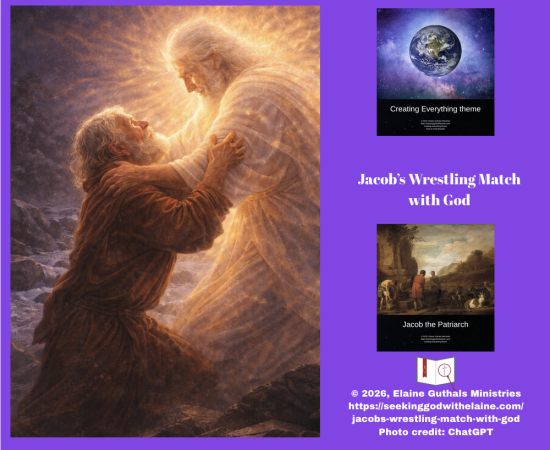
The Wrestling Match
“This left Jacob all alone in the camp, and a man came and wrestled with him until the dawn began to break. When the man saw that he would not win the match, he touched Jacob’s hip and wrenched it out of its socket. Then the man said, ‘Let me go, for the dawn is breaking!’ But Jacob said, ‘I will not let you go unless you bless me.’ ‘What is your name?’ the man asked. He replied, ‘Jacob.’ ‘Your name will no longer be Jacob,’ the man told him. ‘From now on you will be called Israel, because you have fought with God and with men and have won.’ ‘Please tell me your name,’ Jacob said. ‘Why do you want to know my name?’ the man replied. Then he blessed Jacob there” (Gen. 32: 24-29 NLT)
A Man Came and Wrestled with Jacob
Jehovah comes to us when we are alone.
Remember, Jacob was alone in his camp. He had sent his family across the Jabbok.
Later that night, a wrestling match occurred. At first, we are just told it was a man. Later, we are told it was Jehovah.
One thing is for sure – it wasn’t a vision. We’ll get to that in a second.
This was a Man, but we are told it was Jehovah. Because of that, many think this is Yeshua.
Maybe, but I don’t think so – and neither does Jewish tradition. Yes, Yeshua and God are One (Jn. 10: 30), but they are separate. Their nature is one.
Look at Hosea 12: 3-4. “Even in the womb, Jacob struggled with his brother; when he became a man, he even fought with God. Yes, he wrestled with the angel and won. He wept and pleaded for a blessing from him. There at Bethel he met God face to face, and God spoke to him” (Hos. 12: 3-4 NLT).
Angel. God. Man. What are some thoughts as to who/Who this is?
- Esau’s guardian angel
- A prophetic visitation
- A messenger from God, so he “saw” God
Never once does it say that is Yeshua or a pre-incarnate Messiah. Jewish interpretation does not say that it was Jehovah in the flesh.
I go with Door #3, which is Hebrew thought. The shaliach principle is where an agent represents the sender so fully that he can speak as the sender.
The messenger can speak as Jehovah and be described as Jehovah but not be Jehovah.
So, Jacob was alone, wrestling with a divine being that had a solid form. That tells me that Jehovah’s messenger, being a spirit, took on the substance of humans, specifically a male.
Some think this was only a spiritual wrestling. I agree that was the most important aspect, but I disagree that there was no physical wrestling happening.
If this was just spiritual, Jacob would have had to be dreaming — but like Ness said, Jacob wasn’t getting mush sleep that night. He wrote,
“Assuredly Jacob had little either list or leisure for sleeping, much less for dreaming, while he was so struck even with a panic fear of his bloody brother. It was, therefore, a real and corporal combat, not visional or imaginary, which appears by many reasons.”
Resource
But if we are totally honest, wasn’t the wrestling both spiritual and physical?
How did Jacob triumph in his wrestling match? He realized he couldn’t rely on his own strength — he had to depend on Jehovah. He had to acknowledge his weakness.
This strength had to be a spiritual force. It is made up of trust and prayer.
He Touched Jacob’s Hip and Wrenched It
A vision wouldn’t have given Jacob a permanent limp.
Norwood believed that the wrestling was spiritual in nature, not physical. I don’t think so.
Resource
How could a vision or a conversation within his heart wrench Jacob’s hip? Seriously?
Yes, I know Jehovah spoke this universe into existence. But He touched Jacob. I really don’t think that is a figurative touch.
Yes, we are to pray. But I believe Abraham saw men. They ate with him. They ate with Lot.
Why couldn’t Jehovah or His messenger come wrestle with Jacob?
Whoever it was and however the match occurred, there is something everyone could agree upon. Jacob walked a different walk after his wrestling match with Jehovah.
The Midrash reminds us that our encounters with Jehovah are meant to leave their mark. They are meant to make us different people.
Jacob’s limp has become a type of badge of victory. The injury occurred when the man could not best Jacob. True, the victory did not come without a cost, but Jehovah always rewards perseverance.
To honor this struggle, Moses told us that the sciatic nerve is not eaten. To this day, the nerve is removed in a process called nikkur.
One thing we have to keep in mind is that Jacob’s limp is not looked on as punishment. It is seen as the struggle happened in the darkness, the blessing – including the limp – occurred at sunrise. Jacob won, not by strength, but by refusing to let go.
The limp marks the moment the struggle becomes visible.
Not Unless You Bless Me
Jacob was earnest to receive a blessing from the man.
Jacob, sometime in the preceding hours, had gone from fearful to comforted. He was comfortable enough to wrestle with Jehovah or His messenger.
It is only when we wrestle with Jehovah — against doubt, against temptation, and against anything thrown at us by our enemies — that we can and and will receive the blessing.
When Jacob yielded to Jehovah or His messenger, we can see that he fully trusts Jehovah. Carpenter said that he became a spiritually minded man.
I love what Carpenter also said. He wrote, “At Bethel Jacob said, ‘If Thou wilt be with me and wilt do me good.’ At Jabbok his first thought was, ‘Tell me Thy name.’ He desired to know more of God, not to get more from God. To gain further spiritual experience — this is the thirst of the spiritual man. To make a friend of God for the good that we can get — this is the idea of the merely religious man.”
Resource
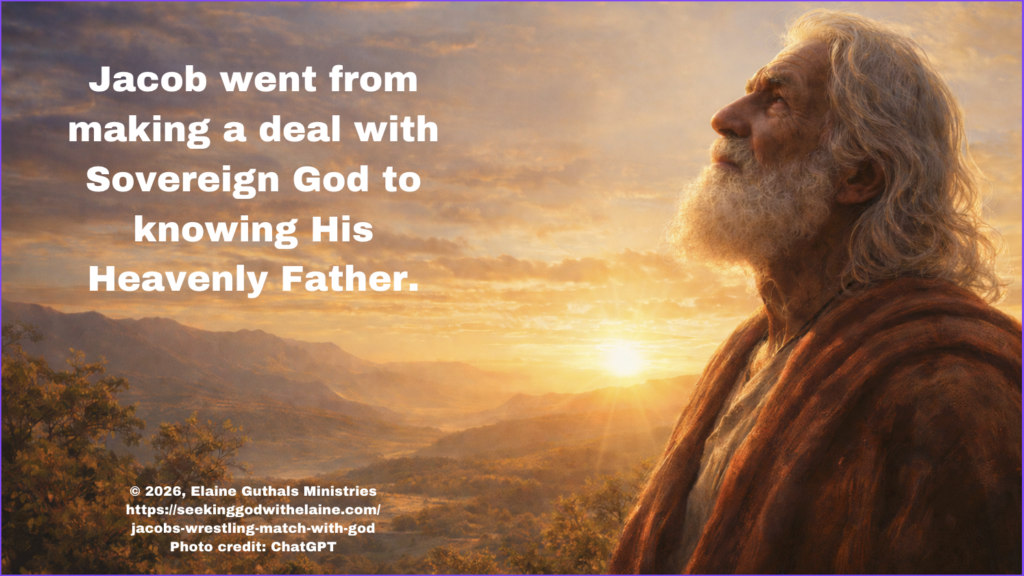
Jacob went from making a deal with Sovereign God to knowing His Heavenly Father.
Did you catch this? Jacob stole the blessing from Esau. Here, he clings until he gets one from with whom he is wrestling.
Will No Longer Be
Jehovah didn’t need to ask Jacob’s name — He wanted him to think.
Names were very important to the Hebrews. It wasn’t just an identifier. It showed the person’s character.
Jacob got a name change — and a character change — because he clung to Jehovah. Look what Krumreacher said. He wrote, “The Lord had asked Jacob how he was called, not as if He did not know it, but in order to give him a name more in accordance with his present state of grace.”
Resource
When Jacob got his blessing, I bet he went, “Huh? How is that going to help me?”
The blessing which Jacob was a name change. When he was born, we thought Jacob was the perfect name. He had come out holding Esau’s heel, and he was a deceiver.
That’s what Jacob means. It means heel grabber, supplanted, and trickster.
Jacob was not that anymore. As names were to mean something, his name no longer reflected who he had become.
Jacob would now be Israel. That means he who struggles with God or God prevails.
The name change was to reflect Jacob’s new purpose in life. He went from deceiver to conquerer.
Gregory said that it acknowledged Jacob’s change in his state. It was an inward deliverance. He also received a change of character.
God was starting to reveal more of His plan. Abraham the Hebrew had Isaac the Hebrew and Ishmael (and others) the non-Hebrew. Isaac had Jacob the Hebrew and Esau the non-Hebrew. Jacob the Hebrew had all Hebrew children.
God’s nation — as promised to Abraham in Genesis 12 — was in its infancy.
There was probably another reason God changed Jacob’s name. In the past, he had been a deceiver. True, I don’t think Jacob had done a complete about face.
But Jacob was now more sensitive to the feelings of others, case in point Esau. He knew more about what God was looking for in relationships with others.
Most importantly, Jacob now knew what Jehovah expected of him.
Jacob still wasn’t totally consistent after he was renamed. Yes, he’d grown and grew some more. None of us are going to be perfect in this life. We just have to be growing in maturity.
The Limp
“Jacob named the place Peniel (which means ‘face of God’), for he said, ‘I have seen God face to face, yet my life has been spared.’ The sun was rising as Jacob left Peniel, and he was limping because of the injury to his hip. (Even today the people of Israel don’t eat the tendon near the hip socket because of what happened that night when the man strained the tendon of Jacob’s hip)” (Gen. 32: 30-32 NLT)
Joy comes in the morning, but many things leave a scar.
After however much sleep Israel got — if any — he got up a changed man. He had a new name, a new character — and a new limp.
What? Do you really think we are supposed to come out of trials with no scars?
Vaughan said no way. He wrote,
“We may wrestle and prevail, but there will be touches of the enemy, which will leave their long and bitter memories. The way to heaven is made of falling down and rising up again. The battle is no steady, onward fight, but rallies and retreats, retreats and rallies.”
Resource
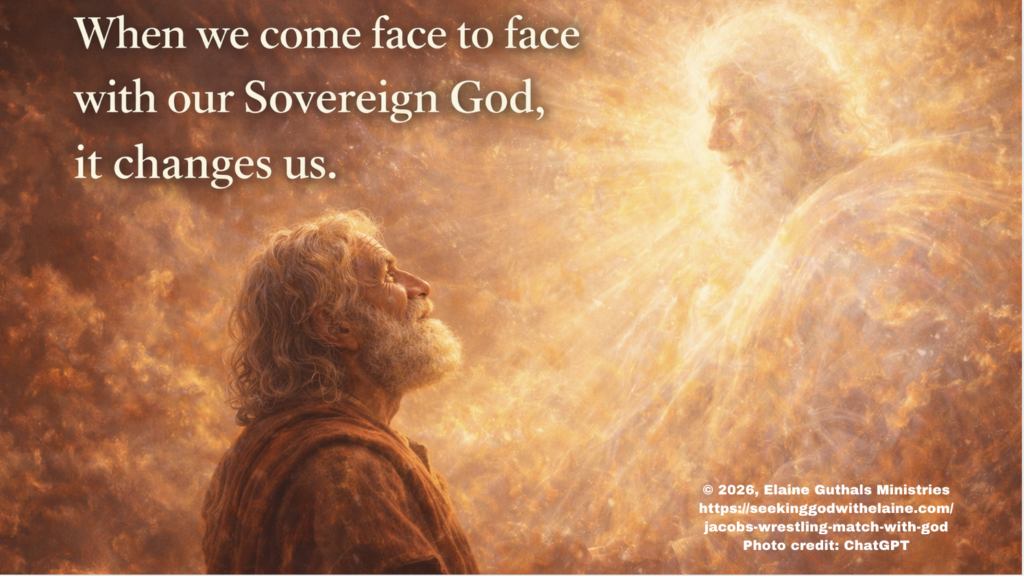
When we come face to face with our Sovereign God, it changes us.
Making the Connections #1
The last time I wrote on this passage, I told you about my Warrior Princess Bracelet. It was a little cuff that said Believe. Unfortunately, both of the bracelets I had like that kept getting caught on something. One totally broke; the other was on the way to breaking.
To read a related devotion, click the button below.
This year for my birthday, my wonderful sister bought me a bracelet that connects with my phone. It pulls up Bible verses when I activate it. It is my new Warrior Princess bracelet.
I have turned my fake-it-till-I-make-it attitude into a self-fulfilling prophecy. I look at it as identity preceding full maturity.
I did it through my own type of wrestling. I am a processor. In the past, I have had coworkers ask me something and then comment, “Oh, I see the gears spinning in your head.” That is because I am thinking things through.
In my mind, I take all of these pieces of information and find the connections. Okay, some may be a stretch for other people, but they make perfect sense in my wee mind.
As I put the connections together, I learn new things. It helps me strengthen or question past knowledge and beliefs.
I do this with scriptures, also. One word or phrase may trigger some connection that others may or may not see. Since then, I’ve started looking at how Scriptures were actually written — what they actually said.
I can see my growth. (I hope that if you have been with me a while that you can see it, too).
I only grew because Jehovah grew me. It wasn’t something I could do on my own. He had to reveal His word to me.
I like what Magee said about wrestling. He wrote,
“It is by wrestling that we win the Divine blessing, but whether in struggling against doubt, against temptation, or against the enemies of the Church, we must take heed that we fight wisely as well as earnestly. We may strive, and we must strive; but let us strive wisely and lawfully if we would win the blessing.”
Resource
God wants us to wrestle with Him so that we can grow. He wants us to figure it out.
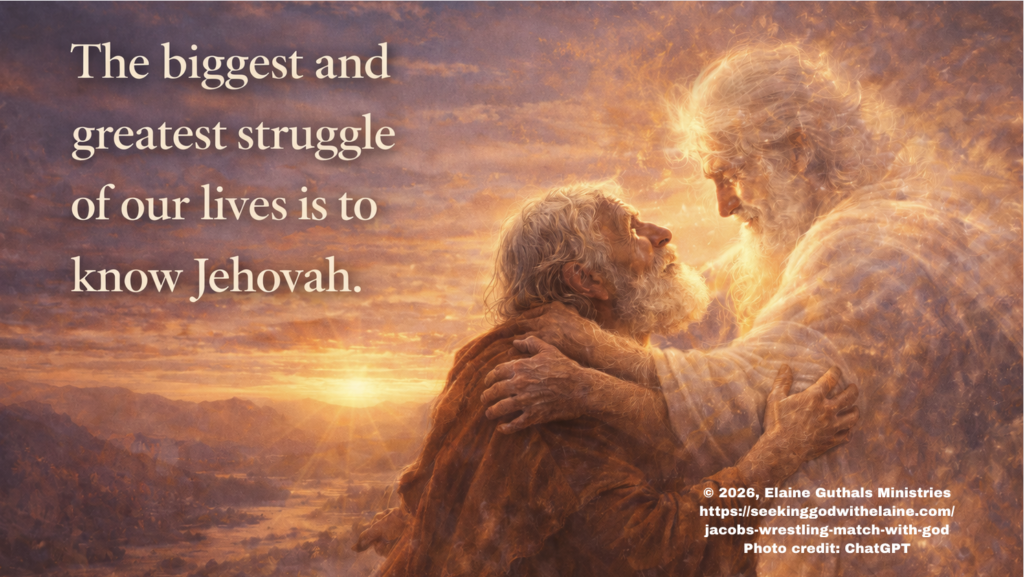
The biggest and greatest struggle of our lives is to know Jehovah.
Making the Connections #2
When we look back at Bethel, we see Jacob beginning to understand the Sovereign God that established the covenant with his family. Parker said that he wasn’t promoted to his high place with Jehovah.
Resource
Now, that night around the Jabbok River, Jacob received his blessing.
What was present? Faith, atonement, justification, regeneration
Making the Connections #3
We can’t gloss over the fact that this blessing was given because Jacob prayed back in verses 9-12. Jacob prayed a powerful pray showing he now possessed a living faith. It was about safety — but it wasn’t about safety.
Jacob didn’t give up because — at the moment he prayed — no heavenly fire fell from the skies and consumed the threat against him.
In fact, it didn’t look like there was any kind of answer from Jehovah.
At that time.
But Jehovah answered Jacob’s prayer on His schedule and in His way. We have to wait on Him.
Look what Taylor said. He wrote,
“When our earnest applications to Him appear to be met with indifference, when our repeated importunity seems only to call forth repeated repulse, when in the yearning earnestness of our entreaty, our hearts feel as if they had lost all strength, even as Jacob’s limb went from beneath him when the angel touched it, let us remember that His design is either to bring our faith to the birth, or by the discipline of resistance %o develop it into greater strength, and let us cling to Him all the more, saying, “I will not let Thee go, except Thou bless me.”
Resource
I know. Taylor must have graduated from Paul’s School of Writing. So, let’s break this down.
- Looks like prayer unanswered
- Even repeated prayers don’t seem to get the job done
- Even when really important to us
- Even when our hearts feel dejection
- Even when we crumble
- Strengthen our faith.
- Keep on clinging
Making the Connections #4
Wait a second. I thought Jehovah told Moses that no one could see Him face to face. “But you may not look directly at my face, for no one may see me and live” (Ex. 33: 20 NLT).
There are Scriptures that says humans did.
- “The Lord appeared again to Abraham near the oak grove belonging to Mamre. One day Abraham was sitting at the entrance to his tent during the hottest part of the day. He looked up and noticed three men standing nearby. When he saw them, he ran to meet them and welcomed them, bowing low to the ground” (Gen. 18: 1-2 NLT).
- “Jacob named the place Peniel (which means ‘face of God’), for he said, ‘I have seen God face to face, yet my life has been spared’” (Gen. 32: 30 NLT).
- “Inside the Tent of Meeting, the Lord would speak to Moses face to face, as one speaks to a friend …” (Ex. 33: 11 NLT).
- “Then Moses, Aaron, Nadab, Abihu, and the seventy elders of Israel climbed up the mountain. There they saw the God of Israel. Under his feet there seemed to be a surface of brilliant blue lapis lazuli, as clear as the sky itself” (Ex. 24: 9-10 NLT).
- “It was in the year King Uzziah died that I saw the Lord. He was sitting on a lofty throne, and the train of his robe filled the Temple” (Isa. 6: 1 NLT).
- “As the flames from the altar shot up toward the sky, the angel of the Lord ascended in the fire. When Manoah and his wife saw this, they fell with their faces to the ground” (Jdgs. 13: 22 NLT).
Okay. So, Exodus 33: 20 is after Exodus 33: 11 and way after Exodus 24: 9-10. What gives?
The way I see it, Jehovah chose a form in which to appear to Abraham, Jacob, and Moses. That was fine with Moses – until he wanted more.
“Moses responded, ‘Then show me your glorious presence’” (Ex. 33: 18 NLT).
Moses wanted to see all of Sovereign God as He is.
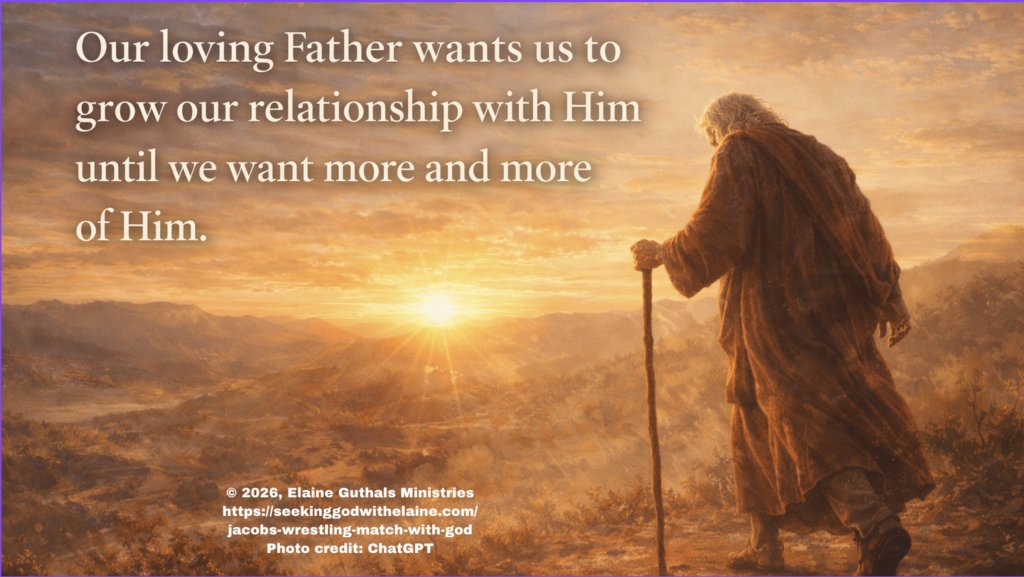
No, Jehovah didn’t bite on Moses, telling him that he was asking too much. Our loving Father wants us to grow our relationship with Him until we want more and more of Him.
How Do We Apply This?
- Make our prayers genuine.
- Rely on the weapon of prayer.
- Rest on Jehovah’s promises.
Resources
Father God. May we have the transformation that Jacob did. May we persevere in our struggles. May we consider the scars as badges of honor as those trials put bricks in our Sanctification Road. May we always pray to You in good times and in bad. Amen.
If you don’t understand something and would like further clarification, please contact me.
If you have not signed up for the email providing the link to the devotions and the newsletter, do so below.
If God has used this devotion to speak with you, consider sharing it on social media.