With Jacob on the way home from Paddan-aram, we know he is going to run into Esau sooner or later. This devotional reading looks at what happened when Jacob knew Esau was coming.
Nuggets
- Jacob again encountered Jehovah’s messengers.
- Jacob made contact with Esau according to custom.
- Esau was already on his way.
- Jacob’s reaction was to divide into two camps.
- Jacob finally put his situation in God’s hands.
- We have to acknowledge Jehovah’s sovereignty and appealed to the Maker of the covenant.
- We need to keep ourselves humble before Jehovah and express our need for Him.
- Jacob knew his petitions would be answered because he knew he could count on Jehovah’s mercies.
- We have to claim Jehovah’s promises with us and assure Him that they are at the forefront of our minds.
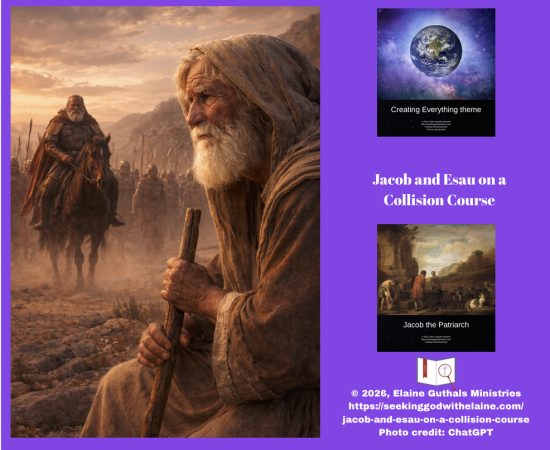
The morning after Jacob and Laban made their covenant, Laban kissed his daughters and grandchildren and left. We do not hear about him again.
Jacob was ready to move on, too. He may no longer have totally feared Laban, but he was his rearview mirror.
Esau, who would have been a fiercer enemy than Laban, was in his windshield. They had parted with a rocky relationship.
Had Esau made his peace, or did Jacob still need to be on his toes?
Let's Put It into Context
To read devotions in the Creating Everything theme, click the button below.
Devotions in the Jacob the Patriarch series
The Angels at Mahanaim
“As Jacob started on his way again, angels of God came to meet him. When Jacob saw them, he exclaimed, ‘This is God’s camp!’ So he named the place Mahanaim” (Gen. 32: 1-2 NLT)
Jacob again encountered Jehovah’s messengers.
To begin Genesis 32, we have another encounter with angels. That is what all Hebrew translations I’ve found calls the beings we see in Genesis 32: 1.
Both the Greek and Hebrew words mean messenger. The Greek is angelos where the Hebrew word is malake.
Resource
The problem I have with the Greek translation is that deities and mythological figures in Greek culture also were associated with angels. It would have been easy for them to bring that worldview image into their spiritual lives.
The reality is that we aren’t told how Jehovah’s messengers look. Wings? Who knows? Halos? Doesn’t say. Young, old, strong, swift? Your guess is as good as mine – and it would be a guess.
You know, we said a while back that everyone but Abraham was afraid when they saw angels. I think we need to add Jacob to that list of being unafraid.
Go back to Bethel on the trip to Paddan-aram (Gen. 28: 12). Jacob saw angels in his dream. He could have written that off as a … dream. He didn’t. He accepted it as a real conversation with Jehovah.
No, this wasn’t a dream. This was a wide-awake, I-can-see-you experience.
The messengers met Jacob where he was in his walk.
Think of it this way. Just as Jacob was leaving Canaan, he had a visit. Now that he was reentering, he gets another visit. Jehovah is not only with us in the day-to-day walk but also in the transitions.
Here, Jacob recognized them for what they were. We don’t know the express reason for their visit, but I think we can take a good stab at it with Leale’s help.
We are told in verse 2 that Jacob named the place the visitation occurred. Names are important in Scripture, even names of places. Mahanaim means two camps.
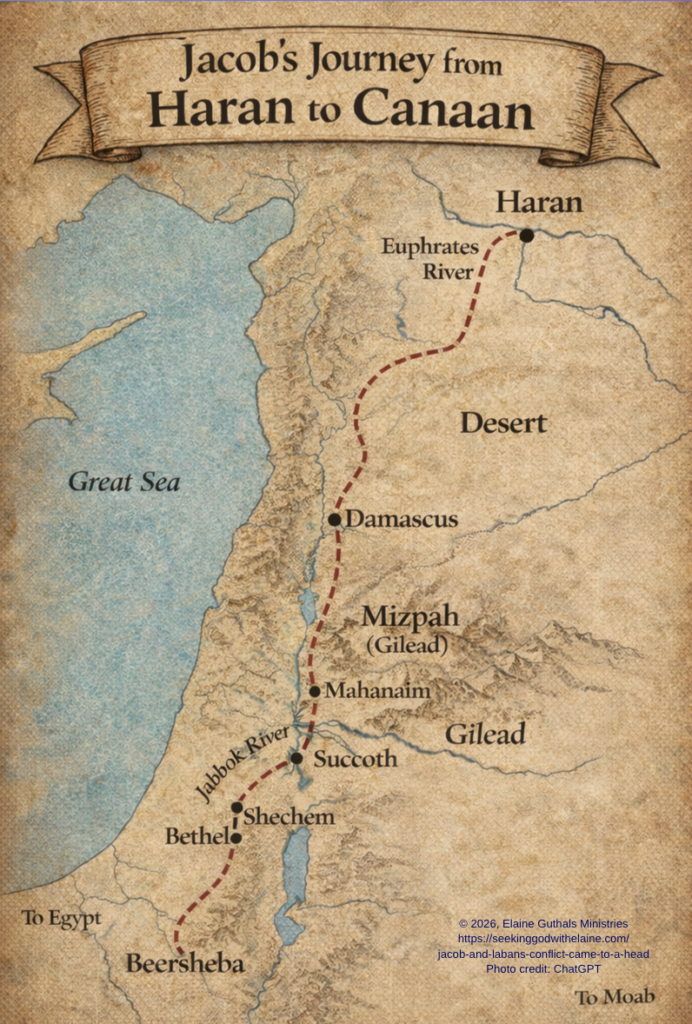
Leale thought that name came from the unknown number of messengers splitting up and going before and after Jacob.
Resource
Can we spell escort and legitimacy even in the unsettling?
To me, it sounds like a squadron of messengers. When Jacob called the place Mahanaim, it was military language. I would say it had to be enough to give Jacob that impression.
It may have been an acknowledgement that Jacob was at a different place in his relationship with God than he was when he left Canaan 20 years before.
But it also brings up a very good point. Our loving Father will come to meet us where we are with what we need.
Once again, Jacob had an encounter with the unseen world.
The Esau Crisis
“Then Jacob sent messengers ahead to his brother, Esau, who was living in the region of Seir in the land of Edom. He told them, ‘Give this message to my master Esau: “Humble greetings from your servant Jacob. Until now I have been living with Uncle Laban, and now I own cattle, donkeys, flocks of sheep and goats, and many servants, both men and women. I have sent these messengers to inform my lord of my coming, hoping that you will be friendly to me.”’ After delivering the message, the messengers returned to Jacob and reported, “We met your brother, Esau, and he is already on his way to meet you — with an army of 400 men!” Jacob was terrified at the news. He divided his household, along with the flocks and herds and camels, into two groups. He thought, ‘If Esau meets one group and attacks it, perhaps the other group can escape’” (Gen. 32: 3-8 NLT)
Jacob Sent Messengers Ahead
Jacob made contact with Esau according to custom.
Jacob wasn’t sure what kind of reception he was going to get from Esau. When he had left those twenty years before, Jacob had to high tail it out of there because he thought Esau was going to kill him.
Now, Jacob was coming home an influential man. He has all these wives, kids, servants, flocks, and herds that were coming with him.
But Jacob couldn’t know if Esau was still steamed about the birthright and blessing theft. Oh, yeah. Esau made the choice to sell him his birthright, but it wasn’t something really Jacob should have approached.
Jacob approached this correctly, though. He didn’t blindside Esau — he gave him fair warning.
Jacob used very deferential language in his message to Esau. He called Esau my lord. He said he was his servant.
We may think listing his wealth meant Jacob was trying to be a show-off. That is far from the truth.
It was an Ancient Near Eastern custom to declare wealth to establish a peaceful intent. I mean, how many times have we heard of raiding parties listing their assets?
Esau and His Army Is Already on His Way
Esau was already on his way.
Esau’s response? Jacob’s messengers weren’t even back before Esau had started out.
Moving with enough to break into two camps probably meant they weren’t moving stealthily. Esau probably had warning someone was coming.
Or did Jehovah tell Esau to come meet Jacob? He knew this issue had to be settled.
Whichever way, it sure sounded like a war party to Jacob. That was a show of strength.
Jacob didn’t wait for anything. Immediately upon hearing of Esau’s threat, Jacob acted.
Does this show Jacob has retained a measure of his planning and scheming? Well, he should.
Jehovah is an organized God. He runs on plans. So should we.
We do have to calculate the consequences of our actions — both good and bad. That must be factored into our decision-making process.
But what about the scheming? Sometimes, we may have to make plans in secret, but they shouldn’t be underhanded.
In the end, Jacob wronged his brother by his suspicions that Esau was coming to take revenge.
Yare’ means afraid, coming from the root word yira meaning to fear. Tsar means distressed.
This wasn’t just external pressure. It was an internal panic.
Wouldn’t we have had the same feelings as Jacob? He sent servants. Esau sent soldiers.
Jacob Divided His Household
Jacob’s reaction was to divide into two camps.
Yeah, go back to verse 1 and 2. That was two camps, also; but that wasn’t out of fear.
This – even with the escort of the messengers – was done out of fear.
Ooo, baby. Can’t things of this world really scare us at times? Sometimes, it is just a gut reaction.
Dividing into two camps wasn’t a show that Jehovah could not protect him. Jacob was saying he was going to do everything is his power to protect what Jehovah gave him.
The dividing came out if responsibility. Jacob had a responsibility to his family to provide for their safety. In this case, he succeeded.
It was stewardship. True, he should have said the prayer before he did the dividing. Was he afraid he didn’t have time?
Gray had a good point. He wrote, “It must have been a huge company at the first, for him to think, after the message he sent (vers. 4, 5), that his brother would imagine the half was all he had.”
Resource
Jacob’s second step was to pray.
Jacob’s Prayer
“Then Jacob prayed, ‘O God of my grandfather Abraham, and God of my father, Isaac — O Lord, you told me, “Return to your own land and to your relatives.” And you promised me, “I will treat you kindly.” I am not worthy of all the unfailing love and faithfulness you have shown to me, your servant. When I left home and crossed the Jordan River, I owned nothing except a walking stick. Now my household fills two large camps! O Lord, please rescue me from the hand of my brother, Esau. I am afraid that he is coming to attack me, along with my wives and children. But you promised me, “I will surely treat you kindly, and I will multiply your descendants until they become as numerous as the sands along the seashore — too many to count”’” (Gen. 32: 9-12 NLT)
Jacob Prayed
Jacob finally put his situation in God’s hands.
We get the first recorded prayer from Jacob in this chapter. Craig told us that gave us a good picture of his heart. He also called it a real prayer.
Resource
Where Jacob had always been impulsive and took care of business by himself before, His time in Paddan-aram has taught him to trust in Jehovah.
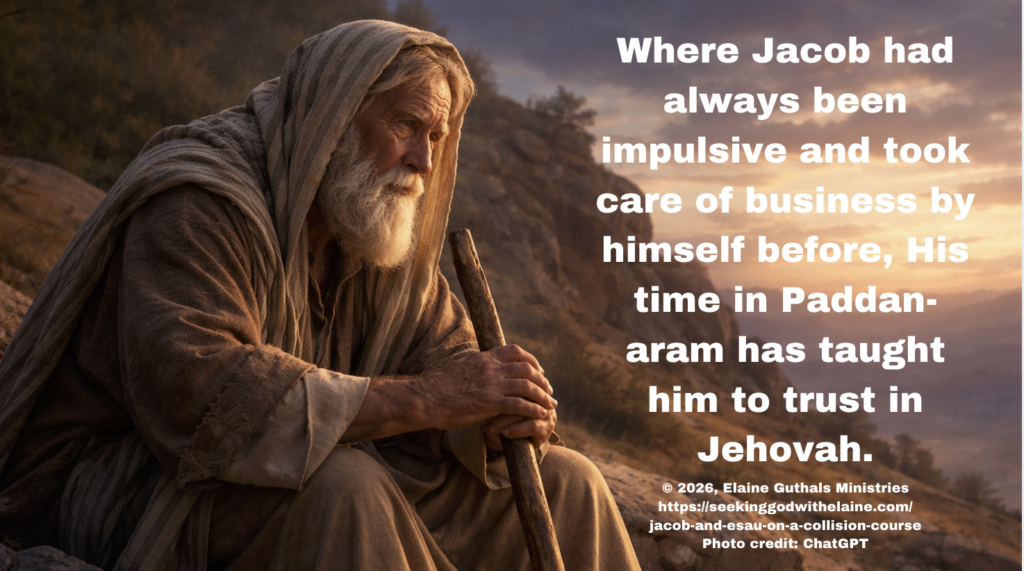
Jacob did ask Jehovah to bless his plan. Good thing that was His plan all along. What Jacob lost doing it this way was peace.
Yeah, Jacob knew the messengers were there and would protect him. But the threat was real, not something to be ignored.
And doesn’t that tell us something? Jehovah answered the prayer before Jacob prayed it. So, no. Jacob didn’t necessarily get the order wrong.
Jacob started his prayer out by telling Jehovah what circumstances he was in. Because Jehovah didn’t know? No!
We pray to align our will with Jehovah’s. We have to tell Him where we are at now, even if it is afraid and distressed.
I see you jumping up and down over there. You think we aren’t supposed to feel anxious. “Don’t worry about anything; instead, pray about everything” (Phil. 4: 6 NLT).
Merimnate, the Greek word used, is translated several different ways in English. Don’t worry. Don’t be anxious. Take no thought. Be careful.
Resource
Not feeling anxious isn’t going to happen. It is human nature.
I take this as, “Don’t keep worrying and feeling anxious. Start praying. He’s got this.”
O God
We have to acknowledge Jehovah’s sovereignty and appealed to the Maker of the covenant.
Part of us may look at “… ‘O God of my grandfather Abraham, and God of my father, Isaac …’” (Gen. 32: 9 NLT) and think, “Why didn’t he say, ‘Where is my God?’”
No, Jacob wasn’t backsliding. He was making a covenant appeal.
Jackson acknowledged that Jacob was addressing Sovereign God’s presence in his family’s past. He was hooking into his family’s past obedience to help grow his faith.
Resource
This wasn’t just about Jacob. It was about the promises Jehovah made to Abraham and Isaac. He promised a relationship with them – and carried that on to Jacob.
This was a don’t-leave-me-now plea.
But this is also about Jacob’s obedience. “You told me to come home, and I came. You said You would work things out. This is a big thing only You can work out.”
I Am not Worthy
We need to keep ourselves humble before Jehovah and express our need for Him.
How do we know Jacob was making a covenant appeal? “I am not worthy of all the unfailing love and faithfulness you have shown to me, your servant …” (Gen. 32: 10 NLT). Then he said, “But You promised.”
Think again of leaving and returning to Canaan. Jacob left with a staff. He was a cheater and liar. We would think that would disqualify him from being a man of faith.
Jehovah doesn’t. What made Jacob — and us — God’s people, His children, is our acknowledgment that we need Him and His saving grace.
We have to admit that we cannot save ourselves. Only belief in Jesus can do that.
The foundation of our belief must be our recognizing Sovereign God’s love and faithfulness to us. All we have to do is to submit to Him. What that means is we follow His laws and commandments.
Now, Jacob returned with wives, children, flocks, herds, camels – enough for two camps.
More importantly, Jacob has fixed his relationship with His Creator. The deceiver had been humbled. The Hebrew word is qatonti — I have become small.
That humility is exactly what Jehovah wants.
On top of that, this follows the classic covenant prayer structure.
In this prayer, Jacob also acknowledged everything that Jehovah had given him. He gave him enough to divide into two companies, each of which looked big enough to be all he had.
Please Rescue Me
Jacob knew his petitions would be answered because he knew he could count on Jehovah’s mercies.
Jacob asked Jehovah to “… rescue me from the hand of my brother, Esau …” (Gen. 32: 11 NLT).
Don’t we hate it when our peaceful gestures are met with hostility?
Let’s step back a second. What was Jacob feeling?
There was fear. This time, Esau had the army to do him the bodily hard that he had threatened.
There was the guilt. Now, Jacob now fully admitted he was guilty. He would take responsibility for his actions.
But there are other responsibilities. He has a wife, children, servants, and livestock. What would Esau and his vengeance do about those lives?
Now, there was humility.
We can’t miss one very important aspect of Jacob’s prayer. We have to ask Jehovah what we want Him to do.
Yes, that was going to be the way the prayer was answered because this was a covenant prayer. But we have to ask that Sovereign God’s Will be done.
This is how we align with that Will.
You Promised Me
We have to claim Jehovah’s promises with us and assure Him that they are at the forefront of our minds.
Does it seem arrogant to give Jehovah’s words right back to Him? No. We show we are listening and expect Him to keep His promises.
Jehovah wants us to quote Scripture and promises back to Him. Through these prayers is one way He will broaden our understanding of them.
Making the Connections #1
I loved what Spurgeon said. He wrote,
“He was leaving Laban and the school of all those tricks of bargaining and bartering which belong to the ungodly world. By a desperate stroke he cut himself clear of entanglements; but he must have felt lonely, and as one cast adrift. He missed all the associations of the old house of Mesopotamia, which, despite its annoyances, was his home. The angels come to congratulate him. Their presence said, ‘You are come to this land to be a stranger and sojourner with God, as all your fathers were. We have, some of us, talked with Abraham, again and again, and we are now coming to smile on you. You recollect how we bade you good-bye that night, when you had a stone for your pillow at Bethel; now you have come back to the reserved inheritance, over which we are set as guardians, and we have come to salute you. Take up the nonconforming life without fear, for we are with you. Welcome I welcome I we are glad to receive you under our special care.’”
Resource
Jehovah and his messengers know when we have given up a previous life to be obedient to Him. They know when that gives us a queasy tummy.
They are right there to encourage, protect, and guide us.
Did Jacob need a reminder about Bethel, as Spurgeon questioned? Maybe. Jehovah and His messengers were right there for that, too.
Making the Connections #2
Vaughan gave us a good description of a messenger’s job description.
- Ministering spirits to the heirs of salvation.
- Perform the tasks given to them by Jehovah.
- Listen to what Sovereign God said in His Word.
Resource
What they don’t do is just sit there and worship Jehovah all day. They have tasks to do.
Making the Connections #3
Doesn’t the twins’ actions show the still-present differences in their characters? “As the boys grew up, Esau became a skillful hunter. He was an outdoorsman, but Jacob had a quiet temperament, preferring to stay home” (Gen. 25: 27 NLT).
Jacob was still with his family, and Esau was still displaying his physical strength and skills.
How Do We Apply This?
- Advance when Jehovah calls us to advance.
- Move in the way Jehovah commands.
- Acknowledge received blessings.
- Pray when obeying Jehovah’s directions.
- Take care of what Jehovah has given us.
Resources
Father God. We know that You will protect us. Forgive us when we take our eyes off you and focus on the coming trouble. Amen.
If you don’t understand something and would like further clarification, please contact me.
If you have not signed up for the email providing the link to the devotions and the newsletter, do so below.
If God has used this devotion to speak with you, consider sharing it on social media.