God told Jacob that it was time to leave Haran. This devotional reading looks at how Jacob got that accomplished this time.
Nuggets
- When Jehovah is working to prepare us for a change, he uses discontent.
- Jehovah called Jacob home.
- Jacob explained his plans to Leah and Rachel.
- God was working even when it looked like agricultural folklore.
- The covenant son got the covenant call.
- This has to have been a big undertaking.
- I see that the sisters’ response as one highlights their own growth on their Sanctification Roads.
- Teraphim were small figurines that were kept in the home associated with family worship and divination.
- Jacob was finally getting away from Laban and coming into his own.

It was time for Jacob to return to Canaan. But remember, he tried that once already.
What was different this time? What he going to make it?
Let's Put It into Context
To read devotions in the Creating Everything theme, click the button below.
Devotions in the Jacob the Patriarch series
The Atmosphere Turned
“But Jacob soon learned that Laban’s sons were grumbling about him. ‘Jacob has robbed our father of everything!’ they said. ‘He has gained all his wealth at our father’s expense,’ And Jacob began to notice a change in Laban’s attitude toward him” (Gen. 31: 1-2 NLT)
When Jehovah is working to prepare us for a change, he uses discontent.
Jacob knew that he would return home “… One day I will bring you back to this land. I will not leave you until I have finished giving you everything I have promised you” (Gen. 28: 15 NLT). Rebekah said a big part of his going was for Esau to settle down so he could come back.
Now, in Jacob’s eyes, Esau seems to be the least of the two enemies. He doesn’t hold a candle to Laban.
That tracks. Esau never did anything to Jacob. Jacob is the one who lied and stole what socially should have been Esau’s.
But a lot changes in six years. The world around us changes, we become discontented, and God changes our mission.
Laban’s sons basically accuse Jacob of theft. They said he “took” what was their father’s.
Well, no. Whatever flocks Jacob received was in agreement of the wages established in Genesis 30: 32.
We have to remember in the Ancient Near East, wealth was seen as honor and inheritance security. They felt stripped of that.
It wasn’t just the sons. It was Laban, too. “And Ya’akov beheld the countenance of Lavan, and, hinei [behold], it was not toward him as before” (Gen. 31: 2 OJB).
Countenance means more than just our facial expression. It means support, also.
Jacob was no longer the favorite son-in-law. Laban now showed hostility toward him.
Jacob was a threat to Laban because he was no longer a hired hand. He was an equal if not higher up on the pecking order than Laban.
Think about it. Laban liked Jacob when he was a dependent son-in-law as well as an employee. Even more, he liked it when Jacob could be considered a manipulated outsider.
Jacob wasn’t that now. He was wealthy. “As a result, Jacob became very wealthy, with large flocks of sheep and goats, female and male servants, and many camels and donkeys” (Gen. 30: 43 NLT).
In the Ancient Near East – as in today’s society – power followed the wealth. It is just that wealth took the form of livestock and offspring.
Jacob had his own clan now. Clans were kinship networks tied to an ancestor. It would have provided protection, economic stability, marriage alliances, legal representation, blood-avenging justice, and land inheritance continuity.
Laban’s sons were probably getting what Laban had refused to admit. The balance of power had shifted. In that time, that felt like rebellion.
Divine Authorization
“Then the Lord said to Jacob, ‘Return to the land of your father and grandfather and to your relatives there, and I will be with you” (Gen. 31: 3 NLT)
Jehovah called Jacob home.
We aren’t told that God told Jacob to return when the 14 years were up. He was now. He had matured enough to become obedient.
Go back to Abraham’s call. “The Lord had said to Abram, “Leave your native country, your relatives, and your father’s family, and go to the land that I will show you” (Gen. 12: 1 NLT).
Leave. Return. The covenant was tied to the land.
But wherever Jacob was, Jehovah promised to be with him. “What’s more, I am with you, and I will protect you wherever you go …” (Gen. 28: 15 NLT).
Jehovah wasn’t – like the false gods of the time – only tied to the building, city, or region. Sovereign God is God of all.

The departure is not impulsive. It is divinely sanctioned.
Jacob could have said that he wanted to stay in his comfort zone. He could have said that he had grown so much here, he wanted to continue on that path. But God calls us to obedience, not comfort. He doesn’t want us to take the safe path. He wants us to take His path.
Look at how much Jehovah changed Jacob in his tenure in Haran. He hadn’t run away when Laban deceived him. He stayed, negotiated for what he wanted, built a clan, and endured injustice.
It takes a lot of Jehovah’s sanctifying work to go from an impulsive person to one who is seasoned.
Jacob was now ready to be obedient. He was ready to move when he got the call.
Jacob Explained the Injustice
“So Jacob called Rachel and Leah out to the field where he was watching his flock. He said to them, ‘I have noticed that your father’s attitude toward me has changed. But the God of my father has been with me. You know how hard I have worked for your father, but he has cheated me, changing my wages ten times. But God has not allowed him to do me any harm. For if he said, ‘The speckled animals will be your wages,’ the whole flock began to produce speckled young. And when he changed his mind and said, ‘The striped animals will be your wages,’ then the whole flock produced striped young. In this way, God has taken your father’s animals and given them to me’” (Gen. 31: 4-9 NLT)
Jacob explained his plans to Leah and Rachel.
Jacob doesn’t say, well, I have to check with my wives. He did take the time to explain it to them (Gen. 31: 4-16). He wanted them (and us) to know that God acts for us.
Since back in those days, wives were considered property, Jacob didn’t have to do that. He could have just said, “We’re going,” and they would have had to fall in line.
But Jacob respected them enough to tell them and allow them to have input.
It is interesting that Jacob brought the sisters out to the field. He wanted to have a private conversation with them.
We know two of Laban’s servants made it into Jacob’s household. We don’t know if more had. To whom would they have been loyal? Maybe he just didn’t want to take a chance.
Maybe Jacob just wanted the visual representation of the contested wealth.
Jacob lays out his argument.
- He has served faithfully (verse 6).
- Laban has been deceptive by changing his wages repeatedly (verse 7).
- Jehovah didn’t allow Laban to harm Jacob (verse 7).
- Regardless of Laban’s manipulation, the flocks designated as Jacob’s wages prospered (verse 8).
The only conclusion Jacob could make was that Jehovah’s hand was over it all.
Link about it. When we were talking about Laban’s divination, we said economic shifts was one of the things interpreted.
Here, Jacob is saying those economic shifts were divine justice.
Where was the calculating, strategic man we have seen since Rebekah’s womb?
We can tell that Jacob grew a lot on his Sanctification Road. He doesn’t say, “Look at my animal husbandry abilities.” See what he did say.
- “God has not allowed him to harm me.”
- “God took away your father’s livestock and gave them to me.”
- “The God of Bethel … said to me…”
Jacob said, “It was all Jehovah.”
Think about it. Bethel was a private meeting with Jehovah. Now, Jacob is testifying. He went from personal survival to shared conviction.
I think Jacob was pretty much settled in his faith at this point. The ride back may have settled him some more, but he was talking here with a maturity about his faith when talking to his wives that we hadn’t seen to that point.
On Jacob’s Sanctification Road, he learned that he didn’t have to scheme. He could and had to depend on Sovereign God’s faithfulness.
We are going to be on our Sanctification Road until Jehovah calls us off it. But hopefully, we get closer to the end transformation wise than later.
After he explained the situation and acknowledged Jehovah’s faithfulness, Jacob asked his wives to agree with his plan.
Yeah, the deceiver and manipulator spread out his plan and let the sisters make up their own minds.
The Dream of the Rams
“One time during the mating season, I had a dream and saw that the male goats mating with the females were streaked, speckled, and spotted. Then in my dream, the angel of God said to me, ‘Jacob!’ And I replied, ‘Yes, here I am.’ The angel said, ‘Look up, and you will see that only the streaked, speckled, and spotted males are mating with the females of your flock. For I have seen how Laban has treated you” (Gen. 31: 10-12 NLT)
God was working even when it looked like agricultural folklore.
God didn’t just leave Jacob at Bethel and never talk to him again. He showed him that He was with him in Haran by coming to him in a dream.
Why didn’t Moses tell us this in Genesis 30? Why did he lead us to think that Jacob bought into some of the folklore prevalent in that society?
It could have been Moses’ economic use of words. He only says what he has to in order to move the narrative.
But then, Moses probably told it in classic biblical storytelling fashion.
The most important thing we see now is that it wasn’t chance. It wasn’t magic.
It was Sovereign God implementing His Will.
Jacob’s Call
“I am the God who appeared to you at Bethel, the place where you anointed the pillar of stone and made your vow to me. Now get ready and leave this country and return to the land of your birth’” (Gen. 31: 13 NLT)
The covenant son got the covenant call.
Sovereign God had kept His part of the vow. No, Jacob probably thought He had taken a night off when Leah got substituted, but he does seem to have had at the very least a minimal marriage with her. He didn’t ignore her.
But Jacob had learned that Jehovah had never left him.
If we go back to the Hebrew, we see that it said Jehovah was the God of Beit-El or Bethel (Gen. 31: 13 CJB). “He named that place Bethel (which means ‘house of God’), although it was previously called Luz” (Gen. 28: 19 NLT).
When Jacob had anointed the stone, he was running, alone, and afraid. Now, he was wealthy, had his own clan, and divinely protected.
This was all part of Jehovah’s divine plan. Was it messy? Ooo, baby, yes!!! Was it intentional? Ooo, baby, yes!!!
Rachel and Leah Responded
Rachel and Leah responded, ‘That’s fine with us! We won’t inherit any of our father’s wealth anyway. He has reduced our rights to those of foreign women. And after he sold us, he wasted the money you paid him for us. All the wealth God has given you from our father legally belongs to us and our children. So go ahead and do whatever God has told you’” (Gen. 31: 14-16 NLT)
I see that the sisters’ response as one highlights their own growth on their Sanctification Roads.
Did we ever think we were going to see these sisters speak in one voice? From one accusing the other of husband stealing – when it was actually she who stole the husband to the baby war, it could have seemed like their relationship had no choice of being righted. This is especially true as this division probably had been occurring most of their lives.
Now, we hear the disillusion in their words. Not only has their attitude toward each other changed, but also their attitude toward their father.
They may have then seen their lives and were sorry for their part in the conspiracy. Even if things work out the way they are supposed to, Jehovah wants us to repent when we do wrong. Lying is wrong.
They may have seen the consequences for their actions for what it was — consequences. Yeah, everything worked out to God’s plan, but that doesn’t give sin a pass.
These were big consequences.
- Sister rivalry
- Manipulated marriages
- Fertility wars
- Transactional intimacy
- Spiritual superstition
- Paternal exploitation
They were happy with Jacob’s decision to follow his call. They were not big fans of Laban at the moment.
It was strange, though, that they talked of inheritance. Usually daughters didn’t, just sons.
What daughters did receive was dowries. However, it sounded like they didn’t. Basically, they were saying, “He sold us and consumed our money.”
Didn’t that sound like Laban? The bride-price he received from Jacob — the labor — was used to his profit. He didn’t turn around and preserve any of that wealth for their security.
That is why they said, “All the wealth God has given you from our father legally belongs to us and our children …” (Gen. 31: 16 NLT). They saw Jehovah’s actions as justice.
They felt exploited. Whatever they felt when the conspiracy started, they did not feel Laban treated them right in the end.
The Departure Began
“So Jacob put his wives and children on camels, and he drove all his livestock in front of him. He packed all the belongings he had acquired in Paddan-aram and set out for the land of Canaan, where his father, Isaac, lived” (Gen. 31: 17-18 NLT)
This has to have been a big undertaking.
Remember, they were going around 525 miles. It was 400 to 450 miles from Haran to Bethel, and another 75 to Beersheba.
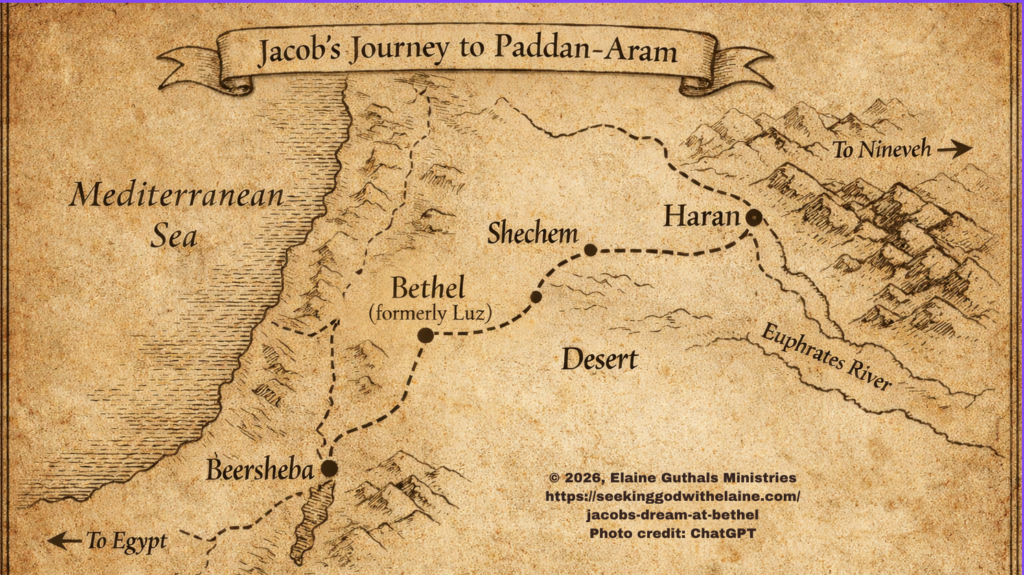
It would be a large caravan, especially if he could offer Esau as many animal as he did and have a lot left for himself. But they did leave without Laban’s knowledge.
Well, sometimes you have to go and then say goodbye or you won’t be allowed to go.
Let’s look at why leaving was such a big deal. Jacob didn’t just marry two sisters. He married into Laban’s clan.
Jacob wasn’t just quitting his job. He was abandoning the clan. He is establishing his own.
We can’t overlook the importance of this. Clans meant a corporate identity, a shared honor and guilt, and a shared inheritance and destiny.
In a society of the fractured family, we may read over that.
Rachel Stole the Teraphim
“At the time they left, Laban was some distance away, shearing his sheep. Rachel stole her father’s household idols and took them with her” (Gen. 31: 19 NLT)
Teraphim were small figurines that were kept in the home associated with family worship and divination.
These figurines were also connected to inheritance rights. We know this from Ancient Near Eastern legal texts, like the Nuzi tablets.
I’ve heard the inheritance claim before. I don’t know if I had ever heard about Laban keeping the dowry, but I can see Rachel believing entitlement. Oh, I could see her taking his authority as she took being first wife from her.
Rachel could have seen that as a transfer of authority from Laban to Jacob. She may have been declaring Jacob’s claim to the family property.
But I also wonder about the worship part. Since she wanted the mandrakes for folklore purposes, I had always wondered if she retained a mixed allegiance, as Laban did.
It is hard to give up a belief that you have held all your life. Even if you don’t totally believe it is true, it is still hard to turn your back on your upbringing.
Rachel may have seen this as a way to take back authority in the way that Leah seized first wife status. Or she may have seen this as a way to take control of her own life.
Whatever the reason(s), I don’t see this as a random theft. I see it more as a strike against Laban.
Rachel’s decision to take the Teraphim may contain snippets of all these reasons — and possibly some we don’t know about. Ancient people were very good at hedging spiritually.
What is clear is that Rachel made a conscious decision to quietly take the figurines.
Jacob Deceives Laban
“Jacob outwitted Laban the Aramean, for they set out secretly and never told Laban they were leaving. So Jacob took all his possessions with him and crossed the Euphrates River, heading for the hill country of Gilead” (Gen. 31: 20-21 NLT)
Jacob was finally getting away from Laban and coming into his own.
Many see this as Jacob deceiving Laban. In other words, you have to be a trickster to deal with a trickster.
I don’t see it as Jacob is now deceiving Laban.
Sometimes, you just have to follow God’s Will, and His Will was for Jacob to go home.
I don’t think Jacob ever stopped being somewhat strategic. We can submit to God, but we have to be intentional enough that we ensure we are doing what He has called us to do.
Jacob slipped away with his complete household. It wasn’t cowardice or treachery.
It was necessary for Jacob to get away from the oppression. Secrecy to accomplish that is not necessarily sin.
The issue was Jacob was leaving the clan without permission from the clan leader. He had asked once (Gen. 30: 25) and ad been refused.
But the intent of leaving was to obey Jehovah.
Making the Connections #1
Don’t read this passage focusing on the theft, trickery, or even family drama. Look at the faith and obedience.
Jacob said that Jehovah knew what Laban had done with his wages. He sees, and He keeps promises.
Making the Connections #2
Think back to when Jacob’s married life began. Two wives in two weeks. It was began with anger, hurt, rejection, and bitterness,
Now, it seems like there is unity. There is maturity.
Making the Connections #3
Jacob has grown so much in his faith. He wasn’t a patriarch when he arrived at Haran. He is now.
Before, Jacob was looking for blessings. Now he knows he has been blessed.
Jacob has come into his own. He is becoming the patriarch.
This is the last time that we will see Jacob under someone else’s authority.
Jacob never railed on Jehovah – not for 20 years. He didn’t crow about outsmarting Laban. He didn’t panic about leaving.
Jacob just packed up his household and left. He called his wives out to the field for privacy and laid everything out clearly and concisely. He was strategic in leaving.
Making the Connections #4
Here Jacob was trying to make a break from Laban and his mixed worship practices, and Rachel brings it with her.
How Do We Apply This?
- Grow in faith in Jehovah.
Father God. Thank You for us seeing Jacob’s growth in You. Help us to grow, also. Amen.
If you don’t understand something and would like further clarification, please contact me.
If you have not signed up for the email providing the link to the devotions and the newsletter, do so below.
If God has used this devotion to speak with you, consider sharing it on social media.