Jacob was the covenant son, but he had been working as a shepherd for 14 years for the privilege of marrying two wives. This devotional reading looks at what happened at the end of those years.
Nuggets
- Jacob, upon the birth of a son with his beloved as his mother, decided to go back to Canaan.
- Laban learned by experience that Jehovah blessed him because of Jacob.
- What I had never caught before was that Laban asked Jacob, “How much do I owe you?”
- Jacob wanted to build his house, not Laban’s.
- It was usual for a shepherd to be paid in animals and grain in the Ancient Near East.
- Laban tried to pull a fast one on Jacob.
- Jacob utilized some common animal husbandry practices of the time.
Jacob had wanted to marry Rachel – and had worked for her father for seven years for that privilege. But Laban had substituted Leah as the bride. That meant Jacob had to work seven more years for Rachel.
The agree-upon time was now up. What would Jacob do now – and more importantly, what would Laban do?
Let's Put It into Context
To read devotions in the Creating Everything theme, click the button below.
Devotions in the Jacob the Patriarch series
Wanting to Go Home
“Soon after Rachel had given birth to Joseph, Jacob said to Laban, ‘Please release me so I can go home to my own country. Let me take my wives and children, for I have earned them by serving you, and let me be on my way. You certainly know how hard I have worked for you.’ ‘Please listen to me,’ Laban replied. ‘I have become wealthy, for the Lord has blessed me because of you. Tell me how much I owe you. Whatever it is, I’ll pay it.’ Jacob replied, ‘You know how hard I’ve worked for you, and how your flocks and herds have grown under my care. You had little indeed before I came, but your wealth has increased enormously. The Lord has blessed you through everything I’ve done. But now, what about me? When can I start providing for my own family?’” (Gen. 30: 25-30 NLT)
Soon after Rachel Had Given Birth to Joseph
Jacob, upon the birth of a son with his beloved as his mother, decided to go back to Canaan.
Jacob had had a busy seven years after his marriage. He was working for Laban doing the seven years for Rachel all the while babies were coming right and left.
1716 BC – Jacob, 84, was tricked into marrying Leah. He agreed to work seven more years for Rachel
~1715 BC — Reuben born (Leah)
~1714 BC — Simeon born (Leah)
~1713 BC — Levi born (Leah)
~1712 BC — Judah born (Leah)
~1712 BC — Dan born (Bilhah)
~1711 BC — Naphtali born (Bilhah)
~1711 BC — Gad born (Zilpah)
~1710 BC — Asher born (Zilpah)
~1710 BC — Issachar born (Leah)
~1709 BC — Zebulun born (Leah)
~1709 BC – Joseph was born (Rachel)
~1709 BC — Jacob, 91, completed the seven years he worked for Laban for Rachel
Based on Timeline from
What Jacob had been waiting for was finally there. Rachel presented him with a son.
It was time to make a change.
Jacob wanted to go home. He may have wanted to mend fences with Isaac and Esau. He definitely would have wanted to see Rebekah.
More likely, Jacob recognized that he had accomplished what he had set out to do — find a covenant wife. It was time to go home to the Promised Land
For the Lord Has Blessed Me Because of You
Laban learned by experience that Jehovah blessed him because of Jacob.
Laban didn’t want to hear, really, that Jacob wanted to leave. He knew Jehovah had blessed him because of Jacob. The New Living Translation has a footnote that says Laban learned that by divination.
What exactly is divination? It is the practice of trying to gain hidden knowledge — usually about the future, unseen causes, or divine favor — through supernatural means or through ritual practices.
This was the normal way in the Ancient Near East to communicate with their gods. It was up to them to interpret the signs.
- Irregularities of the liver of a sacrificed animal
- Unusual animal behavior
- Weather patterns
- Economic shifts
- Dreams
When the Law was given, divination was forbidden. “For example, never sacrifice your son or daughter as a burnt offering. And do not let your people practice fortune-telling, or use sorcery, or interpret omens, or engage in witchcraft, or cast spells, or function as mediums or psychics, or call forth the spirits of the dead.” (Deut. 18: 10-11 NLT).
Laban saw that, after Jacob arrived, his flocks increased, their fertility rose, providing him with more wealth. To him, that was omen interpretation.
Today, we might say it was that Jacob knew better animal husbandry practices. We might call it evaluating the circumstances.
We also know that Laban had household gods (which Rachel took in Genesis 31). In other words, even though Laban knew about Jehovah, he covered all the bases.
- He knew the name of Jehovah.
- He spoke the religious language.
- But he still operated like a Mesopotamian pagan household head.
We aren’t told that Jehovah specifically made promises to Laban, but he knew He did to his family. Lot picked it up, but he had a closer relationship with Abraham after his call.
Tell Me How Much I Owe You
What I had never caught before was that Laban asked Jacob, “How much do I owe you?”
Hadn’t Jacob been working for the wives? There was no mention of wages on top of that.
- “Since Jacob was in love with Rachel, he told her father, ‘I’ll work for you for seven years if you’ll give me Rachel, your younger daughter, as my wife’” (Gen. 29: 18 NLT).
- ‘“But wait until the bridal week is over; then we’ll give you Rachel, too — provided you promise to work another seven years for me’” (Gen. 29: 27 NLT).
Isn’t it un-Laban-like for him to voluntarily suggest more wages on top of that?
But that isn’t really what Laban was saying. If we look at verse 27 in the Orthodox Jewish Bible, we see something totally different. “And Lavan said unto him, Now, if I have found chen (favor, grace) in thine eyes, tarry; for I have learned by nachash (divination) that Hashem [God] hath made a brocha upon me for thy sake” (Gen. 30: 27 OJB emphasis added).
Laban said, “Please don’t leave. I’ll pay you to stay so the money train does leave the station.
When Can I Start Providing for My Own Family?
Jacob wanted to build his house, not Laban’s.
Jacob details how Laban has benefited from their arrangement. But his family had grown.
Jacob has 12 children — 11 sons and 1 daughter. He more than likely had other servants besides the two Laban gave his daughters (that became his concubines).
But look what Jacob said. “The Lord has blessed you through everything I’ve done. But now, what about me? When can I start providing for my own family?’” (Gen. 30: 30 NLT).
Isn’t this the first time since Bethel that Jacob brought Jehovah into the conversation? Nothing was said about his asking Him who should be his wife.
Jacob is maturing in his relationship with Jehovah.
Securing Jacob’s Stay
“‘What wages do you want?’ Laban asked again. Jacob replied, ‘Don’t give me anything. Just do this one thing, and I’ll continue to tend and watch over your flocks. Let me inspect your flocks today and remove all the sheep and goats that are speckled or spotted, along with all the black sheep. Give these to me as my wages. In the future, when you check on the animals you have given me as my wages, you’ll see that I have been honest. If you find in my flock any goats without speckles or spots, or any sheep that are not black, you will know that I have stolen them from you.’ ‘All right,’ Laban replied. ‘It will be as you say.’ But that very day Laban went out and removed the male goats that were streaked and spotted, all the female goats that were speckled and spotted or had white patches, and all the black sheep. He placed them in the care of his own sons, who took them a three-days’ journey from where Jacob was. Meanwhile, Jacob stayed and cared for the rest of Laban’s flock” (Gen. 30: 31-36 NLT)
Wages
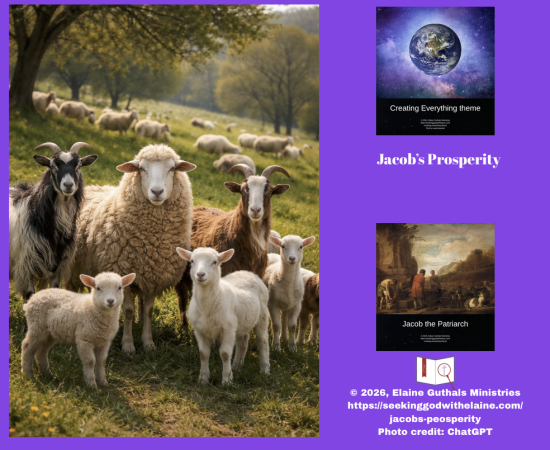
It was usual for a shepherd to be paid in animals and grain in the Ancient Near East.
We might scratch our heads about the wages Jacob finally requested. He asked for:
- Speckled and spotted sheep
- Dark sheep
- Spotted and speckled goats
But if we think about it, it should be logical. Those were the minority animals. Most sheep and goats would have been solid colored.
What? You’re not going to ask your boss to pay you 75% of the profit. Jacob get a smaller percentage because he was the low-status shepherd.
Here is the best part. Laban didn’t have to worry that Jacob was trying to deceive him. It would be obvious at first glance which sheep and goats belonged to Laban, and which sheep and goats belonged to Jacob.
But doesn’t this also keep Laban from deceiving Jacob? The boy was a quick study.
But That Very Day
Laban tried to pull a fast one on Jacob.
Laban agreed to what Jacob proposed for his wages. At first glance, it might seem that he removed what were now Jacob’s sheep and goats as a, “Hey, here you go.”
There is some disagreement as to whether it is those animals that are now Jacob’s or just the spotted, speckled, and dark ones born after that day.
I could see that Laban was just separating out Jacob’s — except for the but in verse 35. Laban separated those animals from the main flock by a three-day journey. Was Jacob good with that?
Or was Laban trying to rig the system? Did he think, “If there are no spotted, speckled, and dark animals for the solid-colored animals to breed with, no more – or very few – of that type of animal would be born.”
We do know that this wasn’t a one-time wage. It was an ongoing division of Laban’s solid-color animals from those Jacob had requested for his wages.
Laban was trying to ensure that Jacob wouldn’t be getting many sheep and goats. There was no starter flock to build the spotted, specked, and dark flock and herd.
Animal Husbandry Practices
“Then Jacob took some fresh branches from poplar, almond, and plane trees and peeled off strips of bark, making white streaks on them. Then he placed these peeled branches in the watering troughs where the flocks came to drink, for that was where they mated. And when they mated in front of the white-streaked branches, they gave birth to young that were streaked, speckled, and spotted. Jacob separated those lambs from Laban’s flock. And at mating time he turned the flock to face Laban’s animals that were streaked or black. This is how he built his own flock instead of increasing Laban’s. Whenever the stronger females were ready to mate, Jacob would place the peeled branches in the watering troughs in front of them. Then they would mate in front of the branches. But he didn’t do this with the weaker ones, so the weaker lambs belonged to Laban, and the stronger ones were Jacob’s. As a result, Jacob became very wealthy, with large flocks of sheep and goats, female and male servants, and many camels and donkeys” (Gen. 30: 37-43 NLT)
Jacob utilized some common animal husbandry practices of the time.
This is another head-scratcher passage. We look at these verses and go, “Huh? I don’t get it.”
Well, Jacob did. In his day there was this thing that we would call the maternal impression theory. It was a long-held belief that, if the pregnant momma – human or animal – had negative emotions, thoughts, or visual experiences, those effected the fetus negatively.
Yes, genetics has debunked that, but don’t we still buy into that to some extent? I know when Adam was a bun in the oven, it was suggested that I listen to Mozart to help him develop.
It could be said that Jacob’s peeled rods (white streaks on dark bark) could be seen as a speckled pattern if not a striped pattern. We may see it as a forerunner of genetic imprinting.
This is seen ask Ancient Near East folklore. There were other interpretations of this verses, however.
The writers of Beyond Today Bible Commentary thought this was a practice to manipulate when the animals went into heat. He wrote,
“By peeling the fresh cut rods (verse 37), Jacob caused the sap-filled meat of the rods to be exposed, thus possibly allowing the sap of the rods to mingle with the water in the watering troughs. Perhaps he believed this additive in the water would help to bring the animals to heat.”
The commentary also suggested that the rods might have been used to create a corralling fence. This makeshift pen would provide a place for a longer mating session.
Resource
This may have been an attempt at selective breeding beyond what we would normally think. Jacob’s attempts wouldn’t matter.
Only Jehovah caused the sheep and goats to be born speckled, spotted, and dark.
Jacob also utilized herd management techniques. He knew his animals – the strong from the weak. It was on the strong that he used the rods.
Making the Connections #1
“I will bless those who bless you and curse those who treat you with contempt. All the families on earth will be blessed through you” (Gen. 12: 3 NLT)
When we think of Jehovah’s promise to Abraham to bless all the families of earth, we may tend to think of everyone except Abraham’s extended family. They weren’t left out.
This became evident to Laban when he looked at the increases after Jacob arrived in Paddan-aram. True, he saw sheep patterns and liver irregularities as omens – but he did see them and credited them to Jehovah.
Making the Connections #2
Taylor made an excellent point. We do learn a lot about ourselves when we go through life experiences. We also learn about the world that way.
Most importantly, Jehovah uses those experiences to reveal Himself to us. Taylor said, “This testimony of experience thus grows with our growth and strengthens with our strength. It is a fortress which is utterly impregnable.”
Resource
Why do you think it was important that Yeshua experience what we experience? True, it wasn’t so He could grow His nature to be closer to Jehovah’s. It was to show us that we can do it.
We just have to pay attention to make sure we are hearing His still small voice.
Making the Connections #3
If we look back at how Jacob worked with the flocks and herds, we can see three schools of thought operating at the same time.
Yes, it seems like Jacob was utilizing some cultural practices of the time if the rods were being used to produce the spotted, striped, and dark animals.
If the rods were being used to allow more time for the breeding to occur – along with ensure the strongest animals breed, that is good animal husbandry practices.
But most of all, we know that Jacob left the outcome up to Jehovah.
- “He said to them, ‘I have noticed that your father’s attitude toward me has changed. But the God of my father has been with me’” (Gen. 31: 5 NLT).
- “… But God has not allowed him [Laban] to do me [Jacob] any harm” (Gen. 31: 7 NLT).
- “In this way, God has taken your father’s animals and given them to me” (Gen. 31: 9 NLT).
Jacob has increased in faith, hasn’t he?
Jehovah has made us stewards of this earth. He wants us to utilized best practices in caring for the animals over which He gives us dominion.
We have to acknowledge that all outcomes come from Him, not just from what we have done.
How Do We Apply This?
- Learn to trust Jehovah more than ourselves.
- Recognize how frail our nature is.
- Follow Jehovah’s practices rather than worldview practices.
- Be good stewards of all He has entrusted to us.
- Give Jeh0vah praise and glory for all the outcomes of our labors.
Resource
Father God. Thank You that You are in control of every aspect of our lives. Forgive us when we follow worldly practices to get the outcome we desire. We know we must be good stewards of the resources that You give us. Let us always acknowledge that You are the One Who decides the outcomes. Amen.
If you don’t understand something and would like further clarification, please contact me.
If you have not signed up for the email providing the link to the devotions and the newsletter, do so below.
If God has used this devotion to speak with you, consider sharing it on social media.