Jacob had come to Paddan-aram to find a wife. This devotional reading looks at who he chose for his wife and how he would pay the bride-price.
Nuggets
- Jacob probably started working for Laban right away, but it took a month until Laban discussed wages.
- There is as much contrast between Leah and Rachel as there is between Esau and Jacob.
- Jacob, there to find a wife, was the one to suggest he work seven years for Rachel’s hand in marriage.
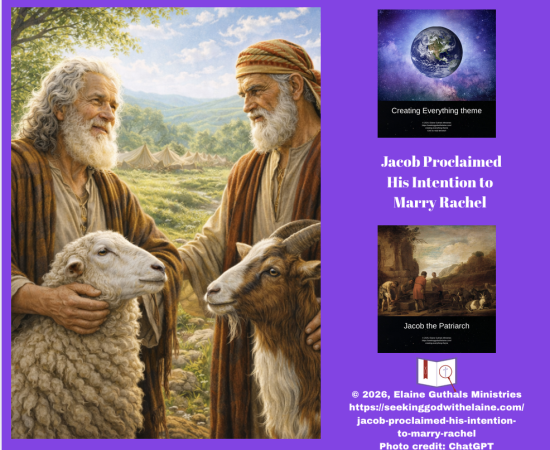
Jacob was welcomed by Laban with open arms. He probably told them right off that he had come looking for a wife.
Laban, probably mourning the lost days of bride gifts, had to figure out how to make it work for him. Let’s see what he came up with.
Let's Put It into Context
To read devotions in the Creating Everything theme, click the button below.
Devotions in the Jacob the Patriarch series
Let's Put It into Context #2
Let’s take a look at the betrothal process. I had thought that the whole process had changed between Abraham’s use of it and Jacob’s use of it — and the divine law hadn’t. Jacob’s circumstances, authority, and covenantal maturity had.
The betrothal process was a negotiation between the groom’s family and the bride’s family. Negotiations revolved around the mohar — or bride-price. These gifts formed a transfer of wealth — commonly in the form of silver, livestock, or other valuables — from the groom’s household to the bride’s father.
The mohar, provided by the groom’s father, served several functions:
- Paid the bride’s family for the loss of her labor and presence as the family functioned as a single economic and social unit
- Showed the bride’s family that the groom had the ability to provide
- Formalized the marriage agreement
Determining Jacob’s Wages
“... After Jacob had stayed with Laban for about a month, Laban said to him, “You shouldn’t work for me without pay just because we are relatives. Tell me how much your wages should be’” (Gen. 29: 14-15 NLT)
Jacob probably started working for Laban right away, but it took a month until Laban discussed wages.
We have already seen where Jacob interacted with the shepherds at the well. He seemed to know about well etiquette.
But how did Jacob get to full-time shepherd?
Well, we don’t know.
We hear nothing about Jacob being a shepherd with Isaac’s flocks. In fact, we really don’t hear much about Isaac’s flocks.
The only reference we get was when Isaac and Rebekah were living in Gerar. “When Isaac planted his crops that year, he harvested a hundred times more grain than he planted, for the Lord blessed him. He became a very rich man, and his wealth continued to grow. He acquired so many flocks of sheep and goats, herds of cattle, and servants that the Philistines became jealous of him” (Gen. 26: 12-14 NLT).
This says Isaac has flocks and herds but doesn’t say who took care of them. It doesn’t say if Isaac did or if he has herdsmen and shepherds.
What we know about Jacob is said contrasting him with Esau. “As the boys grew up, Esau became a skillful hunter. He was an outdoorsman, but Jacob had a quiet temperament, preferring to stay at home” (Gen. 25: 27 NLT).
We can take this stay-at-home time two ways. The first is the way the classic midrash — a Jewish interpretive method that is a running commentary on biblical verses that expands Scriptures — interprets it. “Jacob was a quiet man, dwelling in tents” is seen as meaning that he dwelled in “the tent of Shem and the tent of Eber.” The emphasis here is on Jacob as a student of wisdom/Torah rather than as a pastoral worker.
Remember, genealogy said Noah begat Shem, who begat Arphaxad/Arpachshad, who may have begat Cainan, who begat Shelah, who begat Eber (Gen. 11; Lk. 3).
Anyway, tent dweller, not hired shepherd.
But Jacob did arrive in Haran knowing something about the shepherd’s role. Since he stayed close to the tent, he may have helped around the household (including with flocks) in more informal ways. This would also fit in well with his helping with family affairs as the responsible firstborn-in-character son.
Laban probably decided that Jacob was going to stick around for a while. He probably saw Jacob’s growing attachment to Rachel.
Laban’s Daughters
“Now Laban had two daughters. The older daughter was named Leah, and the younger one was Rachel. There was no sparkle in Leah’s eyes, but Rachel had a beautiful figure and a lovely face” (Gen. 29: 16-17 NLT).
There is as much contrast between Leah and Rachel as there is between Esau and Jacob.
Part of the contrast between Leah and Rachel is the physical description. We are told that Rachel was stunning.
Leah’s description is harder for us to understand. The New Living Translation takes a confusing definition of the Hebrew word rakkoth. Other versions translate it in a variety of ways:
- Weak eyes (NIV, ESV, NASB, CJB, OJB)
- Delicate (KJV)
- Tender (CSB)
- Ordinary (HCSB)
- Lovely (GNT)
The Hebrew word does mean delicate and tender. It also means soft.
Yeah, that could be talking physical characteristic. But remember, Jehovah is more interested in the spiritual aspect of our character.
The midrash states that Leah was supposed to marry Esau. Upset at his violent and immoral character, we would say she cried her eyes out. All this crying made her eyes soft.
I like to think what it was getting at was that she was tenderhearted. That is a contrast to Rachel’s character.
Let’s face it. Rachel didn’t have the most sterling character. She stole Laban’s household idols (Gen. 31: 19) but lied about it (Gen. 31: 34-35). She was envious of Leah’s ability to hear children, so like Sarah, takes matters into her own hands and offers a concubine.
While having the physical beauty, Rachel seems to have a more worldly heart. Leah, on the other hand, persevered and trusted in Jehovah’s care.
Isn’t that Jehovah’s goal for us? We are to trust Him in everything — the good and the bad — the easy and the hard.
We are to content where Sovereign God places us. Leah went through those hard, bad times and always looked to Jehovah for strength — which He provided.
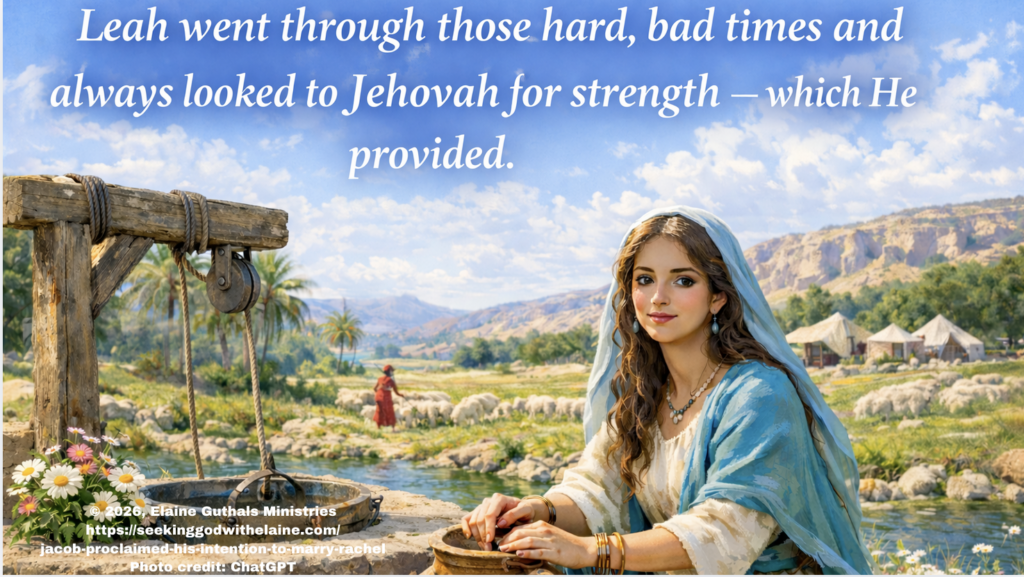
Jehovah knows what we are facing and how we are reacting. He is there to lead us to Him.
The Bride-Price
“Since Jacob was in love with Rachel, he told her father, ‘I’ll work for you for seven years if you’ll give me Rachel, your younger daughter, as my wife.’ ‘Agreed!’ Laban replied. ‘I’d rather give her to you than to anyone else. Stay and work with me.’ So Jacob worked seven years to pay for Rachel. But his love for her was so strong that it seemed to him but a few days” (Gen. 29: 18-20 NLT)
Jacob, there to find a wife, was the one to suggest he work seven years for Rachel’s hand in marriage.
Either I have always read this wrong, or I just didn’t catch it. Jacob was the one to set the term of the wages. I always thought it was Laban.
Part of the reason I thought this was because of what Leah and Rachel said. “Rachel and Leah responded, ‘That’s fine with us! We won’t inherit any of our father’s wealth anyway. He has reduced our rights to those of foreign women. And after he sold us, he wasted the money you paid him for us’” (Gen. 31: 14-15 NLT emphasis added).
But we’ll dive into that when we get there. For now, let’s stick with the betrothal process.
Remember, the process hadn’t changed since Abraham sent Eliezer to Haran to find Rebekah, but Jacob’s circumstances had. The absence of formal rituals — oaths, immediate payment, or public consent scenes — left Jacob on his own.
Laban probably was mourning the lack of the twelve camels with bride-gifts. But here came Jacob, a displaced son instead of an established heir operating from Isaac’s estate.
Jacob still had to provide something of value to Laban — money, livestock, or service. Since the first two were out, the bride-price (mohar) had to be service.
Where other groom’s fathers provided the bride-price — and Isaac didn’t — Jacob had to come up with it himself.
Why didn’t Issac provide the mohar? Possibility 1 is Isaac did, but Jacob lost access to them. Maybe Laban finagled Jacob into a position where he had to work.
I don’t buy that. Jacob’s sole purpose for this journey was to find a wife. I don’t think conniving Laban would have been able to wheedle them out of Jacob’s possession without the bride in return.
Possibility 2 read that Isaac purposefully did not send the bride-gifts. I can see this because Jacob not only deceived his father but “stole” the blessing from Isaac’s favorite son.
This one hits because this whole journey has been about Sovereign God teaching Jacob about humility, endurance and dependence on Him.
A third possibility makes sense, also. Isaac was probably thinking his life was almost over. That was why he chose to give the blessing when he did.
But Isaac had thought that he was giving the blessing to Esau. What if he had already started transferring it to who would have been expected heir?
Both of those land for me and don’t appear to be mutually exclusive.
Hmmmm. Servitude was a legitimate option for paying for the bride-price, but that wasn’t selling the girls?
But back to the agreement.
Jacob said that he would work seven years for the privilege of taking Rachel as a wife.
We have no way of knowing what the going wage would have been for a lowly shepherd. It could have been a modest wage. Remember, shepherding was low-status work.
They also could have been paid in a share of the stock or grain. We know Laban eventually paid Jacob in sheep and goats (Gen. 30: 31).
Even though seven years would not have netted a high wage, the work was hard. So in other words, the years’ work may not have equated what the bride-price would have been, but it had been worth it.
Rachel was worth it.
But look at who each man was talking about. Jacob said, “… if you’ll give me Rachel …” (Gen. 29: 18 NLT).
In verse 19, Laban responded, “… I’d rather give her to you …” (Gen. 29: 19 NLT emphasis added).
We don’t consider that a dangling pronoun because we assume, as did Jacob, that Laban was talking about Rachel. Maybe he was; maybe he wasn’t.
Making the Connections #1
As part of the negotiations between the groom’s and the bride’s families, the bride’s family would give a dowry (nedunyah) to the bride. This provided her economic protection as she entered a new household.
Making the Connections #2
Dods contrasted Jacob and Esau. He wrote,
- “Constancy, persistence, dogged tenacity is certainly the striking feature of Jacob’s character.”
- “In contrast with his tenacious, constant character stands Esau, led by impulse, betrayed by appetite, everything by turns and nothing long.”
Resource
Would Esau have worked for Laban for 7 years, let alone 14? Probably not.
Making the Connections #3
Jehovah knows how to smack us down, doesn’t he? Here was the covenant son agreeing to be the hired hand. The master’s son was forced to be a servant.
Look what Leale said. He wrote, “The nation was thus taught that all its greatness and prosperity were not due to natural endowments and industry, but to the electing love of God. The strength of His grace was made perfect in weakness.”
Resource
Look how Yeshua put it after He had washed the Apostles’ feet. “I tell you the truth, slaves are not greater than their master. Nor is the messenger more important than the one who sends the message. Now that you know these things, God will bless you for doing them” (Jn. 13: 16-17 NLT).
The Apostles had dealt with arguing about being the greatest. Yeshua said, “Flip that. Exhibit servant leadership. Humility is the best because it isn’t about you. It is about Him.”
How Do We Apply This?
- Focus on Jehovah’s plan for our lives.
- Be a servant leader.
Father God. Thank You for the institution of marriage. It was never Your plan that we be alone. Help us to look to You for guidance in choosing our mate. May we always focus on Your plan. Amen.
If you don’t understand something and would like further clarification, please contact me.
If you have not signed up for the email providing the link to the devotions and the newsletter, do so below.
If God has used this devotion to speak with you, consider sharing it on social media.