In order to evade Esau’s anger, Jacob is sent to Paddan-aram to find a wife. This devotional reading looks at the blessing Isaac gives him and the newsletter for the Isaac the Patriarch series.
Nuggets
- Isaac finished the covenant blessing when sending Jacob off to find a wife.
- Esau married another wife, which set up enemies for Israel.

This devotion is going to be totally different. I had thought I was going to do the newsletter next, but found out I needed to do the first part of Genesis 28 before that.
But that passage is very short.
So, I’ve decided to do the next part of our story where we, in essence finish up Isaac’s story — except for his death.
Then I am hooking on the newsletter — which is totally different, too. It isn’t a rehash of what we’ve already read.
It is something that has been swirling in my mind since we finished Isaac’s near sacrifice — which I have since learned was called the Akedah. I had never thought about the fallout of that testing.
So, let’s jump in.
When we left Isaac’s family in the last devotion, Rebekah had just approached Isaac about sending Jacob to her brother’s house to find a wife. While that was an important task for him to accomplish, getting him away from Esau’s anger was a more pressing matter.
Esau was plotting his brother’s murder after their father’s death. Again, Rebekah stepped in. Let’s see what Isaac has to say about this.
Let's Put It into Context
To read devotions in the Creating Everything theme, click the button below.
Devotions in the Isaac the Patriarch series
Sending Jacob Off
“So Isaac called for Jacob, blessed him, and said, ‘You must not marry any of these Canaanite women. Instead, go at once to Paddan-aram, to the house of your grandfather Bethuel, and marry one of your uncle Laban’s daughters. May God Almighty bless you and give you many children. And may your descendants multiply and become many nations! May God pass on to you and your descendants the blessings he promised to Abraham. May you own this land where you are now living as a foreigner, for God gave this land to Abraham.’ So Isaac sent Jacob away, and he went to Paddan-aram to stay with his uncle Laban, his mother’s brother, the son of Bethuel the Aramean” (Gen. 28: 1-5 NLT)
Isaac finished the covenant blessing when sending Jacob off to find a wife.
Why was it so important that Jacob not take a local wife? Seeing that Abraham’s covenant would be carried out through him and not Esau, it was extremely important.
The Canaanites were descendants of Ham’s son Canaan. Ham was cursed when he saw his father Noah’s nakedness when he was drunk (Gen. 9: 20-25).
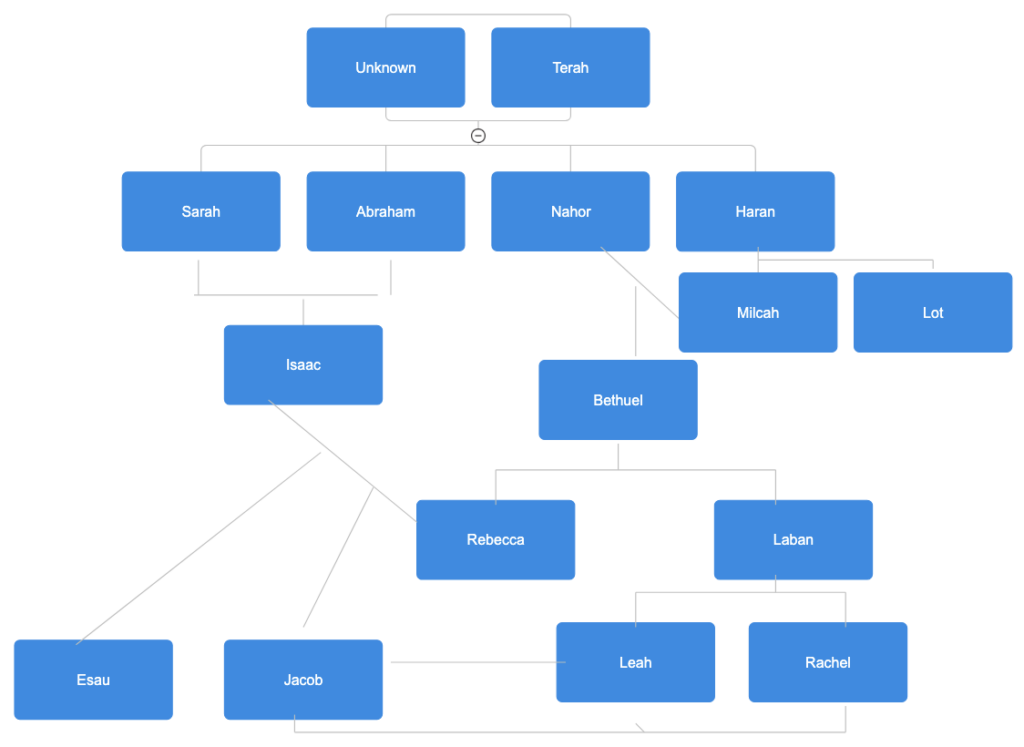
Since the covenant was being fulfilled by Jacob, he needed to take a wife from Abraham’s family.
Isaac sent Jacob to Rebekah’s family, which was Abraham’s brother’s family. He specifically sent him to Laban’s family.
As we discussed, there were some covenant blessings in Jacob’s first blessing. However, not all were included.
Okay, this time, it looks like Isaac fell in line with Jehovah’s wishes. Maybe Rebekah did convince Isaac to follow Jehovah’s Will. Maybe it was Isaac’s choice to repent.
As Pastor Steve says, the blessings are in the obedience.
Bradford gave a possible explanation as to why the first blessing was a partial covenant blessing. He taught,
“… Isaac was in the middle of a real battle with his faith. I think we can also safely assume that Isaac was not entirely convinced that the one he gave the blessing to was Esau (which, of course, it was NOT)……..and that he wasn’t exactly enamored with the character of either of his twin sons. So, either he gave the blessing half-heartedly, because he was unconvinced his son would actually carry it forward, or he was withholding part of it until he sensed the time was right.”
Resource
How were the two blessings different? (I’ve marked the covenant blessings in red.)
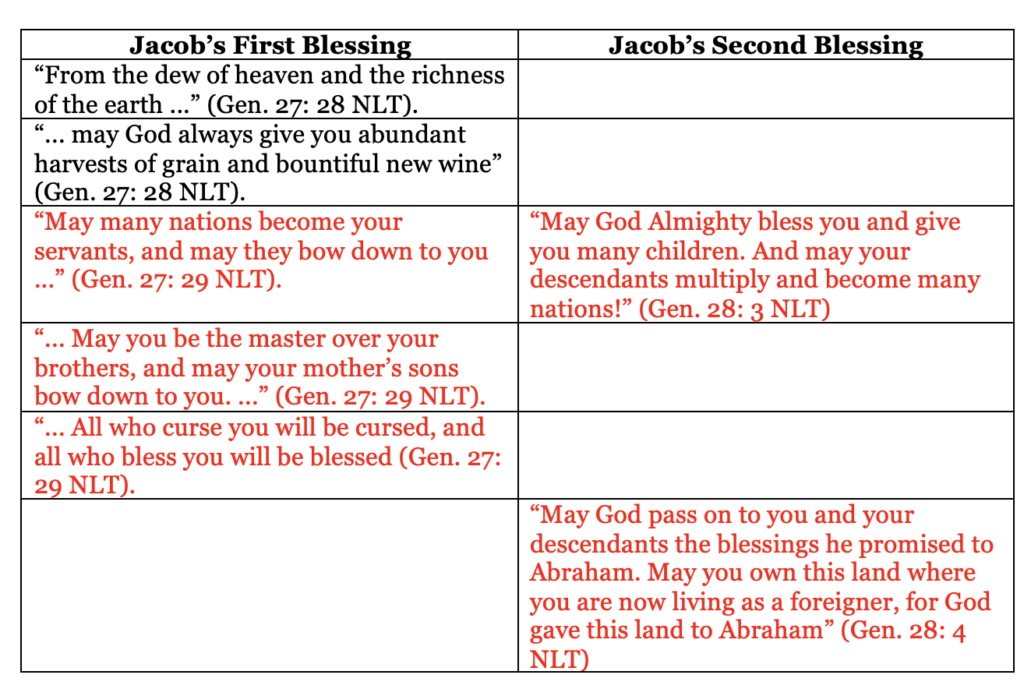
Bradford reminded us of an important act. Ishmael and Esau were not Hebrews. Only Isaac and Jacob were.
However, all of Jacob’s descendants would be Hebrews. Thant is why there is a difference in Abraham’s and Jacob’s blessings.
Because of that Jacob’s become a nation is different than Abraham’s become a nation.
- “I will make you into a great nation [goy] … (Gen. 12: 2 NLT).
- “… And may your descendants multiply and become many nations [ve-hayita likhal]!” (Gen. 28; 3 NLT).
Goy means nations. Ve-hayita likhal means assembly/peoples. Rather than promising the emergence of a nation from nothing, the blessing anticipates the formation of multiple tribes or sub-groups united by covenant.
Abraham’s blessing initiates the covenantal project. Isaac preserves it. Jacob receives it in a form that anticipates structure, multiplicity, and continuity. By the time Genesis 28 is reached, the covenant is no longer abstract or undefined; it is focused, inherited, and internally organized.
Esau Marries another Wife
“Esau knew that his father, Isaac, had blessed Jacob and sent him to Paddan-aram to find a wife, and that he had warned Jacob, ‘You must not marry a Canaanite woman.’ He also knew that Jacob had obeyed his parents and gone to Paddan-aram It was now very clear to Esau that his father did not like the local Canaanite women. So Esau visited his uncle Ishmael’s family and married one of Ishmael’s daughters, in addition to the wives he already had. His new wife’s name was Mahalath. She was the sister of Nebaioth and the daughter of Ishmael, Abraham’s son” (Gen. 6-9 NLT)
Esau married another wife, which set up enemies for Israel.
Esau had two Canaanite wives. We’ve already read that they did not get along with Isaac and Rebekah (Gen. 26: 35).
That wasn’t an issue in Esau’s mind — until they sent Jacob off to find so that he wouldn’t take a Canaanite wife. He decided to choose another.
Am I the only one questioning if that should be the foundation of a marriage? “I’m going to marry you to please my parents. I am going to marry you because it is good for my brother, so it should win me points with Jehovah.”
No, I don’t think I am the only one shaking my head at Esau. Leale called him a mercenary. Hughes called him an imitator. Both called him a hypocrite.
Resources
Esau chose his third wife from family. Mahalath was Esau’s cousin. She was Isaac’s brother Ishmael’s daughter.
We know Sarah asked Abraham to send Ishmael away because he was teasing Isaac (Gen. 21: 9-10). We also know that, even if their relationship hadn’t improved, both were present at Abraham’s burial (Gen. 25: 9).
Would Isaac and Rebekah be any happier with that union?
We have to be very careful. Jehovah doesn’t want us to play at religion. He doesn’t want us to imitate a disciple thinking that will get His blessing.
Everything is dependent on our relationship with Jehovah. Marrying someone isn’t going to gain us His favor.
Bradford said it was even worse than this. He wrote,
“But, as matter-of-fact as this event is told, its future effect is beyond calculation. Because here an alliance through intermarriage is formed, that bonds the two dispossessed firstborns, rejected by Yahoveh as possible heirs to the covenant line of promise, Ishmael and Esau, into what will rather quickly turn into a permanent anti-Israel group of nations. It is the alliance and gene pool mixing of Ishmael and Esau who form the vast bulk of Islam in the world today, and the entire bulk of Arabs.”
Resource
We have to watch when we are trying to make things better.
Newsletter
As many times as I have read the passage about Abraham and Isaac’s near-sacrifice, I missed one important nugget. Where did Abraham live after Isaac’s Akedah?
Akedah is a Hebrew word that means binding. It specifically refers to Abraham binding his beloved son Isaac to sacrifice him at the request of Jehovah.
“And they came to the place which God had told him of; and Abraham built an altar there, and laid the wood in order, and bound Isaac his son, and laid him on the altar upon the wood. And Abraham stretched forth his hand, and took the knife to slay his so” (Gen. 22 9-10 NLT).
After the Akedah, we get a verse talking about Abraham’s residence. “So Abraham returned unto his young men, and they rose up and went together to Beersheba; and Abraham dwelt at Beersheba” (Gen. 22: 19 NLT).
Let’s do a little history lesson.
Where Abraham Lived
Abraham moved from Ur to Haran with his father Terah, his wife Sarah, and his nephew Lot (Gen. 11: 31). (True, Abraham and Sarah had different names, but it was still them.)
When Jehovah called Abraham to move to Canaan, he settled in Shechem (Gen. 12: 6). From there, Abraham moved his household between Bethel and Ai (Gen. 12: 8).
After coming back from Egypt through the Negev, Abraham returned to Bethel (Gen. 13: 3). He moved to Hebron by the grove belonging to Mamre (Gen. 13: 18) after he separated from Lot.
I’ve always assumed that Abraham remained at Hebron for the rest of his life. It was there that Jehovah and the two angels appeared to him before the destruction of Sodom and Gomorrah (Gen. 18: 1).
When another famine occurred, Abraham moved between Kadesh and Shur before moving to Gerar (Gen. 20: 1). Abraham was given royal protection after a dispute between him and Abimelech. “Then Abimelech said, “Look over my land and choose any place where you would like to live.” (Gen. 21: 15 NLT).
We are not told when Abraham moved back to Heron. That is, however, the traditional birthplace of Isaac (Gen. 21: 2).
The next time we are given Abraham’s location is when he enters into the covenant with Abimelech. It was made at Beersheba (Gen. 21: 31-32), where Abraham secured water rights. Wells in Genesis function as legal and economic markers of land use, but they do not require permanent residence.
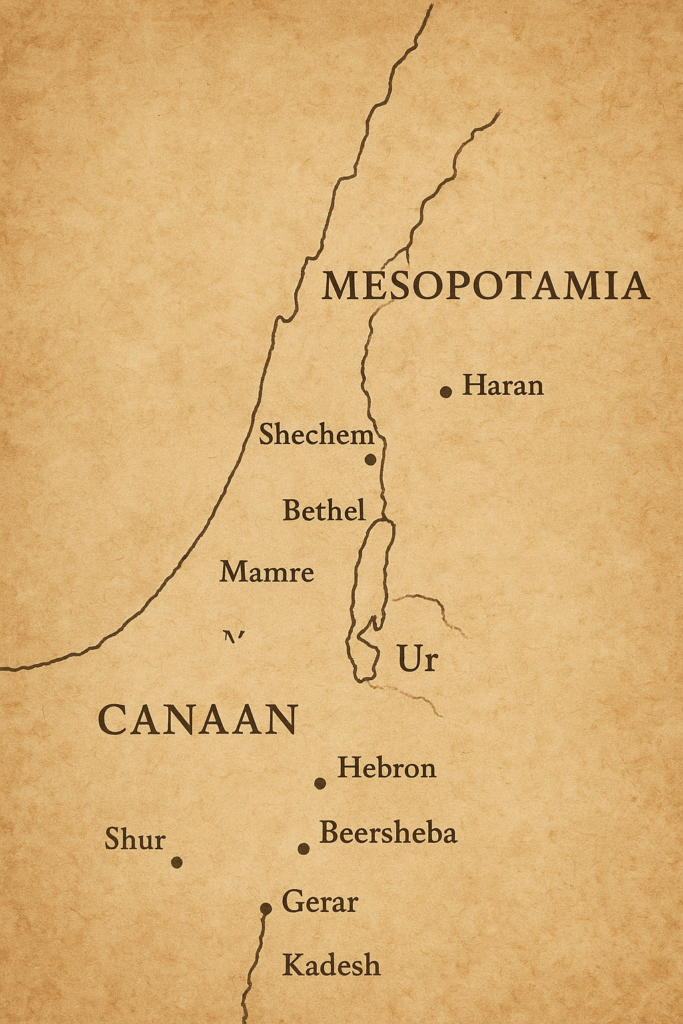
It is important to note that is before the near-sacrifice if it is going in chronological order.
Akedah
Jehovah tested Abraham’s faith by requiring him to sacrifice his beloved son Isaac as a burnt offering (Gen. 22: 2 NLT). Abraham did not waver but journeyed to the mountain on which Jehovah told him to go.
Abraham bound Isaac and placed him on the altar he had built (Gen. 22: 9). He had the knife in hand to complete the sacrifice (Gen. 22: 10).
An angel of the Lord stopped Abraham from killing his son (Gen. 22: 11-12). Jehovah provided a ram to be sacrificed.
Where Do Abraham Go from There?
“Then they returned to the servants and traveled back to Beersheba, where Abraham continued to live” (Gen. 22: 19)
Genesis 22: 19 is an interesting verse. It doesn’t say Abraham returned to Hebron. It says he “… continued to live” (Gen. 22: 19) in Beersheba.
That verse opens a whole can of worms.
- What does continued mean?
- Where was Sarah?
- Where was Isaac?
Continued Living in Beersheba
We know that God’s Word does not read as if it were a daily diary. In Genesis 21, we read where Isaac was born. The only indication we are given of the passage of time is verse 8. “When Isaac grew up and was about to be weaned, Abraham prepared a huge feast to celebrate the occasion” (Gen. 21: 8 NLT).
Jewish children were weaned anywhere from 18 months to 5-years old. Isaac would have probably been a two- or three-year-old child.
The next time we pick up on Isaac’s story, he is probably anywhere from 15 to 30 years old and traveling to the Akedah.
The Hebrew word that describes Abraham’s tenure in Beersheba is yashav. While this does indicate residency, it can mean either temporary or regional dwelling.
In other words, the nomad Abraham could have moved the flocks down there to pasture.
Sarah’s Relationship with Abraham after the Akedah
The last time we heard anything about Sarah was at the weaning celebration. She demanded that Abraham cast Hagar and Ishmael out for the 16-year-old’s mockery of a two- or three-year-old.
Sarah’s name is not mentioned again until we are informed of her death. “When Sarah was 127 years old, she died at Kiriath-arba (now called Hebron) in the land of Canaan. There Abraham mourned and wept for her” (Gen. 23: 1-2 NLT).
Some Jewish interpretive traditions believe that – after the Akedah – Abraham and Sarah lived separately. That could be one reason why Abraham is said to have “… continued to live” (Gen. 22: 19) in Beersheba.
Let’s stop a second and talk this through.
We aren’t told what Abraham told Sarah — if anything — about what Jehovah told him to do. I don’t see him going to her and saying, “God told me to go make a sacrifice — and that sacrifice is Isaac. See you when I get back.”
Resource
We know that Abraham didn’t tell Isaac. “So Abraham placed the wood for the burnt offering on Isaac’s shoulders, while he himself carried the fire and the knife. As the two of them walked on together, Isaac turned to Abraham and said, ‘Father?’ ‘Yes, my son?’ Abraham replied. ‘We have the fire and the wood,’ the boy said, ‘but where is the sheep for the burnt offering?’ ‘God will provide a sheep for the burnt offering, my son,’ Abraham answered. And they both walked on together” (Gen. 22: 6-8 NLT).
If Abraham didn’t tell Isaac until he had to bind him, he didn’t tell Sarah. His answer to Issac shows the faith that had to have gone with him every step that the return steps would have Isaac by his side.
With that much confidence, Abraham would not have told Sarah beforehand. But how would she have reacted when they got home and told her what Jehovah had asked? I don’t know how I would take it.
Sarah’s trouble accepting that Abraham could even have thought about sacrificing Isaac could have eroded their marriage.
No, God’s Word doesn’t say one way or the other what Sarah’s reaction was. What it does say is, when she died, “… Avraham came to mourn for Sarah, and to weep for her” (Gen. 23: 2 OJB emphasis added).
If Abraham had to come, that means he wasn’t there when she died. Was he just elsewhere pasturing the flock? Was he living elsewhere?
Isaac’s Relationship with Abraham after the Akedah
We know that, when Eliezer returned from Paddan-aram to get a wife for Isaac, he was at where Abraham lived – but it wasn’t where Isaac lived. “Meanwhile, Isaac, whose home was in the Negev, had returned from Beer-lahai-roi” (Gen. 24: 62 NLT)
Isaac must have been visiting Abraham. Since Moses said he returned to there, I’ve always assumed that here was Hebron. But then, it may have been Beersheba because that is the last place it stated Abraham lived.
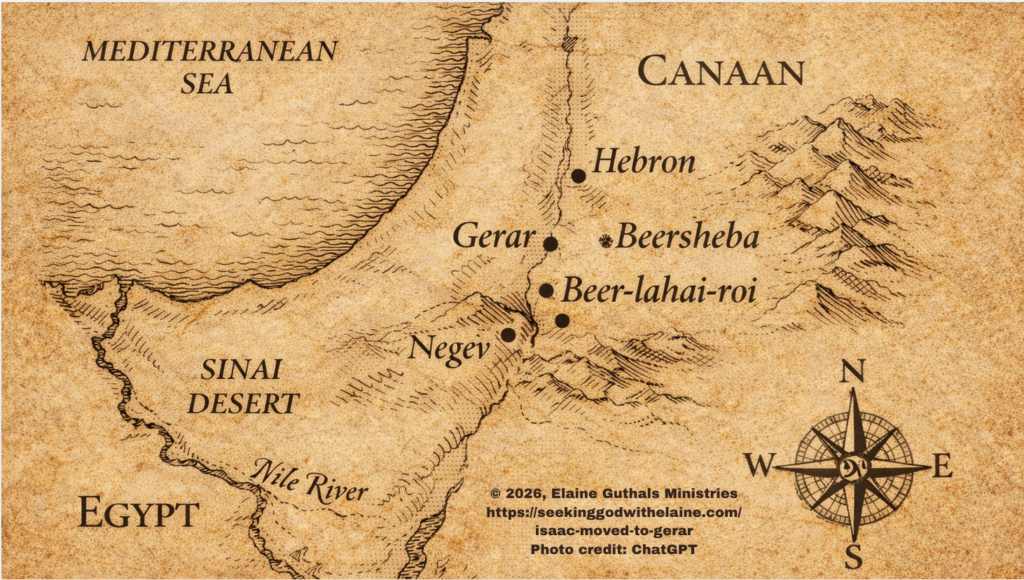
It seems that Isaac’s relationship with Abraham weathered the Akedah.
Conclusion
It threw me for a loop when I read that Abraham didn’t go back to Hebron after the Akedah. Then when I read that he and Sarah were living separately, it really jolted me.
I hope that wasn’t the case. Ending a marriage is difficult for all those involved – parents and children.
But we think that everything will go swimmingly when Jehovah gives us a task or a mission. We especially think that knowing the blessings are in the obedience.
That isn’t a guarantee that others will accept Jehovah’s plan for us. Things may still fall apart when we do everything right.
Lack of clarification and elaboration can sometimes lead us where Jehovah doesn’t want us to go. Still, I think we can learn a very important lesson from looking at this story through this lens.
Jehovah calls us to obedience. That isn’t obedience only when it is easy. It isn’t obedience when our family allows it.
We have to always put God first – no ifs, ands, or buts.
Jehovah will call us to make hard sacrifices. If every choice would be between the easy and the easier, obedience wouldn’t mean anything.

If you don’t understand something and would like further clarification, please contact me.
If you have not signed up for the email providing the link to the devotions and the newsletter, do so below.
If God has used this devotion to speak with you, consider sharing it on social media.