Isaac has now become the Patriarch. This devotional reading looks at how Jehovah blessed him, including by answering his prayer for children.
Nuggets
- Because Isaac was the covenant son and obedient, Jehovah blessed him.
- Based on the ages given and calculated, Abraham would have known the twins.
- Rebekah suffered from barrenness.
- Even before birth, the twins struggled with each other.
- God flat out told Rebekah that her sons would be rivals.
- Once again, Jehovah chose a younger son over the firstborn.
- The birth occurred as Jehovah said.

In the middle of talking about Abraham’s death and closing the book on Ishmael, we had one verse about Isaac. Since the story from Genesis 25 to 26 is about Isaac, we left that verse until now.
What we’ve seen so far about Isaac is that he was a reflective, peaceful man. He went out into the country to meditate.
Isaac was obedient to his father Abraham. He was obedient to his Father Jehovah when He told Abraham to sacrifice Isaac to Him. As Isaac was anywhere from 15 to 30 years old, he could have easily overpowered his 115- to 130-year-old father.
Isaac was obedient to Jehovah.
Let's Put It into Context
To read devotions in the Creating Everything theme, click the button below.
Devotions in the Isaac the Patriarch series
Transition from Abraham to Isaac
“After Abraham’s death, God blessed his son Isaac, who settled near Beer-lahai-roi in the Negev” (Gen. 25: 11 NLT)
God Blessed Isaac
Because Isaac was the covenant son and obedient, Jehovah blessed him.
Abraham lived 175 years. Isaac lived 180 years. Jacob lived 147 years.
We got 15 chapters about Abraham. We got 24 chapters about Jacob.
But we only a few snippets about Isaac.
- Genesis 17 where he is born as the covenant child.
- Genesis 22 where he is slated to be sacrificed – but that was about Abraham’s obedience.
- Genesis 24 where someone else is finding a wife for him, and he showed up for the wedding — but that is mostly Abraham’s story.
- Genesis 25 where he buried his father and continued the covenant line through the birth of his sons.
- Genesis 26 where he had problems with people.
- Genesis 27 where he can’t really tell his kids apart — but that is really Jacob’s story.
- Chapter 28 where he sent Jacob off to find a wife — but that is really Jacob’s story.
- Chapter 35 where he died.
Yep, Isaac lived the longest, but he got the least amount written about him.
That is backwards to the way we think, isn’t it? Isaac, as a Patriarch, was an important man. He was good — and he didn’t die young. There should have been at least ten chapters on him at a minimum, right?
Pearse had a great way of looking at it. He wrote,
“God is the God of Abraham. Yes, we do not wonder at that — Abraham the hero, the warrior, the father and founder of great nations — the man of such gifts and such achievements. But God is the God of Isaac, too — the God of the quiet uneventful life. The heavenly Father hath room in His heart for all His children.”
Resource
Pearse made the point that we need the Abraham’s as well as the Isaac’s. He called him common.
I can see that. We need followers as well as leaders. We need the consistent worker as well as the high-profile.
I think Jehovah would call this being sober minded. Being sober is a character trait distinguished by self-control, genuineness, and sound moral judgment.
There are no big highs. There are no big lows. There is just consistent faith in Sovereign God.
Beer-lahai-roi in the Negev
Isaac lived by the well where Hagar saw Jehovah.
The New Living Translation is missing something. “… and Isaac dwelt by the well Lahairoi” (Gen. 25: 11 NLT). The version we used didn’t mention the well.
But we knew that because we talked about where Isaac lived after Eliezer got back from Paddam-Aram. “Meanwhile, Isaac, whose home was in the Negev, had returned from Beer-lahai-roi” (Gen. 24: 62 NLT)
We talked then that Be’er-Lachi Roi (also called Kadesh-barnea) was where Hagar ended up by the well when she was running away from Sarah. “… She [Hagar] said, ‘You are the God who sees me.’ She also said, ‘Have I truly seen the One who sees me? So that well was named Beer-lahai-roi (which means ‘well of the Living One who sees me’) …” (Gen. 16: 13-14 NLT).
Possibly one of the reasons Isaac lived here and not Hebron with his father was that he also owned flocks and herds. They may have been separated for the same reason Lot separated from Abraham — there were not enough resources to handle two flocks.
The Birth of Jacob and Esau
“This is the account of the family of Isaac, the son of Abraham. When Isaac was forty years old, he married Rebekah, the daughter of Bethuel the Aramean from Paddan-aram and the sister of Laban the Aramean. Isaac pleaded with the Lord on behalf of his wife, because she was unable to have children …” (Gen. 25: 19-21 NLT)
When Isaac Was Forty Years Old
Based on the ages given and calculated, Abraham would have known the twins.
If Isaac was 40 years old when he married Rebekah, Abraham was 140. Since Abraham died at 175, his demise had not been impending when he sent Eliezer to find Isaac a wife.
Abraham did live to see his grandchildren. Isaac was 60 when they were born, making Abraham 160.
She Was Unable to Have Children
Rebekah suffered from barrenness.
It is interesting that Rebekah was considered barren. She probably would have been about 13 when she and Isaac were married, making her probably 33 when her children were born.
Look what Dods said. He wrote,
“The intended mother of the promised seed was left for twenty years childless — to contend with the doubts, surmises, evil proposals, proud challengings of God, and murmurings, which must undoubtedly have arisen even in so bright and spirited a heart as Rebekah’s. It was thus she was taught the seriousness of the possession she had chosen for herself, and gradually led to the implicit faith requisite for the discharge of its responsibilities. … It is a humbling thing to stand in-some other person’s way; but if it is by no fault of ours, but in obedience to affection or conscience we are in this position, we must, in humility and patience, wait upon Providence as Rebekah did, and resist all morbid despondency.”
Resource
Did Rebekah have second thoughts about marrying Isaac? She had no doubts when she agreed to the marriage.
Bradford noted that this barrenness meant no children were born, not just daughters. It seems strange that Jehovah said, “I’ll make your descendants a nation,” and Sarah, Rebekah, and Rachel dealt with the inability to produce children.
Resource
Still, Isaac, however, did not approach a solution the way Abraham and Sarah did. He didn’t acquire concubines.
Isaac prayed to Jehovah. He waited on Him.
Did Isaac remember his birth? He was an answer to prayer to a barren couple.
But then, neither Isaac nor Rebekah were beyond childbearing age. In fact, a CrossTalk article said Rebekah was within the typical childbearing age for her time.
Resource
So, the issue wasn’t that Rebekah couldn’t get pregnant. She just hadn’t yet.
Rivalry in the Womb
“… The Lord answered Isaac’s prayer, and Rebekah became pregnant with twins. But the two children struggled with each other in her womb. So she went to ask the Lord about it. ‘Why is this happening to me?’ she asked. And the Lord told her, ‘The sons in your womb will become two nations. From the very beginning, the two nations will be rivals. One nation will be stronger than the other; and your older son will serve your younger son’” (Gen. 25: 21-23 NLT)
Struggled with Each Other in Her Womb
Even before birth, the twins struggled with each other.
Esau and Jacob were a handful even before they were born. They fought each other inside the womb. This activity was definitely not normal.
This translation sugarcoats their struggles and Rebekah’s frame of mind. “The children fought with each other inside her so much that she said, “If it’s going to be like this, why go on living?” So she went to inquire of ADONAI” (Gen. 25: 22 CJB).
The Orthodox Jewish Bible is more descriptive in referring to what the boys were doing. “And the banim struggled jostling within her; and she said, If it be well, why am I thus? And she went to inquire of Hashem” (Gen. 25: 22 OJB).
Hosea also described the conflict occurring in Rebekah’s body. “Even in the womb, Jacob struggled with his brother; when he became a man, he even fought with God. Yes, he wrestled with the angel and won. He wept and pleaded for a blessing from him. There at Bethel he met God face to face, and God spoke to him — the Lord God of Heaven’s Armies, the Lord is his name!” (Hos. 12: 3-5 NLT)
Rebekah was getting despondent. If the boys didn’t get along prior to birth, how were they going to be after birth?
Two Nations
God flat out told Rebekah that her sons would be rivals.
There was a good reason that the boys were struggling in their mom’s womb. That was going to be the story of their existence. In other words, don’t look for any relief any time soon.
The two boys would be struggling for dominance for a good chunk of their lives.
We should keep in mind as we go on with the story that God told Rebekah that Esau would serve Jacob. Bradford said something we have already noted. He wrote, “This is a theme that is ongoing in the Bible; a theme that separates what SEEMS to be from a physical-earthly sense, from what actually IS from spiritual-heavenly point of view”
Resource
Jehovah is once again separating His chosen people.
Your Older Son Will Serve Your Younger Son
Once again, Jehovah chose a younger son over the firstborn.
At this point, some of us may begin to wonder why Jehovah even bothered with dedicating the firstborn to Himself. In the most important cases that we know of, that wasn’t the case.
- God called Seth. He didn’t call Cain or Abel.
- God called Abraham. He didn’t call Nahor and Haran, his older brothers.
- God called Isaac. He did not call Ishmael, the firstborn.
- God called Jacob. He did not call Esau, the firstborn.
- God called Judah. He did not call Reuben, the firstborn.
- God called Ephraim. He did not call Manasseh, the firstborn.
- God called David. He did not call Eliab, Abinadab, Shimea, — or any of his other four brothers.
In Esau and Jacob’s case, Esau was not even chosen to be called a Hebrew. How could that happen when they were twins?
Easy. The distinction was made by Jehovah’s declaration based on being spiritual, not genealogy.
So, being a Hebrew had nothing to do with physical birth. It was by declaration.
Bradford reminded us that is what election means. It means being chosen by Jehovah by His sovereign decision.
Resource
But that doesn’t mean Jehovah would forget about Esau. Just as He did Ishmael, He said that Esau would be a separate nation. We know He kept His promise – Esau’s descendants are the Edomites. And just as Ishmael’s descendants, the Arabs, are in conflict with Israel, so too were the Edomites.
Happy Birthday!
“And when the time came to give birth, Rebekah discovered that she did indeed have twins! The first one was very red at birth and covered with thick hair like a fur coat. So they named him Esau. Then the other twin was born with his hand grasping Esau’s heel. So they named him Jacob. Isaac was sixty years old when the twins were born” (Gen. 25: 24-26 NLT)
The birth occurred as Jehovah said.
Back in Rebekah’s day, there were no sonograms so that science could confirm what Jehovah said. She had to wait until she gave birth.
And, as always, things happened just as Jehovah said it would.
The son they named Esau arrived first. I love how Bradford described him – “… loveable little fuzzball.”
Resource
Just because Esau wasn’t the covenant son didn’t mean he was lacking physically.
But that also doesn’t mean Jacob didn’t do his best to be born first. Verse 26 says he came out grasping his brother’s heel.
Isn’t Esau and Jacob’s birth a great visual of our struggle against sin?
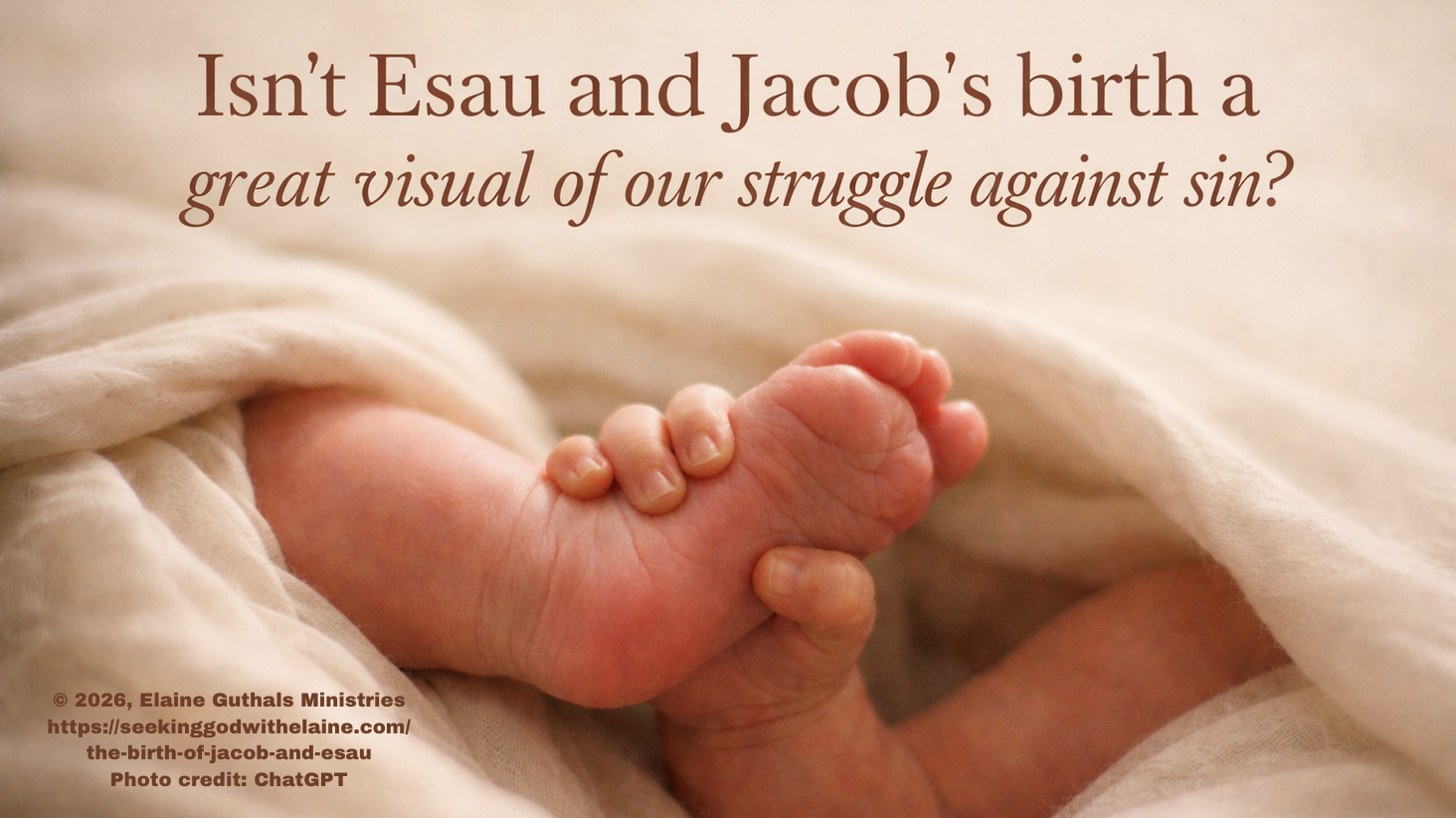
We tend to grasp onto sin. We don’t want to let it go – but then again, we don’t want it to get the best of us.
Either way, we tend to hold on.
But we know, in this instance, Jacob wanted to be the firstborn. He was trying to keep Esau back.
Making the Connections #1
Watt had a great observation about two principles Jehovah has— but to some it will seem like a contradiction. He wrote, “… (1) that God repeats Himself in His modes of training men; and (2) that God does not repeat Himself.”
Resource
Does Jehovah bless all His children? Emphatic YES! Does He bless us all in the same way? Emphatic NO!
Our loving Heavenly Father blesses us the most by increasing our faith. He will bless each individual who genuinely seeks Him.
Yeshua said that the Holy Spirit would be given to each of Jehovah’s children. And He does instruct us and correct us.
But we are all on different places on our Sanctification Road. Each of our roads are made of bricks — experiences, testings — but those are different for each of us.
Jehovah repeats Himself because it is one message. That message is that salvation can only be gained through Yeshua — and we all need it.
Sometimes, we have to hear the same thing over and over again before we grab hold of it and make it our own. He wants to communicate with us as clearly as possible.
We also need to hear things again for confirmation. We need that assurance. It is purposeful redundancy for our instruction.
But Jehovah doesn’t repeat Himself. What if the only message we ever hear is salvation?
Those who truly want salvation should be saying, “And then what?”
Just preaching salvation and never getting to sanctification throws the new believer out into the world to stand up to Satan without giving them the tools to do so.
Making the Connections #2
Woolnough listed three habits Isaac possessed that we need.
- Thought
- Dealing with others
- Home
We talked a lot about Isaac’s habit of meditation. This is the process by which we take what Jehovah has revealed to us and decide how we are going to apply it to our lives.
Woolnough explained what he meant by Isaac’s habit of dealing with others. He wrote, “But notably you feel in Isaac’s case what is that influence which leads a man to make ample and timely disposition of his secular affairs, that he may give himself more fully to better things.”
Resource
Home is very important to Jehovah, but we usually use a different word to describe it — families. Families within their homes have an important task assigned to them by Him.
“And you must commit yourselves wholeheartedly to these commands that I am giving you today. Repeat them again and again to your children. Talk about them when you are at home and when you are on the road, when you are going to bed and when you are getting up. Tie them to your hands and wear them on your forehead as reminders. Write them on the doorposts of your house and on your gates” (Deut. 6: 6-9 NLT).
Families are teach each other in Jehovah’s ways.
Making the Connections #3
We talked about Jehovah told Rebekah that Esau would serve Jacob. I have long baffled by the rest of the story.
Didn’t Rebekah tell Isaac that Jacob was the covenant son? Wouldn’t that have been something that she would at least have dropped into a conversation with Isaac?
Bradford said that if she did keep it to herself, she would have been disloyal and disrespectful. We don’t get that vibe from of their relationship.
I could see a parent not telling a child that – especially the child not chosen. But the chosen one was Rebekah’s favorite.
But Bradford was right. Imagine waiting until the boys were mature and telling Esau, “You’re not chosen.”
Resource
Part of me also says that Jehovah would not have just told Rebekah. He would also have told Isaac.
How Do We Apply This?
- Know that Jehovah will answer our prayers.
- Accept Jehovah’s response to our prayer requests because they may contain temptation as well as mercy.
Resource
Father God. When You give us a nice, quiet life, You are with us. When You make us wait for Your timing, You are with us. When You fulfill Your promises, You are with us. In all circumstances — good or bad — You are with us. Thank You. Amen
If you don’t understand something and would like further clarification, please contact me.
If you have not signed up for the email providing the link to the devotions and the newsletter, do so below.
If God has used this devotion to speak with you, consider sharing it on social media.