The Covenant between Jehovah and Abraham
Jehovah entered into a covenant with Abram.
- Covenant established (Gen. 12: 1-3)
- Blessings of the covenant (Gen. 12: 7; Gen.13: 14-17)
- Sign of the covenant (Gen. 15: 1-21)
- Acceptance of the responsibilities of the covenant (Gen. 17: 1-27)Promise of the covenant (Gen. 18: 9-15).
Five promises were given during Abraham’s original call.
- I will make you a nation (Gen. 12: 2).
- I will bless you (Gen. 12: 2).
- I will make your name great (Gen. 12: 2).
- I will bless those who bless you, curse those who curse you (Gen. 12: 3).
- All will be blessed through you (Gen. 12: 3).
We have to look at the Hebrew here because something is lost in translation. “On that day Hashem cut a brit (covenant) with Avram, saying, Unto thy zera have I given ha’aretz hazot, from the Wadi of Mitzrayim unto the great river, the river Euphrates:” (Gen. 15: 18 OJB emphasis added).
The Hebrew word for cut is karat. What did Abram do to most of the animals that were sacrificed in Genesis 15: 10? He cut them in half. That allowed the parties to pass through them, showing agreement and acceptance of the covenant.
But it is more than that. If the covenant was broken – one party did not do what was required – the other party could cut him in two!
So, God cut a covenant with Abram.
The covenant was kept for many years. Then, Israel broke it – and was cut into two nations.
There are three ways God says that the covenant with be eternal.
- generation to generation (Gen. 17: 7)
- everlasting covenant (Gen. 17: 7)
- possession forever (Gen. 17: 8)
We don’t want to miss this. God made one man – Adam – and, through his family, created all humankind. God made one man – Noah – and, through his family, saved humankind from distinction. God made one man – David – and, through him, really made Israel into a nation. God made one man – Jesus – and, through His sacrifice, saved all humankind from our sins when we accept Him as our Savior.
Don’t think one person doesn’t have influence.
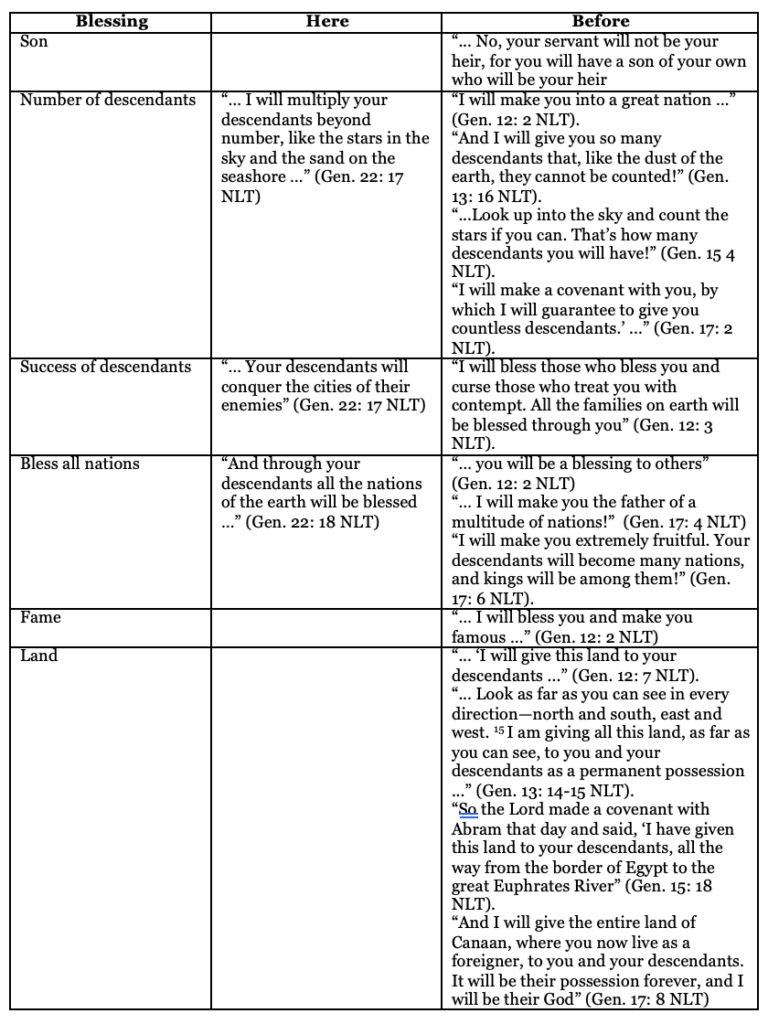
Promise of a Son
The promise was fulfilled with the birth of Isaac.
Sovereign God knew that Abram was right in Genesis 15 – all the promised blessings hinged on him having a son.
Abram struggled with the promise of descendants. Giving Abram the land meant nothing if he didn’t have descendants.
Oh yeah. This was probably building up for a while. Ten years is a long time to wait.
No, we don’t know why God asked Abram to wait for a son. God had his reasons. Maybe Abram knew them. Maybe he didn’t.
We aren’t always told why. We are told to obey anyway. Abram did.
Abram wasn’t doubting. He was just impatient.
Abram only wanted to know. It wasn’t that he didn’t believe. He only needed a little reassurance.
Jehovah was looking into the future when He came to Abram to repeat the promise of the covenant (Gen. 15: 2-3). Abram was looking into the future, too, but he wasn’t seeing what God was seeing. He didn’t see how he was going to get there.
What Abram was seeing was that he was old and Sarai was old. That left a servant for his heir – not exactly what God was promising.

Abram wasn’t just saying, “I don’t have a son.” He was saying, “I can’t take my eyes off of today’s problems, so they are blocking the view of tomorrow.”
The thing is we have to watch how we approach Sovereign God. We don’t want to whine. We definitely don’t want to doubt.
Jehovah answered Abram’s whine. He said, “Have faith. You are going to have a son.”
We need to remember that we can be rock solid when we are standing on God’s promises. If He has promised it, He will see it through to completion.
Notice, God wasn’t slapping Abram down for questioning. He wasn’t upset at Abram because he was going through a hard time.
Just the opposite. “I am your shied and your reward because you belong to Me. You are mine.”
It doesn’t matter if our trials come through nature or Satan himself – even if we bring them on ourselves – Jehovah is right there with us.
Genesis 17 was the first time Sarah is directly included in the covenant. When God and Abraham had talked covenant dealings before, Abraham hadn’t really talked about Sarah’s part of it. There is no talk of who would be the mother of the descendants.
Sarai not only got a name change, but she also got the promise of a son. Sarai means princess. Sarah means mother of nations.
Moses really didn’t say anything about Sarah’s faith. She had to believe in the promise as much as Abraham did, or I doubt the couple would have been chosen. But we do see her arrogance in the way she treated Hagar.
Abraham and Sarah both laughed (Gen. 17: 17; 18: 11-12). They were both old, way past the childbearing years.
God is the God of the impossible (Lk. 1: 37). We can’t limit Him by our human limitations. We have to let Him work in our lives.
The laughter in Genesis 17 was just the outward expression of Abraham’s lack of faith that he and Sarah would have a child. That is the main reason he offered Ishmael as the covenant son.
Since Abraham didn’t believe deep down to his core that God was the God of the impossible, he offered the son he had.
We can’t lose track of the fact that, the last time God and Abraham had a covenant discussion, Abraham was 85 years old. Now, he was 99. In his estimation, time wasn’t only a-wasting, but it was already gone.
The other reason Ishmael was offered as a substitute was that, regardless of Abraham’s relationship with Hagar — slave, concubine, or wife — he probably saw Ishmael as his firstborn. It was common practice in the culture that the firstborn was the one to inherit. Plus, we know that Abraham probably loved him (Gen. 21: 11).
In that culture, children whose mother was a slave was also a slave. Isaac was born free — his mother wasn’t a slave. Ishmael was a slave because his mother was a slave.
Abraham could have been praying that God not take out his and Sarah’s unbelief on Ishmael. He may have thought that God would end Ishmael’s life when Isaac was born. At a minimum, he may have thought Ishmael would be banished as Cain was.
Abraham may have been praying for Ishmael’s spiritual condition. At the core, he knew that walking with God was how we needed to live. He was asking that Ishmael walk as God had told Abraham to: “… Walk in my presence and be pure-hearted” (Gen. 17: 1 CJB).
Abraham wanted Ishmael to have a relationship with God. He not only wanted Ishmael to be living and breathing but also obediently walk with God and worshiping Him.
But God’s refusal to choose Ishmael most assuredly stemmed from one fact. That fact was Isaac was the chosen son.
God assured Abraham that Ishmael — even though he was rejected — would be blessed.
Now it was time — when Abraham was 100 and Sarah was 90 — to fulfill that promise. The promise had taken a quarter of a century or more to be fulfilled.
The covenant son wasn’t just any son — like Ishmael Abraham’s son through Hagar. It was Sarah’s son (Gen. 18: 10 NLT).
Isaac was born only through the grace of God in a distinctive action. Without God giving Abraham and Sarah this child as promised, he would not have been born. This is like Jesus.
Isaac was born within the bounds of matrimony. God is all about working through families.
The bottom line was God’s covenant was through Isaac, a type of Christ.
Descendants
It wasn’t just one son Abraham was being promised. He was being promised many sons (Gen. 17: 7 NLT).

Think about it. Here was this possibly despondent man in Genesis 15. It definitely sounds like he was frustrated.
God told him, “You may not hear pitter patter of little feet right now, but eventually you are going to have as many descendants as there are stars in the sky.”
Sovereign God’s talking to Abram had the intended effect. “And Abram believed the Lord, and the Lord counted him as righteous because of his faith” (Gen. 15: 8 NLT).
The thing is we all need to have a faith like Abram’s. That is the way in which we will be blessed through the covenant.
Look at all the “I will” combinations in this passage.
- “I will make a covenant with you, by which I will guarantee to give you countless descendants” (Gen. 17: 2 NLT).
- “This is my covenant with you: I will make you the father of a multitude of nations!” (Gen. 17: 4 NLT).
- “I will make you extremely fruitful. Your descendants will become many nations, and kings will be among them! I will confirm my covenant with you and your descendants after you, from generation to generation. This is the everlasting covenant: I will always be your God and the God of your descendants after you. And I will give the entire land of Canaan, where you now live as a foreigner, to you and your descendants …” (Gen. 17: 6-8 NLT).
Seven “I will” statements in eight verses. God was committed to this covenant. We know He followed through on His part!
We also need to react to Jehovah as Abram did. We need to fall on our faces before God. Yeah, this may mean literally down on the ground. It definitely means figuratively.
Abram believed that, through his descendants, humans would be reconciled to God. He may not have known that Jesus was the One to do it, but he knew the Messiah would be His descendant.
This covenant was for Abraham and his descendants. (Yeah, we get that with it being an everlasting covenant.) But does that mean they have no choice in the matter?
Abraham’s children still had free will. They had to choose to serve God.
A Great Nation
Sovereign God really didn’t elaborate in Genesis 12 on make a nation as Abram having kids — or specifically kid singular. But Abram was saying in Genesis 15: 4, “What good would any other blessing be if I don’t have a son?”
Jehovah would make of Abraham a great nation. To me, this goes back a couple of chapters. “… This is now etzem (bone, essence, self, substance) of my etzem, and basar (flesh, meat) of my basar …” (Gen. 2: 23 OJB).
Otherwise, who’s to say that can’t be interpreted as Abraham defeating a king and becoming ruler of an established nation — which is not what Jehovah had in mind.
Right from the get-go, God told Abram that He was not only calling Abram but also calling his descendants. He was going to be the father of many.
Abram was going to be blessed by his descendants forming a nation as well as blessing others.
Abram’s name change showed the changes that would be coming in his life. Both Abram and Abraham showcase aspects of fatherhood.
· Abram means exalted father.
· Abraham means father of many nations.
Abraham would also be the father of many faiths. We also know that he is the patriarch of Judaism, Christianity, and Islam. That would probably make the name change based on a change of character, also. Abraham would now be the father of the faithful, also.
It is interesting what Genesis 17: 4 says in the Orthodox Jewish Bible. “As for Me, hinei, My brit (covenant) is with thee, and thou shalt be an Av [father, forefather] of many Goyim [see 18:18] [Gentiles]” (Gen. 17: 4 OJB).
The translation for the word hinei delivered a much deeper commitment — a total commitment — to fulfilling this covenant.
Maybe I am just being picky, but it seems like the New Living Translation has rewritten verse 5 “…. I will make you the father of a multitude of nations!” (Gen. 17: 5 NLT).
Look what the Hebrew says. “… Av hamon Goyim (Father of a multitude of Goyim) have I made thee. [T.N. Ga 3:29 says “And if you belong to Moshiach [Messiah] (YESHAYAH 53:10), then you are of the ZERAH [shining, brightness, dawning] of Avraham Avinu, [our father] you are yoreshim (heirs) according to the havtachah (promise).]” (Gen. 17: 5 OJB).
It doesn’t necessarily say nations. It says a multitude of Gentiles.
Blessing to Others
God had an ideal in view when He made the choice of Israel to be His peculiar people.
One promise was to bless everyone through Abram. Yes, he was going to have enough descendants to become a nation. But even people not his descendants were going to be blessed – even Ham’s descendants including Nimrod.
We just have to grab hold of that blessing (Jer. 17: 7 NLT). The opposite is to be cursed (Jer. 17: 5 NLT).
It has nothing to do with our moral characteristics – being a good person. Salvation is based only on our relationship with God. We have to be a good, not evil, person before we can do good for others – spiritual or physical.
The Jews, though, thought salvation came through Abraham. Jesus said, “Wrong. It comes through Me.”
Jehovah blessed Abraham, and He blesses us in the same way.
Jehovah comes to us. He doesn’t force Himself on us. We have to be obedient, like Abram, and listen to His call.
We use Genesis 12: 3 to say that those who bless Israel will be blessed, and those who curse Israel will be cursed. I think the bless those that bless you part is talking about Jesus. God has already talked about the Messiah (Gen. 3: 15). He is going to take care of our spiritual condition before a physical condition.
The most important thing Abram gained was that his descendant – Jesus – became the Savior for all, not just the Hebrews/Israelites/Jews. That is what everyone from Adam on own needed/needs.
Land
When Abram left Haran, he wasn’t promised land of his own. Genesis 12: 7 was the first time the promise of land was involved. Jehovah gave the land of Canaan to Abraham as a permanent possession.
Once Lot moved, Sovereign God came to Abram. He had a special reason for coming. He clarified what land He was giving to Abram and his descendants.
God gave Abraham the land “… as far as you can see in every direction — north and south, east and west” (Gen. 13: 14 NLT). That is a lot of land.
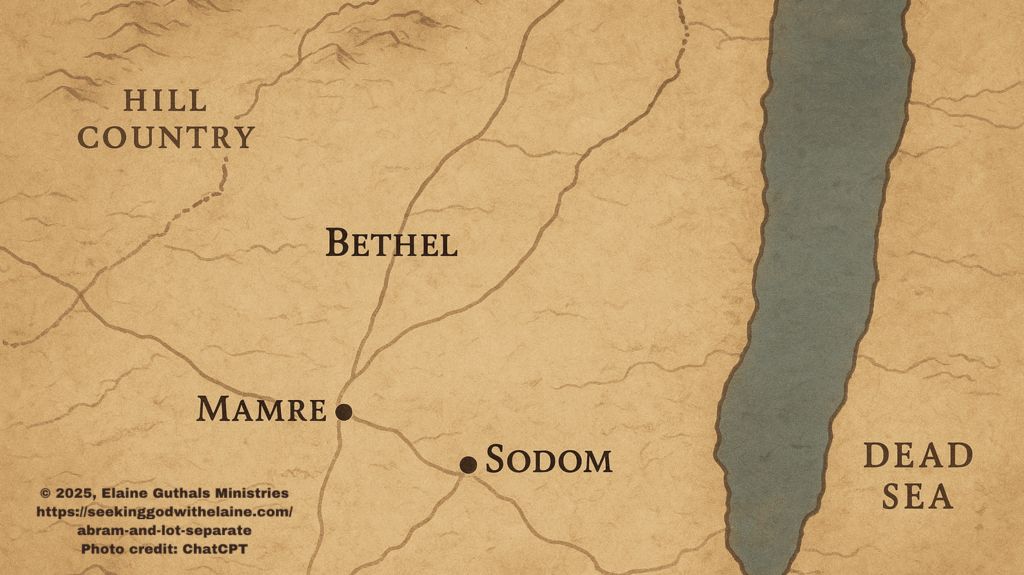
Why would God tell Abram to look in all directions?
Bethel was in the land that – in the future – would be given to the tribe of Benjamin. That was considered the middle of the Promised Land.
So, yes, Abram could see all of the Promised Land from where he was standing.
God knew that the only land Abram was going to own in his lifetime was where he was going to be buried. But He had something bigger in mind.
God knew that, even though Abram would have a dysfunctional family, he was a family man. So, He made sure he saw the land that would be given to his descendants. “It’s not yours, but look at it.”
This road trip in Genesis 13 would have made it more tangible for Abram. He could see the land on which he was walking.
But think about it. Abram could only see that day. God could see hundreds of years into the future.
Sovereign God was confirming the covenant He made with Abram. God promised the land of Canaan to Abram four times (Gen. 12: 7: 13: 15; 15: 7; and 17: 8).
We like to say the third time is the charm. God went even one more.
Protection and Reward
In the sign of the covenant with Abram, Jehovah promised him to protect and reward/fulfill his desires.
For 10 years, Abram has been walking with God, following His commandments. Sometimes, he did a good job. Sometimes, he didn’t.
Before, God promised blessings. What God had offered Abram in Genesis 15 was Himself.
God never gave up on Abram. He knew Abram would become Abraham, the father of Israel.
On this day, when Jehovah came to Abram, He told him not to fear. What did Abram have to fear?
- Famine, which had occurred and may again (Gen. 13)
- War, which already had occurred once and probably would again (Gen. 14).
- Persecution, considering he was surrounded by idol worshipers.
- Pain, because it is customary to humans.
Abram already knew God would protect Him. He showed him that in Egypt (Gen. 13).
God came with assurance.
God said, “I am thy shield and reward” (Gen. 15: 1 OJB). Not that “… your reward will be great” (Gen. 15: 1 NLT).

It isn’t that we will live eternally in Heaven. It is that we will live eternally with God.
If you can’t stand to live with God now, you aren’t going to Heaven. If you can’t stand to do His laws and commandments by His interpretation, you aren’t going to Heaven.
Because God Himself is our reward, we have a surety of Him being our shield. He will keep us safe. King said He would defend us by his providence and grace.
God is our portion means He is the definitive source of our happiness, fulfillment, and inheritance. In all things, we can be content in Him.
Our joy and happiness — in fact, life current and eternal — is only through Him.
The Mark of the Covenant
God’s making a covenant with Abraham was a sure thing, but Abraham had responsibilities that he had to perform. His part was simple.
• Walk in God’s presence (Gen. 17: 2)
• Be pure-hearted (Gen. 17: 2)
• Practice circumcision (Gen. 17: 10)
Bottom line is we have to be obedient to what God says.
It is easy to think that circumcisions began with Abraham, that this was a new and singular practice of the Hebrews/Israelites/Jews. Wrong. The practice was practiced throughout other people groups.
Circumcision was required of all males in Israel. This included those who were born as slaves into the household or bought into it. No, God didn’t make it about a tight knit group.
God knew having worldview people around would lead us to drawing away from Him. He didn’t want to put us in that predicament.
True, babies don’t have a choice, but their parents do. Yeah, circumcision was required but again, humans have free will.
Anyone who was not circumcised was cut off (Gen. 17: 14 NLT). Remember, God is in the business of separating and dividing. He wants His children to have obvious differences from those around them.

There is another aspect to this. God works through families. This practice was to be handed down through the generations.
We can’t think the act of circumcision was just about the physical act, even though the stone knife used certainly made it that. We need to know the spiritual meaning of it. By this act, others would know they were God’s people as they were dedicated to God.
We have to remember that blood is shed in this practice. That made it a personal covenant.
We know that only through the blood are our sins forgiven. Some may say that Yeshua did away with the circumcision requirement. Oh, no.
Abraham was prompt in getting himself, Ishmael, and all other makes in his household circumcised. He didn’t put it off (Gen. 17: 23).
Think about it. Abraham was diligent and circumcised Ishmael even though he knew Ishmael would not be a Hebrew. Maybe he was keeping him as a spare just in case. Maybe he thought God would change His mind.
Look at it this way. Ishmael was not the chosen son, but he was allowed into the covenant process. He could have chosen to follow God.
Ishmael chose not to follow God.
This wasn’t just a works-based faith. Yes, the circumcision was outward, but it had to be fostered by an inward faith.
No, Abraham didn’t say that he was old, so he wasn’t going to change the way he worshiped God. He didn’t shy away from the pain and blood.
Abraham circumcised his heart.
In accordance with the covenant, Abraham had Isaac circumcised on the eighth day after his birth.
Though circumcision did not originate with the Hebrews, it was the sign of the covenant with Abraham (Gen. 17: 9-14). Yet where those were probably a medical procedure to prevent incurable diseases and disorders, this was an act of acceptance of the covenant.
Circumcision was required of all males in Israel. This included those who were born as slaves into the household or bought into it. Circumcision was required, but humans have free will to chose to do it or not. The consequences of choosing not to be circumcised was being cut off from Jehovah.
Just as he was obedient when the sign was given, Abraham was obedient when his covenant son was born.

To read devotions in the Creating Everything theme, click the button below.
Devotions in the Abraham the Patriarch series