Abraham lived a live that is an example to us all. This devotional reading looks at the end of his life.
Nuggets
- Abraham took Keturah as a wife, with whom he had several sons.
- As (considered) firstborn, Isaac was entitled to a double portion of Abraham’s wealth.
- The half-brothers were probably ticked off that they just got gifts of Abraham’s estate, not a portion of it.
- Abraham died at the age of 175.
From the day he was called until the day he died, Abraham lived a life that gained him the distinction of being called righteous. “And Abram believed the Lord, and the Lord counted him as righteous because of his faith” (Gen. 15: 6 NLT).
One thing Abraham did not escape was physical death. Let’s take a look at the end of his life.
Let’s Put It into Context #1
To read devotions in the Creating Everything theme, click the button below.
Devotions in the Abraham the Patriarch series
Let's Put It into Context #2
Let’s start this discussion by doing some background information on marriage.
I like Hampshire’s purpose for marriage. He wrote, “God gave us marriage to enjoy and display the gospel.”
Resource
Yes, Jehovah was the Creator of marriage – as a covenant relationship. It is a visual of our relationship with Jehovah and His relationship with us. It is a display of His power and character.
We see this as Yeshua is identified as the Bridegroom, and the Church is identified as the Bride.
Woman was created so that man would not be alone (Gen. 2: 18). “This explains why a man leaves his father and mother and is joined to his wife, and the two are united into one” (Gen. 2: 24 NLT).
Human marriage, according to Hampshire, is to have the following elements:
- Unending love
- Mutual submission
- Forgiveness
- Compassion
- Self-sacrifice
Because of sin, marriage was distorted. In the Old Testament, this included taking concubines. Concubines (pilegesh) – while they were generally servants – were secondary wives, typically chosen to bear children when the primary wife was barren.
I had always considered the wife to have the legal status and the concubine to be more of a mistress in today’s terminology. I was wrong.
Women who had the legal status of concubines, though, did not have the full privileges of the primary wife. In other words, according to Lyons, the terms were not used interchangeably.
Resource
But they were treated well and held in high regard.
There would have been no betrothal, no marriage ceremony. There would have just been a statement.
The status of concubine, according to Got Answers, was permanent. Rushmore said that meant the slave could not be sold if the owner was no longer satisfied with her.
Resources
Because they were considered wives, they were part of the family.
Even though God’s Word tells us that Abraham, Jacob, David, Solomon, and others had more than one wife, we should not read that as Jehovah giving His blessing to do that. His idea of the institution is that it is one man and one woman until death do them part.
One reason given by Got Questions for God tolerating this practice was that it fulfills the go-forth-and-multiply blessing (Gen. 1: 28). That was a way to populate the earth.
Abraham Married Another Wife
“Abraham married another wife, whose name was Keturah. She gave birth to Zimran, Jokshan, Medan, Midian, Ishbak, and Shuah. Jokshan was the father of Sheba and Dedan. Dedan’s descendants were the Asshurites, Letushites, and Leummites. Midian’s sons were Ephah, Epher, Hanoch, Abida, and Eldaah. These were all descendants of Abraham through Keturah” (Gen. 25: 1-4 NLT)
Keturah
Abraham took Keturah as a wife, with whom he had several sons.
Keturah is mentioned twice in God’s Word. But her positions is described differently in the two references.
Remember, concubines had legal status but did not have the full privileges of the primary wife. To me, this is why Keturah could be called an isha in Genesis 25: 1 and a pilegesh in I Chronicles 1: 32. She was a secondary isha because she was a pilegesh.
This is different than how Hagar is described. True, Hagar was given the title isha (wife), not philegesh (concubine) in Genesis 16: 2. After that, she is always referred to as a shifchah [female slave of the lowers rank] (Gen. 16: 5, 6, and 8).
But then concubines (pilegesh) generally were slaves/servants.
I had always been under the impression that Abraham married Keturah after Sarah had died. Got Questions and Lyons didn’t think this was the case. Got Questions thought Keturah was more of a concubine while Sarah was alive who then was elevated to (probably) primary wife after Sarah’s death.
Resource
Bradford gave us a good explanation of why Abraham would have had to be married to Keturah before Sarah died, giving us a big caution about believing God’s Word is given in a chronological manner. If the marriage happened after Sarah’s death, the birth of Keturah’s sons would have been miraculous conceptions also.
Resource
This could have occurred during the 13 years between Ishmael’s birth and Isaac’s birth. They may not have been mentioned because they did not further the spiritual narrative.
The mention of Ishmael may have been representative of the others. Plus, it may have been more of a story because of the demand of Sarah and the flight of Hagar.
Did Abraham have more wives? We aren’t told.
Abraham may have had more wives because there were a lot of things about his life that we weren’t told. I would say that he probably didn’t.
We are told that Abraham had concubines, but we aren’t told if two was it or if or how many sons the others had.
I did read an article that said Eliezer was Abraham’s son. I don’t think so.
Resource
Lindsey based her opinion (probably in part) on the Septuagint. “And Abram said, Master Lord, what wilt thou give me? whereas I am departing without a child, but the son of Masek my home-born female slave, this Eliezer of Damascus” (Gen. 15: 2 SEP emphasis added).
Just because Masek was a female slave born in Abraham’s house didn’t make Abraham the father of her child. According to Got Questions, it was a common practice in Abraham’s time to adopt a servant as an heir. But I don’t think our adopt had the meaning Abraham was going for.
Resource
Abraham wouldn’t have been lamenting he was childless – meaning in Hebrew destitute of children – if Eliezer was his biological child. “… since I go childless …” (Gen. 15: 2 OJB). (To me, this means he couldn’t have been married to Keturah at this point and had children with her.)
Abraham had no problem with suggesting Ishmael as a substitute. Why wouldn’t he have offered the older son, who was more in line with the character Jehovah wanted?
Midian
A fun fact is that Abraham’s son Midian was the ancestor of the Midianites, who were spice traders who traveled in caravans. These were the people to whom Moses fled after killing the Egyptian.
Bradford told us where the Midianites’ territory was. He wrote, “Their territory was located on the Arabian Peninsula, bordered by the eastern edge of finger of the Red Sea today called the Gulf of Aqaba.” This is modern Saudi Arabia and Jordan.
Resource
We read of Midianite merchants purchasing Joseph and taking him to Egypt (Genesis 37: 25–28). Eventually, the Midianites became an adversary because they led Israel into idolatry (Num. 25: 6-18). The Midianites were some of the people ruining the Israelite’s crops during the time of Gideon (Jdgs. 6: 3-6).
At times, the Midianites were referred to as Ishmaelites. While the shared a heritage with the descendants of Ishmael and were in goose proximity to them, this was a mistaken identification.
The Distribution of Abraham’s Estate
“Abraham gave everything he owned to his son Isaac. But before he died, he gave gifts to the sons of his concubines and sent them off to a land in the east, away from Isaac” (Gen. 25: 5-6 NLT)
Everything He Owned to Isaac
As (considered) firstborn, Isaac was entitled to a double portion of Abraham’s wealth.
Rather than meaning position in the lineup of sons, firstborn signified special status, preeminence, leadership, and inheritance. (Notice worldly inheritance is last on the list.)
That is because the designation firstborn meant that son was being set apart. In general terms, being designated firstborn had to do with birthright and inheritance.
The birthright meant who was going to take over authority and leadership of the clan. Because of this distinction, he got a double portion of the inheritance. He was given the worldly status associated with his position.
But we cannot overlook the fact that the firstborn was consecrated to Jehovah. “Dedicate to me every firstborn among the Israelites. The first offspring to be born, of both humans and animals, belongs to me” (Ex. 13: 2 NLT).
Yeah, it does say birth order there. “… whatsoever openeth the rechem (womb) …” (Ex. 13: 2 OJB). But we know Jehovah didn’t always – in fact, usually so far – call the first son to be born.
- Jehovah called Abel. He did not call Cain, the firstborn. When Cain killed Abel, God called Seth.
- Jehovah called Abraham. He did not call Nahor, the firstborn.
- Jehovah called Isaac. He did not call Ishmael, the firstborn.
- Jehovah called Jacob. He did not call Esau, the firstborn.
- Jehovah called Judah. He did not call Reuben, the firstborn.
- Jehovah called Ephraim. He did not call Manasseh, the firstborn.
- Jehovah called David. He did not call Eliab, Abinadab, Shimea, — or any of his other four brothers.
Let’s think this through. We know Ishmael was 13 years older than Isaac. All of Keturah’s children were probably older than Isaac.
We have to keep in mind that Abraham was not just giving Isaac all of his worldly possessions here. He was giving him all the blessings of the covenant.
Gave Gifts to the Sons of his Concubines
The half-brothers were probably ticked off that they just got gifts of Abraham’s estate, not a portion of it.
Abraham presented gifts to each and sent them away from Isaac. This was a common practice in Abraham’s time. It was totally up to the father whether sons from concubines got anything at all.
Why did the sons from concubines not get a portion of the inheritance and be sent away? This was so they could not contest the inheritance, eliminating family conflicts. We mentioned how Abraham didn’t like conflicts.
This practice preserved the estate for the heir. In this case, it was preserving the covenant promises.
But giving them a gift instead of a portion could have escalated any hostilities instead of eliminating them. The gifts could have been anywhere from stingy to substantial.
Whatever the case, Isaac was made a very wealthy man.
Bradford reminded us that this was just another example of dividing and separating. It goes hand in hand with electing.
Resource
We get that Abraham sent his other sons off to secure the Promised Land for Isaac. But why east?
Abraham wanted to establish a distance among the siblings. He may have thought about Jehovah’s promise to bless all nations through him, so he was dispersing them to do just that. This also allowed them to grow independently and develop their own identities.
We also know there was probably spiritual reason. Abraham may have been sending them east to the Land of Nod. “So Cain left the LORD’s presence and settled in the land of Nod, east of Eden” (Gen. 4: 16 NLT).
The Land of Nod was where the Land of Eden was not. Nod is a Hebrew word. It means wanderer, exile, or fugitive.
We said back in Genesis 4 with Cain’s exile that his journey would bring him first into what we know today as Arab nations. Those nations were being established here.
The Death of Abraham
“Abraham lived for 175 years, and he died at a ripe old age, having lived a long and satisfying life. He breathed his last and joined his ancestors in death. His sons Isaac and Ishmael buried him in the cave of Machpelah, near Mamre, in the field of Ephron son of Zohar the Hittite. This was the field Abraham had purchased from the Hittites and where he had buried his wife Sarah” (Gen. 25: 7-10 NLT)
Abraham died at the age of 175.
The wording of verse 8 indicated that he had a good life. They didn’t have any concept of eternity, so living a long life was what was prized.
Maclaren agreed that a long and satisfying life was not based on a numeric standard. He wrote, “The words point to a calm close, with all desires granted, with hot wishes stilled, and a willingness to let life go, because all which it could give had been attained. We have two main things to consider.”
Resource
Abraham’s death happened as it was foretold by Sovereign God. “(As for you, you will die in peace and be buried at a ripe old age.)” (Gen. 15: 15 NLT).
No, Jehovah wasn’t talking about a number and a feeling. When reviewing Abraham’s life, Jehovah was talking longevity in Abraham’s steadfast service of Him.
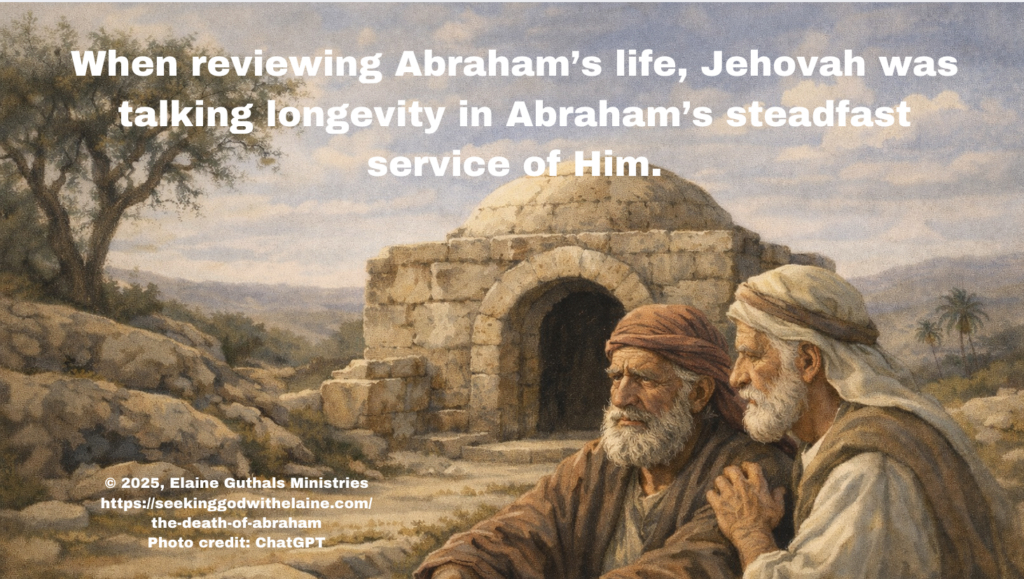
The New Living Translation called it joined with his ancestors. I’m used to hearing it said as gathered to his people.
Gathered to his people means more than Abraham was buried in the cave alongside Sarah. It meant that Abraham would be reunited with his ancestors who had died before him — Terah, Noah, Shem, and Seth.
Bradford said that this was different from the phrase went down to Sheol. It was not intimating an end.
Resource
Still there was no mention of Heaven. Bradford that the afterlife, while hinted at, was not addressed in depth. The existence of eternal life with Jehovah did not considered until the end of the Old Testament around 400 BC.
Maclaren had an interesting thought. How many times have we said that the bricks in Abraham’s Sanctification Road was built on bricks of his separation from things here in this life?
- Left his country and kin (Gen. 11: 31).
- Father died (Gen. 11: 32).
- Left Haran (Gen. 12: 1)
- Left Canaan for Egypt (Gen. 12: 10).
- Left Egypt (Gen. 12: 20).
- Separated from Lot (Gen. 13: 13).
- Separated from Ishmael (Gen. 21: 14).
- Almost separated from Isaac (Gen. 22: 10).
- Separated from Sarah (Gen. 23: 1-2).
- Separated from worldly possessions (Gen. 25: 5).
- Separated from life (Gen. 25: 7-8).
Now, Abraham was being gathered to his people. More importantly, he was being gathered to his Heavenly Father.
Whatever Abraham gave up, he was given more back because of his faithfulness.
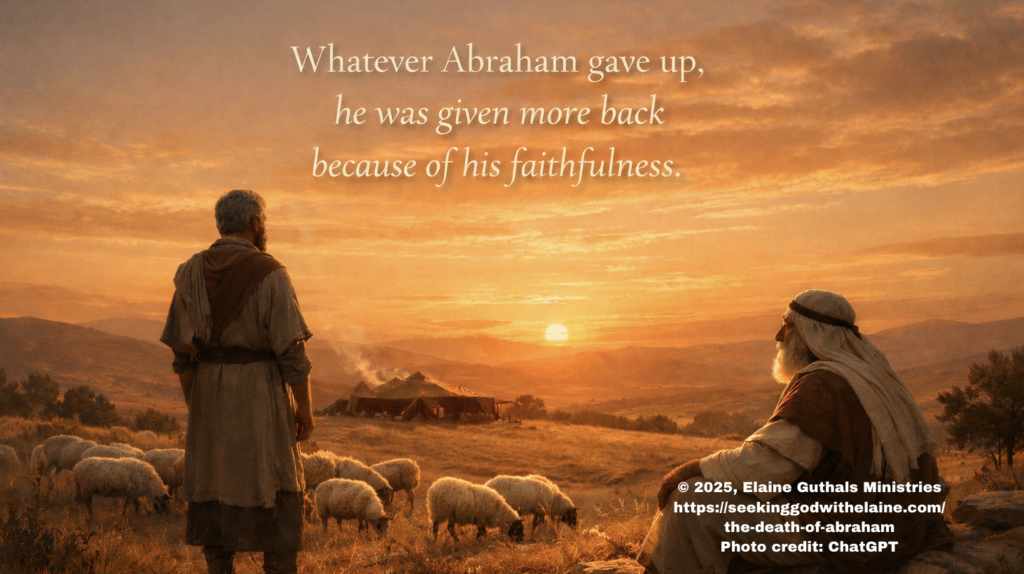
While it didn’t mention any of the other sons, Isaac and Ishmael were both present at Abraham’s burial. Leale called it a time of peace.
Resource
We know the illness and death of loved ones can tear families apart. Whatever animosity Isaac felt because of Ishmael’s treatment of him in life, he could stand side by side with him at the death of their father.
Making the Connections #1
Abraham had a rich life in his 175 years. He went from a nobody who worshiped false gods to the spiritual leader of a new nation.
- Abraham taught to remain faithful to Jehovah.
- He taught us to always be obedient even in the difficult missions.
- He taught us to remain pure even if it meant giving up that — especially those — who we dearly love.
- He taught us to build our relationship with Jehovah while we walk with Him.
- He taught us to honor Jehovah as He controls our lives.
- He taught us to wait on Jehovah no matter how long it takes for Him to fulfill His promises.
Making the Connections #2
Regardless of what sins Abraham committed in his life, he has been shown to us as a model of faithfulness.
- “It was by faith that Abraham obeyed when God called him to leave home and go to another land that God would give him as his inheritance. He went without knowing where he was going. And even when he reached the land God promised him, he lived there by faith — for he was like a foreigner, living in tents. And so did Isaac and Jacob, who inherited the same promise. Abraham was confidently looking forward to a city with eternal foundations, a city designed and built by God” (Heb. 11: 8-10 NLT).
- “It was by faith that Abraham offered Isaac as a sacrifice when God was testing him. Abraham, who had received God’s promises, was ready to sacrifice his only son, Isaac, even though God had told him, ‘Isaac is the son through whom your descendants will be counted.’ Abraham reasoned that if Isaac died, God was able to bring him back to life again. And in a sense, Abraham did receive his son back from the dead” (Heb. 11: 17-19 NLT).
- “Circumcision was a sign that Abraham already had faith and that God had already accepted him and declared him to be righteous — even before he was circumcised. So Abraham is the spiritual father of those who have faith but have not been circumcised. They are counted as righteous because of their faith. And Abraham is also the spiritual father of those who have been circumcised, but only if they have the same kind of faith Abraham had before he was circumcised” (Rom. 4: 11-12 NLT).
- “Abraham never wavered in believing God’s promise. In fact, his faith grew stronger, and in this he brought glory to God. He was fully convinced that God is able to do whatever he promises. And because of Abraham’s faith, God counted him as righteous. And when God counted him as righteous, it wasn’t just for Abraham’s benefit. It was recorded for our benefit, too, assuring us that God will also count us as righteous if we believe in him, the one who raised Jesus our Lord from the dead. He was handed over to die because of our sins, and he was raised to life to make us right with God” (Rom. 4: 20-25 NLT).
- “In the same way, ‘Abraham believed God, and God counted him as righteous because of his faith.’ The real children of Abraham, then, are those who put their faith in God” (Gal. 3: 6-7 NLT).
How Do We Apply This?
- Remain faithful to Jehovah.
- Be sanctified to have His character.
- Understand that we cannot altar Jehovah’s plan.
Resource
Father God. Thank You for the example of Abraham. Thank You for showing us what faith and obedience look like. Thank You for showing us we are rewarded for that even when we falter, sin, and repent. Amen.
If you don’t understand something and would like further clarification, please contact me.
If you have not signed up for the email providing the link to the devotions and the newsletter, do so below.
If God has used this devotion to speak with you, consider sharing it on social media.