Abraham had asked his trusted servant Eliezer to take a journey to find a wife for his son. This devotional reading looks at that journey and what he finds when he gets where he is going.
Nuggets
- Eliezer agreed to carry out the mission Abraham gave him.
- Eliezer prayed a sincere, humble prayer for a sign showing the success of his mission — a success that only Jehovah could give.
- Eliezer asked that Jehovah show to him who the wife for Isaac was in a specific way.
- Eliezer’s prayer was answered in the way he asked even before he finished praying because
- God was directing the events.
- Eliezer started passing out the gifts right away. He rewarded Rebekah for her kindness.
- Eliezer started passing out the gifts right away.
- Rebekah told her family of the encounter at the well.
- It seemed like Laban was performing the duties of the firstborn son.

Abraham had grown old, and his mind turned to grandchildren. But before he could get grandchildren, Isaac had to find a wife.
To find that wife, Abraham asked his trusted servant to go back to his family and find a wife.
Let's Put It into Context #1
To read devotions in the Creating Everything theme, click the button below.
Devotions in the Abraham the Patriarch series
Let's Put It into Context #2
Let’s get timing established again.
1890 BC — Terah, Abram, Sarai, and Lot moved from Ur to Haran (Gen. 11: 31)
1885 BC — Abram called at age 75 (Gen. 12: 1-3)
1823 BC – Sarah died (Gen. 23: 1)
c. 1823–1820 BC – Abraham sends Eliezer to Paddan-Aram to find a wife for Isaac (Gen. 24)
1820 BC – Isaac, at age 40, marries Rebekah (Gen. 25: 20)
Based on Timeline from
Good to Go
“So the servant took an oath by putting his hand under the thigh of his master, Abraham. He swore to follow Abraham’s instructions. Then he loaded ten of Abraham’s camels with all kinds of expensive gifts from his master, and he traveled to distant Aram-naharaim. There he went to the town where Abraham’s brother Nahor had settled. He made the camels kneel beside a well just outside the town. It was evening, and the women were coming out to draw water” (Gen. 24: 9-11 NLT)
Eliezer agreed to carry out the mission Abraham gave him.
Moses didn’t say Eliezer set off immediately, but it sounds like they started preparing right away. It would take time to get the provisions for that kind of trip in those days. It does sound like he set off at the first possible opportunity.
Gray reminded us that Eliezer did not go alone. No, he probably couldn’t wrangle ten camels on his own.
Security personnel would also have been needed. The camels were carrying a lot of expensive gifts. Someone might have thought they could take those off Eliezer’s hands.
Resource
We have to remember it would have been a long journey. They would be crossing land owned by warlike tribes.
So, Eliezer got to where he was going. Got Questions said it was a trip of some 450 miles.
Resource

When Sovereign God gives us a mission, that is how we are to approach it. We have to see it is from Him.
We can question but not in doubt or disobedience. We have to obey immediately.
We can and are supposed to depend on Jehovah. There are times we have to understand that He has given us others as a means to dispense that provision.
Carrying Out the Mission
“‘O Lord, God of my master, Abraham,’ he prayed. ‘Please give me success today, and show unfailing love to my master, Abraham. See, I am standing here beside this spring, and the young women of the town are coming out to draw water. This is my request. I will ask one of them, “Please give me a drink from your jug.” If she says, “Yes, have a drink, and I will water your camels, too!” — let her be the one you have selected as Isaac’s wife. This is how I will know that you have shown unfailing love to my master’” (Gen. 24: 12-14 NLT).
O Lord, God of My Master, Abraham
Eliezer prayed a sincere, humble prayer for a sign showing the success of his mission — a success that only Jehovah could give.
I don’t see Eliezer’s choice of words “‘O Lord, God of my master, Abraham,’…” (Gen. 24: 12 NLT) as indication that Eliezer didn’t have his own belief.
Eliezer had been circumcised; but unless he had circumcision of the heart, that didn’t mean anything. Still, he believed enough that he prayed for the success of his mission.
But let’s look at this in the Hebrew. “… Hashem Elohei adoni Avraham …” (Gen. 24: 12 OJB).
Hashem means The Name, Elohim refers to God, and Adonai translates to Lord. Yeah. Eliezer called on the Name of the Lord.
The whole purpose of the mission was to advance Jehvoah’s covenant with Abraham. God made the covenant with Abraham, not Eliezer. He was just reminding Sovereign God of that promise – not that He needed the reminder.
Eliezer was removing himself from the equation. He was a humble man of integrity who wanted his mission to succeed.
To me, it shows Eliezer had faith and was a man of integrity. He not only prayed for the success of his mission, but he also prayed that it would come to fruition quickly.
The Complete Jewish Bible backs that up with better wording. “He said, ‘Adonai, God of my master Avraham, please let me succeed today; and show your grace to my master Avraham’” (Gen. 24: 12 CJB emphasis added).
Today. Right now.
No, the man who used to be Abraham’s heir didn’t try to drag things out. He wanted success soon.
Was Eliezer putting limits on Sovereign God? No. He was plugging into His mercies and grace for that day.
Give Me a Drink
Eliezer asked that Jehovah show to him who the wife for Isaac was in a specific way.
No, Sovereign God didn’t mind the fleece that Eliezer threw out. It wasn’t like Gideon’s fleece, that convinced him He really was talking to him (Jdg. 6: 36-40).
Bradford thought this showed that Eliezer was worrying. I don’t think so – at least not anything overly unusual.
Resource
Eliezer wasn’t doubting that Jehovah could and would do what He said. He was counting on Him to give him direction.
This was more of a you-show-me-whom-You-have-picked deal. Eliezer didn’t want any mistake on his part. To him, this was too important a decision to be made on his own.
Wasn’t that the whole purpose of the prayer? “I don’t know these people. You do. Not only that, but You already know whom You have picked out. Just clue me in.”
It was even more than that. It was, “I only see the outside. You see the heart” — the most important quality Isaac’s bride can have.
When God sends us out on a mission, He has already prepared the field. He goes before us, with us, and behind us.
It isn’t us working. It is God working through us.

I can see where Eliezer might have been feeling the weight of his responsibilities. If he could have chosen any woman from Paddan-Aram, that would have been one thing. He specifically had to go back to Abraham’s family and get a niece.
Remember the correspondence Abraham got at the end of Genesis 22? That would have helped Eliezer’s mission. He at least knew some of the players.
The prayer Eliezer prayed was genuine and sincere. He wanted the best wife for Isaac — and he wanted Jehovah to pick her.
Yes, Sovereign God was answering Abraham’s prayers, but Eliezer was the one saying these words. He had to have faith to remove the obstacles of sin his prayer life.
Establishing Contact
“Before he had finished praying, he saw a young woman named Rebekah coming out with her water jug on her shoulder. She was the daughter of Bethuel, who was the son of Abraham’s brother Nahor and his wife, Milcah. Rebekah was very beautiful and old enough to be married, but she was still a virgin. She went down to the spring, filled her jug, and came up again. Running over to her, the servant said, ‘Please give me a little drink of water from your jug.’ ‘Yes, my lord,’ she answered, ‘have a drink.’ And she quickly lowered her jug from her shoulder and gave him a drink. When she had given him a drink, she said, ‘I’ll draw water for your camels, too, until they have had enough to drink.’ So she quickly emptied her jug into the watering trough and ran back to the well to draw water for all his camels. The servant watched her in silence, wondering whether or not the Lord had given him success in his mission” (Gen. 24: 15-21 NLT)
Eliezer’s prayer was answered in the way he asked even before he finished praying because God was directing the events.
Enter Rebekah. Her name is interesting, Davison said that it means winning in character and fast in friendship.
Resource
Look at Davison’s list of Rebekah’s character traits.
- Religious
- Calm
- Self-controlled
- Courteous
- Modest
- Obliging
- Strong
- Decisive
That is a good list to have.
On that day at the well, Rebekah was just going about her day. She would have gone to the well as part of her household duties.
According to CrossTalk, she was probably in her mid-teens, the normal age for a girl to marry in that society.
To me, this is logical. If betrothal occurred when the woman was as young as three, a younger person would not have been going to the well or asked to make her own decisions.
Resource
Besides, nothing was ever said about a betrothal.
Bradford explained why it was smart for Eliezer to go to the well. He wrote,
“And, here we see something we’ll encounter often in the Bible: a woman, or women, coming to the well to fetch water. This is not a romantic notion or some literary device; women of the Middle East in that era stayed separate from men for the most part. There were certain times of the day when it was understood that women would go to the water well, or to a spring or a river, to draw water…..a standard task for women…..and usually men would not be around. This was all about traditional modesty. And, in particular this applied to unmarried girls and young women. Therefore, often when we get a narrative about a male Bible character encountering a woman at the well or spring, there is this sense of surprise…..the girl is startled….at the site or voice of a man.”
Resource
In other words, if you wanted to find a girl, go the well.
But remember, not just any girl would do. And Jehovah answered Eliezer’s prayer even before he was done praying it.
Let’s take a look at the family chart again.
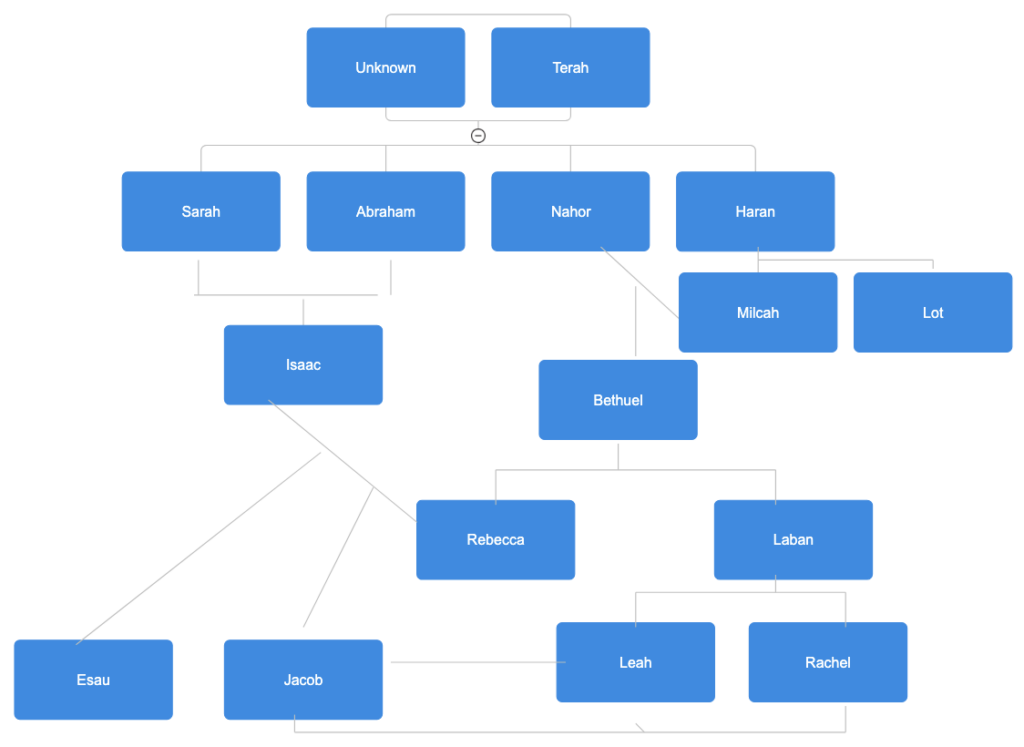
Look what Eliezer did. “Running over to her …” (Gen. 24: 17 NLT). I thought Jewish men didn’t run.
Eliezer was smart. If he asked for a drink for only himself, the lady he asked might just get a drink for him.
But if she got water for his camels without being asked, it showed her industry, kindness, compassion, and hospitality — along with it being a clear sign that this lady was the one.
Rebekah got enough water for the camels until they had satisfied their thirst.
So, Eliezer thought his mission was complete? No.
Rebekah getting the water for his camels was the satisfaction of his prayer. Abraham, though, has another requirement for Isaac’s wife. She had to be from his clan.
Eliezer watched Rebekah, not forging on ahead but waiting on Jehovah.
Making Himself Known
“Then at last, when the camels had finished drinking, he took out a gold ring for her nose and two large gold bracelets for her wrists. ‘Whose daughter are you?’ he asked. ‘And please tell me, would your father have any room to put us up for the night?’ ‘I am the daughter of Bethuel,’ she replied. ‘My grandparents are Nahor and Milcah. Yes, we have plenty of straw and feed for the camels, and we have room for guests.’ The man bowed low and worshiped the Lord. ‘Praise the Lord, the God of my master, Abraham,’ he said. ‘The Lord has shown unfailing love and faithfulness to my master, for he has led me straight to my master’s relatives’” (Gen. 24: 22-27 NLT)
Eliezer started passing out the gifts right away.
Remember, Eliezer brought camels bearing gifts. “Then he loaded ten of Abraham’s camels with all kinds of expensive gifts from his master …” (Gen. 24: 10 NLT). He rewarded Rebekah for her kindness.
This was a normal custom in that period, according to Malisch. He wrote a lengthy description on what was in the camel’s load. He wrote,
“Golden trinkets were abundantly used among most of the Asiatic nations from early times; and those which Abraham’s servant offered to Rebekah (ver. 22) belong to the most common ornaments. The nose-ring, chiefly, though not exclusively, worn by men, and applied by American tribes also, is inserted in the cartilage of the nose, either in the middle or in one side; it is often of considerable size, reaches generally beneath the mouth, and not always contributes to enhance the beauty of the face.”
Resource
The sermon went on to describe other trinkets worn by men. Yeah, I thought they would be do for Rebekah, too.
The gifts Eliezer gave to Rebekah was a symbol of commitment. I don’t know how many girls Rebekah knew that were chosen from marriage about five minutes after they met the guy negotiating the deal. She probably needed – maybe consciously, maybe unconsciously – to have some reassurance this guy was trustworthy.
These gifts would have been expected. They constituted a dowry, which was custom in those days. These gifts would have shown Rebekah what kind of family she would be marrying into.
All in all, these gifts would have been the invitation to welcome Rebekah into the family.
Eliezer found out that the second requirement was met. Rebekah was a part of Abraham’s family.
Hospitality kicked in then. Eliezer may have been asking about lodging for the evening, but he also knew he had to talk to her father.
Eliezer gave praise where praise was due. Jehovah took him straight to Abraham’s family.
Success of the Mission
“The young woman ran home to tell her family everything that had happened. Now Rebekah had a brother named Laban, who ran out to meet the man at the spring. He had seen the nose-ring and the bracelets on his sister’s wrists, and had heard Rebekah tell what the man had said. So he rushed out to the spring, where the man was still standing beside his camels. Laban said to him, ‘Come and stay with us, you who are blessed by the Lord! Why are you standing here outside the town when I have a room all ready for you and a place prepared for the camels?’” (Gen. 24: 28-31 NLT).
Ran Home
Rebekah told her family of the encounter at the well.
Another indication of Rebekah’s age is in Genesis 24: 28 in the Hebrew. “And the na’arah [a girl from infancy to adolescence] ran, and told them of her bais em these things” (Gen. 24: 28 OJB emphasis added).
Gray wondered whether Rebekah was late getting home. Were they concerned?
Resource
Then Rebekah got home, showing presents. What did they think then?
Brother Named Laban
It seemed like Laban was performing the duties of the firstborn son.
Why did Laban go to greet Eliezer? He was Rebekah’s brother, not father.
I had assumed that Bethuel was dead, and Laban was the firstborn.
Bradford observed that Laban served as if he were the guardian responsible for overseeing the unmarried women of the clan.
Also, Bradford noted how much of a big deal meeting a stranger was at that time. If he had known Eliezer before, many years had passed since they had seen each other — over 60 years. Both looked much differently now.
Resource
Is it significant that Moses or the writer of Genesis said that Laban saw the gifts before he heard the story of who the man was? Maybe. We’ll find out what kind of a man he became in a few chapters.
For now, we’ll just say that Laban thought Eliezer was blessed, not necessarily Abraham. Schmoozing? Probably.
Laban probably thought — if he worked it right — he could get some of that wealth for himself.
I thought Laban’s greeting was interesting. “Laban said to him, ‘Come and stay with us, you who are blessed by the Lord! …’” (Gen. 24: 31 NLT). In the Hebrew it was Baruch Hashem. That means bless the Lord or praise the Lord.
At least Laban knew of Jehovah. I am sure Laban grew up with stories about how great grandpa took off, and great-uncle was called.
Making the Connections #1
One thing that runs through this chapter is the prayerful way in which a wife for Isaac was chosen.
The only stipulation Abraham put on the choosing process was that it had to be someone from his family. He didn’t say, “Jehovah told me who exactly it is going to be.”
Eliezer prayed, “Jehovah, You choose. Let me know by water from the well.” (Well, we do know we are to go to the well for living water.)
We’ll find out that Isaac prayed as he walked and meditated (Gen. 24: 55). “I don’t know where they are in the process. So, I don’t know when I am going to get to meet her. But I know You are in control and working it out.”
Bottom line is Isaac got what he wanted because he loved Rebekah deeply (Gen. 24: 67).
Making the Connections #2
Eliezer knew this was not some small piece of Isaac’s life — even though Jehovah wants to be God of the small things. He knew that this was the continuation of Abraham’s line — all the way down to the Messiah.
That was a huge thing. Thankfully, He is God of the big things, too.
How Do We Apply This?
- Always go to Sovereign God in prayer in all things.
- Don’t limit Jehovah.
- Wait on Him.
- Communicate with Jehovah through grace.
- Remember He may answer prayers immediately or He may wait.
Resource
Father God. You have the perfect spouse for us. Please let our husbands be as prayerful as Isaac. Let our wives be as obedient to You as Rachel. Bless our unions as You did theirs. Amen.
If you don’t understand something and would like further clarification, please contact me.
If you have not signed up for the email providing the link to the devotions and the newsletter, do so below.
If God has used this devotion to speak with you, consider sharing it on social media.