Blog

  • Controlling Our Thoughts through Contemplation and Praise

    We can control our thoughts when we take it outside of ourselves. This daily devotional looks at looking to the heavens and raising our praises to God to help us control our thoughts.

    Nuggets

    • Contemplating the beauty and majesty of our world can calm our thoughts and give us peace.
    • Praising God helps us to control our thoughts.

    To read devotions in the Redo for Godliness series, click the appropriate button below.

    Devotions in the How Do We Live Godly Lives? series

    We can be so insular at times. That doesn’t help when we get locked into the thoughts in our heads.

    There are times we need to break out of that. We can do that by contemplating on the heavens and praising God.

    We are looking at Charnock’s sermon entitled The Sinfulness and Cure of Thoughts to show us how to cleanse, a.k.a. sanctify, our thought processes.

    Resource

    Let’s Put It into Context

    Here is a running list of what we’ve discussed previously.

    Using Objects for Spiritual Influence

    “When I look at your heavens, the work of your fingers, the moon and the stars, which you have set in place, what is man that you are mindful of him, and the son of man that you care for him?” (Ps. 8: 3-4 ESV)

    “Draw spiritual inferences from occasional objects. David did but wisely consider the heavens, and he breaks out into self-abasement and humble admirations of God (Psalm 8:3, 4)” (Charnock, The Sinfulness and Cure of Thoughts)

    Contemplating the beauty and majesty of our world can calm our thoughts and give us peace.

    This has long been a favorite verse of mine. What I see David saying is look up. We see a big, beautiful sky. Sometimes, it is blue. Sometimes gray. Sometimes black.

    At times, there is not a cloud in the sky. At other times, we can have fun picking out shapes in the clouds.

    Move on beyond that, we find stars, moons, and other planets. That leads to galaxies, black holes, and nebulas — along with a lot of other stuff.

    God created all of that.

    And we think He can’t handle anything that comes up in our lives? Wrong!

    David knew that He could rely on God. Witherspoon wrote, “The words carry a general confession of the influence of Divine Providence upon every event, and in particular with respect to salvation, or deliverance from impending danger.” Providence is God’s acts of meeting the needs of His creation.

    Resource

    We can be confident that God will provide for us. God is omnipotent. Omnipotent means God is all-powerful.

    To read a related devotion, click the button below.

    When we contemplate all of this, it should help us simmer down our thoughts. We aren’t in this alone. We are in this with Someone Who is much stronger than us.

    When we contemplate how trustworthy God is, we can control our thoughts and be content.

    When we contemplate how trustworthy God is, we can control our thoughts and be content.

    Using Praise to Secure Blessings

    “Salvation belongs to the Lord; may your blessing be on your people. Selah” (Ps. 3: 8 CSB)

    “Glean matter of instruction to yourselves, and praise to your Maker, from everything you see; it will be a degree of restoration to a state of innocency, since this was Adam’s task in paradise” (Charnock, The Sinfulness and Cure of Thoughts)

    Praising God helps us to control our thoughts.

    Another way to corral our thoughts is to praise God. Praising Him brings blessing upon us.

    Blessings don’t mean just gaining material possessions and happiness. Birch said that it was “not merely when we have what we wish, but far more when we do not wish what we have not.”

    Resource

    Salvation is the greatest blessing that we can be given.

    • Salvation is the gift of life through the deliverance from condemnation and sin to acceptance and holiness and changes us from being spiritually dead to spiritually alive.
    • Sins are actions by humans that disobey God and break one of His reasonable, holy, and righteous laws and commandments, goes against a purpose He has for us, or follows Satan’s promptings.
    • Holiness is the transcendent excellence of His nature that includes elements of purity, dedication, and commitment that lead to being set apart. Purity means possessing God’s moral character, having eliminated the stain of sin.
    • Spiritual death is the spiritual separation from God that occurred as a consequence of Adam and Eve’s original sin. The spiritually alive are those who have ABCDed, so they are no longer separated from God.

    The ABCDs of Salvation

    If you have not become a believer in Christ, please read through the
    Plan of Salvation and prayerfully consider what God is asking you to do.

    A – admit our sins
    B – believe His Son Jesus is our Redeemer
    C – confess God as Sovereign Lord

    D – demonstrate that commitment by making any changes needed in our lives to
    live the way in which God has called us

    The Disciple’s Job Description

    Glossary

    We have so much for which to praise God.

    Parker gave us a great way to determine if we are being blessed. He wrote, “When you feel that you must do more work, God’s blessing is upon you. Be sure of that confidence. When you want to be idle, God has withdrawn from you because you have withdrawn from Him.”

    Resource

    I get that. When we are gung-ho for God, work isn’t work. It is a joy — it is praise. We feel Him there every step of the way.

    When God isn’t there because we have turned away, it is a struggle. It is work. There is no joy.

    Kennion had an interesting sermon entitled The People of God. In the Old Testament, the nation of Israel was declared to be the people of God.

    In the New Testament, Jesus clarified that. He said that we must individually become children of God. Kennion wrote, “We are redeemed, not with corruptible things, such as silver and gold, but with the blood of Christ.”

    Resource

    We have to become children of God to fully praise Him and know His blessings. He won’t bless us if we are not following His laws and commandments.

    We have to become children of God to fully praise Him and know His blessings.

    Making the Connections

    Okay. Let’s recap the previous two devotions for a second plus add in what we’ve said here. Charnock has taught us so far that we cleanse our thoughts when we return to having a strong relationship with God. We can do that by studying the Scriptures, meditating on God, contemplating on His creation, and praising Him.

    What all of this is telling me is we need to focus on God. We look up; we dig deep into His Word; we surround ourselves with Him.

    I know. That can be hard when we are in the midst of all the chaos. It is also hard when we are hurting because we just don’t see a purpose or an end.

    ControllingOurThoughtsThroughContempationAndPraisePin

    How Do We Apply This?

    Through it all, we have to focus on God. We have to do more than what we regularly do if we feel we are in a really bad spot.

    If we do daily devotions, we have to do a deeper dive into Scriptures. We have to schedule extra prayer time.

    For the past three years, I’ve gone on two-day retreats by myself. I don’t think I am going to get to go this year, and that makes me very sad.

    We have to find our way to shut ourselves off from the world and focus fully on Him.

    Lord, I Have Shut theDoor
    Vocalist: Elaine Guthals
    Keyboard: Chris Vieth

    Meditating on God means thinking on Him. We do that by praising Him and acknowledging Who He is.

    Father God. We praise You. We honor You. We will focus our thoughts on You. Amen.

    What do you think?

    Leave me a comment below (about this or anything else) or head over to my Facebook group for some interactive discussion.

    If you don’t understand something and would like further clarification, please contact me.

    If you have not signed up for the email daily or weekly providing the link to the devotions and the newsletter, do so below.

    If God has used this devotion to speak with you, consider sharing it on social media.

  • Controlling Our Thoughts through Meditation

    In order to live godly lives, we need to control our thoughts. This daily devotional looks at how we control our thoughts by meditating on God through the sanctification process.

    Nuggets

    • Meditating on God helps us in the sanctification process.
    • Our thoughts are a good indicator of who we are.
    • Meditation puts us in the presence of the Sovereign God and our Redeeming Savior.

    To read devotions in the Redo for Godliness series, click the appropriate button below.

    Devotions in the How Do We Live Godly Lives? series

    We are looking at Charnock’s sermon entitled The Sinfulness and Cure of Thoughts to show us how to cleanse, a.k.a. sanctify, our thought processes.

    Resource

    We can do that through meditation. This isn’t Eastern meditation.

    This is Scriptural meditation. “I will meditate on your precepts and fix my eyes on your ways” (Ps. 119: 15 ESV).

    It is thinking thoughts the right way.

    Let’s Put It into Context #1

    Here is a running list of what we’ve discussed previously.

    Let’s Put It into Context #2

    Phillips had a really good definition on meditation. He wrote, “Meditation is the action of the thoughts upon subjects which present themselves to the mind.”

    Resource

    Don’t we sometimes think that meditation is just the thinking part? It is also the action in the form of planning. It has an element of evaluation in it.

    Meditating on God

    “Oh how I love your law! It is my meditation all the day” (Ps. 119: 97 ESV)

    “Ballast your heart with a love to God. David thought all the day of God’s law, as other men do of their lusts, because he inexpressibly loved it”

    “I hate the habit of faith is attended with habitual sanctification, so the acts of faith are accompanied with a progress in the degrees of it. That faith which brings Christ to dwell in our souls will make us often think of our Inmate” (Charnock, The Sinfulness and Cure of Thoughts)

    Meditating on God helps us in the sanctification process.

    We are going to start this out with a kind of funky quote from Charnock. We get the first part. Meditating stabilizes our hearts and minds and calms us as we think about the love of God.

    Charnock wrote that he hated that sanctification was a process. The way I read that was he would have rather it would have been a one-time gift.

    We probably all have felt that way at some point or another. Instead, we get the struggle.

    That struggle is caused by the fact that, even though we are new creations, our old sinful nature is still within us. Satan is still trying his best to get us to sin against God.

    Glossary

    Yes, that does present itself in our actions. It begins, however, in our thoughts. That is where Satan launches his attack.

    That is where we must shore up our defenses.

    Enter the meditating all day. If we are thinking of God all day, there is no room for Satan to get a toehold.

    If we are thinking of God all day, that makes Him the Inhabitant — the Inmate — of our heart.

    Meditating for Us

    “For as he thinketh in his heart, so is he: Eat and drink, saith he to thee; but his heart is not with thee” (Prov. 23: 7 KJV)

    “Accustom yourself to a serious meditation every morning. Fresh-airing our souls in heaven will engender in us a purer spirit and nobler thoughts. A morning seasoning would secure us for all the day. In this meditation, look both to the matter and manner. First, Look to the matter of your meditation. Let it be some truth which will assist you in reviving some languishing grace, or fortify you against some triumphing corruption; for it is our darling sin which doth most envenom our thoughts …” (Charnock, The Sinfulness and Cure of Thoughts)

    Our thoughts are a good indicator of who we are.

    Tuck wrote that our thoughts tell God the intent of our hearts. Words and actions can be manipulated to portray any motive we want. Our thoughts are more authentic.

    Resource

    Our journey on the Sanctification Road includes sanctification of our thoughts. That means that we can learn to control them.

    I know. There are many times that we don’t think we can.

    We can, but only with God’s help.

    Have you ever considered that sin generally comes from our thoughts? Even when it has a visual or auditory component, we have to consider whether we will give into the temptation.

    Maybe that is why it is so hard to corral our thoughts after we become disciples! Satan doesn’t want to give up that inroad to getting us to deny God.

    We have some control. It isn’t a free-for-all in our minds. And Satan does slap evil thoughts into our minds.

    Tuck wrote “Thinking is the combining, comparing, and rearranging of the actual contents of the mind.”

    Resource

    One phrase that caught my attention was when Tuck said the power of renewed will.

    • Yes, it is a habit.
    • Yes, it is a redo.
    • The power is from God through the Holy Spirit, Who lives within us.

    Tuck identified what it feels like to not regulate our thoughts: helplessness.

    Think about when we get our thoughts corralled. We can’t say it is us mastering ourselves. It is all God. “Search me, O God, and know my heart! Try me and know my thoughts!” (Ps. 139: 23 ESV).

    But it is about knowing ourselves. Walter wrote, “The thoughts of men’s hearts do evidence what their spiritual state is.”

    Resource

    But then it seems Walters contradicts himself. He said that our heartbroken thoughts doesn’t tell us the state of our souls.

    Hmmm. Isn’t that when we tell ourselves that we are at rock bottom all the way around? Isn’t that when we tell ourselves we are worthless?

    That is when, though, our thinker is impaired. We’re not combining, comparing, and rearranging in the undamaged order.

    We’ve been looking at character all year. Mitchell told us that our character finds its home in our heart. Clifford called our thoughts the index of character. Cuyler stated that “The character of a man’s thoughts determines the character of his life.”

    Resource

    We express ourselves through our actions. Our thoughts show our purpose.

    If we think of the Sanctification Road as a progress — really — life is, too. Clifford contends that sanctification utilizes our thoughts to accomplish regeneration. Regeneration is being changed from spiritually dead to spiritually alive and the internal requickening in us that God brings about through the work of the Holy Spirit to give us new character. Spiritual death is the separation from God that occurred as a consequence of Adam and Eve’s original sin. The spiritually alive are those who have ABCDed, so they are no longer separated from God.

    The ABCDs of Salvation

    If you have not become a believer in Christ, please read through the
    Plan of Salvation and prayerfully consider what God is asking you to do.

    A – admit our sins
    B – believe His Son Jesus is our Redeemer
    C – confess God as Sovereign Lord

    D – demonstrate that commitment by making any changes needed in our lives to
    live the way in which God has called us

    The Disciple’s Job Description

    I almost didn’t put that. To me, the progression is salvation, regeneration, sanctification, perfection.

    I can see what Clifford is saying if we look at regeneration as one of the past, present, and future words. I was regenerated at the moment of salvation. I am in the process of being regenerated through salvation. Once eternity begins, I will fully be regenerated.

    “May my meditation be pleasing to him, for I rejoice in the LORD” (Ps. 104: 34 ESV)

    Secondly, Look to the manner of it. First the glances of the eye, soon on and soon off; they make no clear discovery, and consequently raise no sprightly affections. Secondly, Let it be affectionate and practical. Meditation should excite a spiritual delight in God, as it did in the Psalmist: ‘My meditation of Him shall be sweet: I will be glad in the Lord’ (Psalm 104:34); and a Divine delight would keep up good thoughts, and keep out impertinencies” (Charnock, The Sinfulness and Cure of Thoughts)

    Meditation puts us in the presence of the Sovereign God and our Redeeming Savior.

    Horton gave us a really good history on the Hebrew meaning of meditation. It has three aspects to it.

    The first is the aspect of meditation. We examine our thoughts, which, as Horton wrote, “… are of great importance to us, and that as they are a very great discovery of the frame and temper of our hearts.” Thoughts that stick show who we really are.

    Resource

    The second is the aspect of prayer. Horton talked about conversing and communing with God. By doing this, we find contentment.

    Spurgeon reminded us that meditation is not lazy. When we think on God, we lay the best possible foundation we could have.

    Spurgeon also reminded us that it is our meditation. “May my meditation be pleasing to him, for I rejoice in the LORD” (Ps. 104: 34 ESV emphasis added). This is our connection with God.

    Resource

    The third is the aspect of discourse. Horton said this was the communion of the saints. He wrote, “Christians find a great deal of contentment in holy and religious communication; not only when they think upon Him within themselves, which is meditation, not only when they speak unto Him, which is done in prayer, but also when they speak of Him, and about Him in converse, and Christian discourse.”

    Resource

    I know. That takes the scenic route to the period. What Horton is saying is our meditation and conversations with God spill over into our conversations with others.

    The Weekly Pulpit had an interesting description of meditation. They said that “it is not the pressing act of mind, as when pursuing knowledge, or seeking to unravel some mystery, but the mind, in its own seclusion, dwelling calmly and seriously on matters affecting life and death.”

    Resource

    I like Garbett’s description of calling meditation attentive thought. We must focus our thoughts away from worldly things and put it solely on God.

    Resource

    Think about how this clears our thoughts. We go from the chaotic, divisive thoughts of this world to God’s pure and holy thoughts.

    We talked in Where Is the Balance? about the work of God. His working in us is the only way we are going to know Him.

    We must focus our thoughts away from worldly things and put it solely on God.

    To read a related devotion, click the button below.

    Part of that is remembering. Reflecting back on something that has happened can impact us more now than it did at the time.

    That may be because we are out of the heat of the moment. We can evaluate it better. Maybe we can hook it to other experiences that we can’t pull up in the chaos of the event.

    This introspection does help us slow down and think about what is important. It gives us time to consider what God wants us to be and do and allows us to plan to do that.

    Meditation leads to what Bogg called moral excellence. He defined it as “… that which renders them at all attractive, and to the reflecting, and cultivated mind, is the direct object of esteem and love.”

    Resource

    Oh, wait. That reflecting and cultivated mind kind of slipped in there on me. I wasn’t expecting that.

    But doesn’t that fit? It is apt. It combines the thinking and the work that it takes to think and plan.

    To me, our moral excellence is what we are striving for. It is doing what is right and not doing what is wrong God’s way.

    ControllingOurThoughtsThroughMeditationPin

    Making the Connections

    We control our actions. We can control our thoughts and feelings through meditating on God. Horton wrote, “God’s servants are much employed and taken up in the thought of God, in holy and Divine meditation.”

    Resource

    I liked what Bogg said. He wrote, “IN ALL THESE CHARACTERS OUR MEDITATION OF HIM SHOULD DELIGHT THE SOUL; because all that is great, and excellent, and glorious, and good, and attractive, passes before our minds in contemplating the character, the works, the ways, and the purposes of God; objects, the contemplation of which, not only gives scope for the exercise of its noblest powers, but excites all the most pleasing affections of the soul; reverence, esteem, love, gratitude, faith and hope.”

    Resource

    How Do We Apply This?

    Horton said that when we are engaged in prayer, reading and hearing the Word, and other godly activities, they promote holy thoughts and meditations.

    Resource

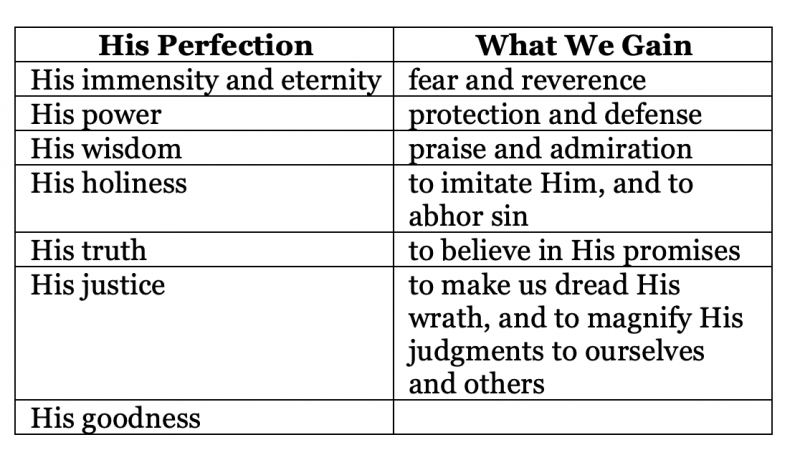
    Hannam gave us a little more direction on how to apply our meditation. He said we should meditate on God’s perfections and told us what we gain.

    MeditationOnGodsPerfection

    What I get from all of this is we need set times to do the thinking. Oh, yeah. We all can have our moments when we turn on the reflections. But this is talking about a defined, intentional process to tie into God’s plan for our lives.

    We shouldn’t leave our meditation to chance. But so often, we do (four fingers pointing back at me, here).

    Shedd reminded us that our happiness depends on the quality of our thoughts. When God is the focus of our thoughts, our happiness is secured.

    Resource

    Father God. We want to meditate on You all day long. Help us to think on You in our hearts and in our minds so that we may please You. Amen.

    What do you think?

    Leave me a comment below (about this or anything else) or head over to my Facebook group for some interactive discussion.

    If you don’t understand something and would like further clarification, please contact me.

    If you have not signed up for the email daily or weekly providing the link to the devotions and the newsletter, do so below.

    If God has used this devotion to speak with you, consider sharing it on social media.
  • How Do We Overcome the Corruption of Bad Thoughts?

    We are on the Sanctification Road to become more like God. Beginning a study on thoughts and meditation, this daily devotional looks at studying Scripture and returning to our first love.

    Nuggets

    • Studying the Scriptures cleanses bad thoughts.
    • We cleanse our thoughts when return to having a strong relationship with God.

    To read devotions in the Redo for Godliness series, click the appropriate button below.

    Devotions in the How Do We Live Godly Lives? series

    How Do We Use Our Thoughts through Meditation?
    How Do We Prevent Bad Thoughts?
    How Do We Order Our Evil Thoughts?
    How Do We Focus on Good Thoughts?

    We’re going to be looking at part of Charnock’s sermon entitled The Sinfulness and Cure of Thoughts. His intent was to show us how to cleanse, a.k.a. sanctify, our thought processes. He described our thoughts as the “… inward operations of the souls of men …”

    I love how Charnock described how described what happened when Satan tempted Adam and Eve. He wrote, “Original corruption stuffs us with bad thoughts …”

    Resource

    That made me laugh. It also made me feel like a Thanksgiving turkey.

    Let’s start off by seeing how Charnock suggested we cleanse those bad thoughts.

    Studying Scripture

    “And it is my prayer that your love may abound more and more, with knowledge and all discernment so that you may approve what is excellent, and so be pure and blameless for the day of Christ” (Phil. 1: 9-10 ESV)

    Studying the Scriptures cleanses the bad thoughts.

    Let’s address the last verse first. We are doing the redo for godliness so that we can improve. That improvement equates to successfully completing the Sanctification Road.

    Our goal is to be “… pure and blameless for the day of Christ” (Phil. 1: 10 ESV). That will lead to perfection.

    We get to perfection through prayer, love, knowledge, and discernment. Charnock focused on the knowledge part of the verse. He zeroed in on studying the Scriptures. Still, the knowledge increases our prayer, love, and discernment.

    We get to perfection through prayer, love, knowledge, and discernment.

    Let’s focus on the knowledge and love. The two are linked together. Knowledge is needed to grow love.

    That being said, Liddon wrote, “He [Paul] does not pray that their knowledge may abound more and more in love. Whenever knowledge and love are put in competition, the precedence is always given to love. As compared with knowledge love is intrinsically stronger, and worth more practically.”

    Resource

    Liddon argued that thought must also be linked with love and knowledge. Gordon agreed. He wrote, “Knowledge reveals character and character draws out love.”

    Resource

    Isn’t it true that we lack knowledge of the Scriptures? I know for years I didn’t study them like I should have. We don’t give reading them the priority we should. That doesn’t even address studying them and meditating on them.

    Knowledge supplies the foundation for love. We can’t love something about which we know nothing.

    Emmons reminded us that this won’t be perfect knowledge. We aren’t God. God isn’t going to tell us everything. Some of what He tells us, we aren’t going to understand.

    But Emmons had it right. We have to love the True God. We can’t say we love God because He gives a pass to sinners. Sinners are all people who have not made a genuine profession of faith — who have not sincerely ABCDed.

    The ABCDs of Salvation

    If you have not become a believer in Christ, please read through the
    Plan of Salvation and prayerfully consider what God is asking you to do.

    A – admit our sins
    B – believe His Son Jesus is our Redeemer
    C – confess God as Sovereign Lord

    D – demonstrate that commitment by making any changes needed in our lives to
    live the way in which God has called us

    The Disciple’s Job Description

    God really doesn’t overlook sin. He gives a pass to sinners who repent. Repentance is acknowledging our separation from God and expressing sorrow for breaking God’s laws and commandments by making the commitment to changing ourselves through obedience so that we no longer do the wrong things.

    Resource

    It is clear that, in order to know God, we have to search for Him and seek Him. It can’t be a halfhearted encounter.

    Searching for and Seeking God

    Hearing His Word (Rom. 10: 17).
    Reading His Word (Rev. 1: 3).
    Praying to Him (Heb. 4: 16).
    Studying His Word (Ac. 17: 11).
    Meditating on His Word (Ps. 1: 1-2).
    Memorizing His Word (Ps. 119: 11).

    We must delve into the Scriptures to find the many facets of the Sovereign God. We do that not only by hearing and reading His Word, but by studying it, meditating on it, and memorizing it.

    We must bathe all of that with prayer. Prayer is a two-way communication with God in which we pour out our soul to Him. It is only through this direct communication do we truly come into contact with our Heavenly Father.

    Returning to Our First Love

    “But I have this against you, that you have abandoned the love you had at first” (Rev. 2: 4 ESV)

    We cleanse our thoughts when return to having a strong relationship with God.

    We’ve talked about falling away from our first love before. Jesus accused the Church of Ephesus of doing this.

    To read a devotion in the First Love series, click on the appropriate button below.

    We’ve considered about this overall. However, we did not look at this through the lens of losing our first love through our frame of mind. Let’s see what we can see.

    “Reflect often upon the frame of your mind at your first conversion. None have more settled and more pleasant thoughts of Divine things than new converts when they first clasp about Christ, partly because of the novelty of their state, and partly because God puts a full stock into them; and diligent tradesmen at their first setting up, have their minds intent upon improving their stock. Endeavour to put your mind in the same posture it was then” (Charnock, The Sinfulness and Cure of Thoughts)

    Our thoughts play a role in salvation and returning us to our first love.

    Let’s start with a review. Our faith begins in our mind. Jay wrote, “All religion commences in serious thought. There is nothing more useful than self-recollection; there is no means better for reviving the soul than a review of former experiences.”

    Resource

    That is where it starts before we get it to the heart level. However, thoughts continue to play a role.

    Mitchell argued that it is difficult to identify when disciples have lost their first love. He wrote, “The soul itself is perhaps hardly conscious of it. Or if conscious of anything, it is that prayer is not so easy and pleasant as it used to be, that the thoughts are more wandering, that temptation is more attractive, and thanksgiving is irksome, unreal, and unblessed. The whole tendency of our being is to deteriorate.”

    Resource

    Oh, yeah. Those wandering thoughts get us every time.

    But these thoughts also help us, don’t they? They are how we evaluate ourselves.

    If our thoughts are wandering all over kingdom come, it is harder to corral them to take an in-depth assessment of how things really are. We either don’t start or give up before we get ours reconciled with God.

    Unfortunately, Aitken called it right when he said that many times we lose our first love through thoughtlessness. That makes sense when we tie it to what Bushnell says about “… the heavenly in feeling [becoming] the heavenly in choice, thought, judgment, and habit …”

    Resource

    God gives us the choice of whether or not we are going to follow Him. It is called free will. Free will is the ability within us to make decisions, which determine actions that produce character.

    That choice means God is not a dictator. He does not force us to do His Will.

    But that also makes us to choose daily whether we are going to follow Him. “This Book of the Law shall not depart from your mouth, but you shall meditate on it day and night, so that you may be careful to do according to all that is written in it. For then you will make your way prosperous, and then you will have good success (Josh. 1: 8 ESV).

    What is meditate? It is to think about it, reflect on it, deliberate and engage in it. (We will look at it more in depth in the next devotion.)

    Doing all of that is what is needed to reconcile us with God. That shows us where our relationships with God is out of kilter and what we need to do to fix them.

    HowDoWeOvercomeTheCorruptionOfBadThoughtsPin

    Making the Connections

    Spring described holiness as obedience to the truth. Wow! I like that.

    Resource

    • Holiness is the transcendent excellence of His nature that includes elements of purity, dedication, and commitment that lead to being set apart.
      • Purity means possessing God’s moral character, having eliminated the stain of sin.
    • Obedience means to hear, conform to, and carry out the instructions that God gives us.
      • God’s truth is faithfulness that leads to godliness.

    The best way to gain knowledge is to experience something. The best way to know God is to experience His love and grace.

    How Do We Apply This?

    • We cleanse our thoughts by focusing on God.
    • We have to reflect God’s love, not just worldly love.
    • We should study God’s perfections and attributes, the mystery of the gospel, and Christ’s teachings.

    Resource

    Father God. We want to know of You. We want to focus our thoughts on You. Tell us what we need to know and can understand. Amen.

    What do you think?

    Leave me a comment below (about this or anything else) or head over to my Facebook group for some interactive discussion.

    If you don’t understand something and would like further clarification, please contact me.

    If you have not signed up for the email daily or weekly providing the link to the devotions and the newsletter, do so below.

    If God has used this devotion to speak with you, consider sharing it on social media.

  • How Does being Righteous Affect Balance?

    Solomon concluded his discussion about balance by discussing finding the balance of righteousness. This daily devotional looks at how we can be too righteous.

    Nuggets

    • Our lives become unbalanced when we become too righteous.
    • Even though we are sinful in nature, God calls us to be perfect as He is.

    Devotions in  The Meaning of Life series

    Solomon interrupted his discussion of wisdom to talk about righteousness. He then transitioned to talk about perfection. Those two play a big part in our feeling balanced in our lives.

    Let’s Put It into Context

    Here is a running list of what we’ve discussed previously.

    On being Too Righteous

    “In my futile life I have seen everything: someone righteous perishes in spite of his righteousness, and someone wicked lives long in spite of his evil. Don’t be excessively righteous, and don’t be overly wise. Why should you destroy yourself? Don’t be excessively wicked, and don’t be foolish. Why should you die before your time? It is good that you grasp the one and do not let the other slip from your hand. For the one who fears God will end up with both of them” (Ecc. 7: 15-18 CSB)

    Our lives become unbalanced when we become too righteous.

    Wait. Something is really wrong here. Righteous means we are free from sin because we are following God’s moral laws.

    “In my futile life I have seen everything: someone righteous perishes in spite of his righteousness, and someone wicked lives long in spite of his evil” (Ecc. 7: 15 CSB). Perishes in spite of his righteousness just seems wrong.

    We generally think of this as someone who is an over-the-top religious person. Hook contrasted those with the people who “… will take care of what is the minimum of faith and good works which will save them from damnation …” Those are the ones we generally think God will look down upon.

    Resource

    But is Hook saying that God has problems with both ends of the continuum?

    I think it will depend on our definition of overly much. If it is, like Hook described, our having increased prayer time, frequent attendance at services, and fasting, that really isn’t overly much.

    Worldview people think our witnessing to them is overly much. They think we should keep our relationship with God to ourselves. What they don’t want to acknowledge is that witnessing is part of our job description.

    The Disciple’s Job Description

    Complete Job Description

    Individual Description

    Job Duty #4
    Proclaim the Gospel (Mark 16: 15)

    Job Duty #6
    Make Disciples (Matthew 28: 19-20)

    So, what is overly much righteousness?

    Hook talked about pretenders in religion. The Pharisees were the poster child here. They thought they were overly religious, but Jesus said they didn’t have a clue.

    Person of Interest

    There are also those who identify as believers who think that gives them license to sin. (Hook thought the Pharisees did, but I am not so convinced on that.) It doesn’t. God calls us to follow His laws and commandments.

    Taylor identified those who try to work out their righteousness for themselves.
    We try to do our own self-help program. But remember God said we can’t do it without Him.

    Resource

    To read a related devotion, click the button below.

    It isn’t about our personal righteousness, either. It is about God’s righteousness, which we reflect.

    To read a related devotion, click the button below.

    Watkinson said that sometimes we allow righteousness to run wild. He noted it can be strained, arbitrary, inharmonious, and exaggerated.

    • Watkinson contends that Paul advised Timothy to hold fast to the form and pattern of righteousness, but we try to hold fast to every particle. That makes it strained.
    • We sometimes like — and worldview people try to force us — to pick and choose which laws and commandments we are going to follow. We can’t do that. We have to follow them all.
    • We also cannot apply them differently to different people. Tom can’t get away with telling complete lies, while Sally can get away with telling white lies, and Elaine has to always tell the truth.
    • Ooo, baby. Don’t we up the requirement on some laws and commandments? Didn’t Eve? God said don’t eat the fruit. She said don’t touch.

    We even get out of balance when we evaluate ourselves. We bite on ourselves too much for the sins we commit. We keep biting on ourselves for sins God on which has already forgiven us.

    Oh, slam. Watkinson wrote, “But some of us are evermore arraigning ourselves at the bar of conscience about arbitrary, frivolous, vexatious things.”

    Resource

    In other words, we are sweating the small stuff. We need to quickly respond to God’s call and totally choose to follow His ways on the meaty matters of life.

    We need to quickly respond to God’s call and totally choose to follow His ways on the meaty matters of life.

    Unfortunately, runaway righteousness gives itself away when it strives for standards of a character that is unattainable. Now, don’t get me wrong. We’ve been looking all year at sanctifying our character in our redo for godliness.

    The problem, as Watkinson describes it, is when we try for something even more than what God is asking. I read it to mean we are trying to make us more godlike than God.

    Stillingfleet took it another way. He thought what we get wrong is “… the nature and measures and bounds of what they account duties of religion.” Okay, I see that.

    We like our yard sticks. We especially like our boundaries. We want to know we can go this far and no farther — but especially that we can go this far. We can do this, but not if it bleeds over into that.

    Resource

    Yeah. That smacks of the checklist we so love. “Just let us know so we don’t have any doubts what You are looking for, God.”

    “Just let us know so we can judge others.” Yeah, that is probably more like it. Remember Wilkinson’s arbitrary and inharmonious?

    Stillingfleet tied this back to our previous devotion on wisdom. Wisdom is a moral virtue.

    Sometimes, we think we are the smartest person in the room. That gets really bad when we try to hook that with being overrighteous.

    Jortin said meddle into other people’s lives and try to fix defects that may or may not be there. Worse yet, we try to fix God’s doctrines.

    Resource

    Trust me. He isn’t going to just send us to time out for that offense.

    On being Perfect When We Aren’t

    “Wisdom makes the wise person stronger than ten rulers of a city. There is certainly no one righteous on the earth who does good and never sins. Don’t pay attention to everything people say, or you may hear your servant cursing you, for in your heart you know that many times you yourself have cursed others” (Ecc. 7: 19-22 CSB)

    Even though we are sinful in nature, God calls us to be perfect as He is.

    My first thought reading these verses was that Solomon thought he was still in Proverbs.

    Boston described verse 20. He wrote, “Here is the undoubted character of all the human race, fixing imperfection and sinfulness on the best of the kind in this world, and so concluding all to be liable to sin, and under it.”

    Resource

    Yep, that’s how it is. We ABCD. We think we are going to keep God’s laws and commandments perfectly, and — oops, we don’t.

    We’ve talked multiple times what does it really mean when it says, “Be perfect, therefore, as your heavenly Father is perfect” (Mt. 5: 48 CSB).

    Boston wrote, “It is a perfect conformity of heart and life to the commands of God …” That means obeying God’s laws and commandments through the greatest commandments.

    Resource

    Glossary

    Another thing Boston said was “sincerity is not enough in the eye of the law.” We can be people of integrity. Good for us.

    Resource

    It isn’t going to get us anywhere on judgment day if we haven’t ABCDed.

    No, we can’t be perfect in this life. “If we say we have no sin, we deceive ourselves, and the truth is not in us” (I Jn. 1: 8 ESV).

    It is our duty to be perfect, but there is struggle in life as we try to be. “For the desires of the flesh are against the Spirit, and the desires of the Spirit are against the flesh, for these are opposed to each other, to keep you from doing the things you want to do” (Gal. 5: 17 ESV).

    Every time we fall short, we need Jesus’ blood to take away the sin.

    Solomon told us to not pay attention to what others say of us. Park disagreed to some extent. If we have wronged others, we need to know this.

    Resource

    However, we shouldn’t be overly concerned about what others think. We have to realize that worldview people are judging us on worldview standards, not God’s. We shouldn’t be concerned with worldview standards.

    We need to be concerned with what God thinks of us.

    HowDoesBeingRighteousAffectBalancePin

    Making the Connections

    God doesn’t want us hitting the extremes. He wants to be sober and self-controlled. Sober is a character trait distinguished by self-control, genuineness, and sound moral judgment.

    Glossary

    How Do We Apply This?

    • Seek God, but remember we aren’t going to understand and learn everything about God.
    • Cut others slack when we are finding fault with them.

    Resource

    Searching for and Seeking God

    Hearing His Word (Rom. 10: 17).
    Reading His Word (Rev. 1: 3).
    Praying to Him (Heb. 4: 16).
    Studying His Word (Ac. 17: 11).
    Meditating on His Word (Ps. 1: 1-2).
    Memorizing His Word (Ps. 119: 11).

    I can’t give any better advice than Hook. He wrote, “… be as righteous as you possibly can; go on improving; seek to grow in grace; attend to little things, as well as great; be always careful lest you should not be righteous enough, if God were this day to require your soul of you. Be very careful lest you should be overmuch wicked; let no man scare you from your duty, in seeking to advance in the straight and narrow path, which leadeth unto life, by their suggestions that ye be not ‘righteous overmuch.’”

    Resource

    We need to keep in balance by being sober and even keeled.

    Father God. You call us to be sober and balanced. You call us to be righteous and perfect. Lord, help us to be what You call us to be. Amen.

    What do you think?

    Leave me a comment below (about this or anything else) or head over to my Facebook group for some interactive discussion.

    If you don’t understand something and would like further clarification, please contact me.

    If you have not signed up for the email daily or weekly providing the link to the devotions and the newsletter, do so below.

    If God has used this devotion to speak with you, consider sharing it on social media.
  • Where Is the Balance?

    Many of us are constantly looking for balance in our lives. This daily devotion looks at where that balance can be found.

    Nuggets

    • We gain balance by gaining knowledge of God.
    • God works in our lives to give us balance.

    Devotions in  The Meaning of Life series

    In this hectic world, it is easy to get our lives out of balance. Part of the problem is that we are looking at the wrong things to give us balance. Let’s take a look at what Solomon said when he was talking about the meaning of life

    Let’s Put It into Context #1

    Here is a running list of what we’ve discussed previously.

    Let’s Put It into Context #2

    • Wisdom is an enlightened acceptance of God’s principles that leads to knowledge, discernment, and good sense that is put into practice through salvation, increasing our goodness and virtue.
      • Discernment means we can evaluate the situation and recognize right from wrong. 
      • Salvation is the gift of life through the deliverance from condemnation and sin to acceptance and holiness and changes us from being spiritually dead to spiritually alive.
      • Sins are actions by humans that disobey God and break one of His reasonable, holy, and righteous laws and commandments, goes against a purpose He has for us, or follows Satan’s promptings.
      • Holiness is the transcendent excellence of His nature that includes elements of purity, dedication, and commitment that lead to being set apart.
        • Purity means possessing God’s moral character, having eliminated the stain of sin.
      • Spiritual death is the spiritual separation from God that occurred as a consequence of Adam and Eve’s original sin. The spiritually alive are those who have ABCDed, so they are no longer separated from God.
      • God’s goodness is His holy, pure, and righteous behavior.
        • Holy means to be set apart, perfect, and morally pure while possessing all virtues.
        • Pure means not being sinful or having the stain of sin.
        • Righteous means we are free from sin because we are following God’s moral laws.
      • Virtues are standards of moral excellence.

    The ABCDs of Salvation

    If you have not become a believer in Christ, please read through the
    Plan of Salvation and prayerfully consider what God is asking you to do.

    A – admit our sins
    B – believe His Son Jesus is our Redeemer
    C – confess God as Sovereign Lord

    D – demonstrate that commitment by making any changes needed in our lives to
    live the way in which God has called us

    The Disciple’s Job Description

    Glossary

    Knowledge Brings Balance

    “Wisdom is as good as an inheritance and an advantage to those who see the sun, because wisdom is protection as silver is protection; but the advantage of knowledge is that wisdom preserves the life of its owner” (Ecc. 7: 11-12 CSB)

    We gain balance by gaining knowledge of God.

    Patterson argued that education gives people much more than just providing for outward, physical necessities, as it is a defense. He felt this was especially true of religious knowledge. He noted “that wisdom giveth life to them that have it.”

    Resource

    Wisdom also gives us an intellectual life. But we have to remember that this isn’t wisdom according to the world. “For the wisdom of this world is foolishness in God’s sight. As it is written: ‘He catches the wise in their craftiness’” (I Cor. 3: 19 NIV).

    It isn’t the need for knowledge that God is poo-pooing. We know that we need knowledge to know God. Patterson wrote, “It is ‘the key of knowledge’ that opens the kingdom of heaven; and if this be the constitution of the Gospel, very plain it is that the state of a human soul abandoned to utter ignorance is that of a soul devoted to inevitable death.”

    Resource

    We said something along that line in Elaine-speak a while back. We don’t get anywhere on our path to salvation without knowledge.

    Knowledge is the precursor to faith. Faith is the precursor to salvation. It all hinges on free will.

    The knowledge that the Holy Spirit gives us is said to quicken us. That means it enlivens or animates us. It gets us going from spiritually dead to spiritually alive.

    Melvill wrote that it also gives us the feeling of “… having thrown off the bondage of corruption …” A lot of that has to do with being new creations. “Therefore, if anyone is in Christ, he is a new creation. The old has passed away; behold, the new has come” (II Cor. 5: 17 ESV).

    Resource

    Glossary

    We can’t try to use knowledge to make it our god. We can’t look for an explanation that will replace God as Sovereign God.

    Patterson had a lot to say about those who grew up uneducated. He called them wasteful and immoral.

    I am sure worldview people would probably take exception to that. Whatever they do is a waste because, unless it is done for God, it is temporary — even if they think it is good. This world will end, and unless the service is performed for God, all the reward will end when the earth does.

    We’ve talked about the worldview morals not being enough. They need to be kicked up to spiritual graces. They have to come through our faith. Faith is the conviction that the doctrines revealed in God’s Word are true, even if we do not understand all aspects of them, a belief which impacts our lives.


    If our morals don't come through submission to God, they are just worldly morals, not spiritual graces. But then we have to grow the spiritual graces to holiness.
    Our morality si a reflection of our faith and is expressed through love

    The Work of God Brings Balance

    “Consider the work of God, for who can straighten out what he has made crooked? In the day of prosperity be joyful, but in the day of adversity, consider: God has made the one as well as the other, so that no one can discover anything that will come after him” (Ecc. 7: 13-14 CSB)

    God works in our lives to give us balance.

    Verse 13 starts out with an interesting phrase. It talks about the work of God. Roe talked about several different applications of this phrase.

    • “When he finished speaking with Moses on Mount Sinai, he gave him the two tablets of the testimony, stone tablets inscribed by the finger of God” (Ex. 31: 18 CSB)
    • “Jesus replied, ‘This is the work of God — that you believe in the one he has sent’” (Jn. 6: 29 CSB)
    • “Do not tear down God’s work because of food. Everything is clean, but it is wrong to make someone fall by what he eat” (Rom. 14: 20 CSB).

    God works in our lives. He controls what happens.

    Jay reminded us that God is the author of life. He wrote, “Nothing can befall us without the permission and appointment of the all-disposing providence of our Heavenly Father.”

    Resource

    Roe pointed out that it is our duty to be satisfied with our lives. Yes, he said it is our responsibility and obligation to be happy and content — regardless of the circumstances.

    Resource

    Think about it. We are sinners by nature. Sinners are all people who have not made a genuine profession of faith — who have not sincerely ABCDed.

    We are also sinners because we choose to sin. Sins are actions by humans that disobey God and break one of His reasonable, holy, and righteous laws and commandments, goes against a purpose He has for us, or follows Satan’s promptings.

    We don’t deserve God’s mercy. We definitely aren’t entitled to it.

    Boston said that we can only obtain the balance by faith. We can’t get there by our feelings. He wrote, “For it is the light of the Word alone that represents them justly, discovering in them the work of God, and consequently designs becoming the Divine perfections. These perceived by the eye of faith, and duly considered, one has a just view of afflicting incidents, fitted to quell the turbulent motions of corrupt affections under dismal outward appearances.”

    Resource

    What is this thing that has been made crooked? “When Adam sinned, sin entered the world. Adam’s sin brought death, so death spread to everyone, for everyone sinned” (Rom. 5: 12 NLT).

    We can’t save ourselves. “For by grace you have been saved through faith. And this is not your own doing; it is the gift of God” (Eph. 2: 8 ESV).

    The Homilist reminded us that not all crooked things are evil. All, however, are made by God. I loved the reasoning for the crooked things.

    • It ensures our desire for something better, i.e. Heaven.
    • It allows for temptations to prove our faith.
    • It allows for the consequences of sin.

    Resource

    The Homilist expanded on what was meant by crooked things. Included were natural disasters. Anxiety, fear, sorrow, and bereavement were added. The results of inequitable distribution of wealth and abilities is attributed to sin. Broken character feeds broken relationships.

    Unfortunately, we can see it in our relationship with God, too. The Homilist wrote, “No sooner do we begin to try to serve and love God than these roughnesses crop up. Watch the door of your lips and see how much irreverence, how many vain and foolish words come forth. Watch your tempers, and something surely comes to put them out of gear.”

    Resource

    We can only find our balance by finding it in a right relationship with God. When our relationship with Him is as it should be, our lives will be balanced.

    We can only find our balance by finding it in a right relationship with God.

    Making the Connections

    Jortin compared Solomon’s treatment of the subject with Paul’s. Where Solomon advocated cheerfulness in prosperity and considerateness in adversity, Paul pressed us to rejoice always. Jesus, on the other hand, told us to rejoice and be glad.

    Resource

    That follows. When we think about God’s attributes of goodness, purity, and holiness, it doesn’t have room for gloom and doom.

    WhereIsTheBalancePin

    How Do We Apply This?

    • Melvill reminded us that this knowledge has to be at the heart level. It can’t just be head knowledge.
    • We have to look to God to fix us and remake us.
    • Ask God to remove any sin in our lives.
    • If we have a thorn in the flesh as Paul did that cannot be removed, ask God for relief.
    • Don’t fight against God if something isn’t happening the way we think it should. God is working it out.
    • See and acknowledge how God is working in our lives.

    Resource

    We want to find our balance in God. We want to be preparing for our lives for eternity.

    Father God. We know we will not find balance in our lives without You. We look to You for purity, holiness, and love. We will find it in a relationship with You. Amen.

    What do you think?

    Leave me a comment below (about this or anything else) or head over to my Facebook group for some interactive discussion.

    If you don’t understand something and would like further clarification, please contact me.

    If you have not signed up for the email daily or weekly providing the link to the devotions and the newsletter, do so below.

    If God has used this devotion to speak with you, consider sharing it on social media.

  • How a Minister Says Goodbye

    Paul closed his letter to the Romans with his usual goodbye. This daily devotional looks at the blessing and doxology closing out the letter.

    Nuggets

    • Jesus’ grace is available to all believers.
    • Through our obedience in faith in Jesus Christ, God strengthens us and provides His wisdom.

    To read devotions in the Redo for Godliness series, click the appropriate button below.

    Devotions in the Transformed to Perfection series

    Devotions in the On Being a Minister series

    Paul ended his letter to the Romans with a blessing and a doxology. He always closed his letters by pointing his readers to the One true God and His power and love.

    Let’s Put It into Context #1

    Here is a running list of what we’ve discussed previously.

    Paul’s Blessing

    “The grace of our Lord Jesus Christ be with you all” (Rom. 16: 24 CSB)

    Jesus’ grace is available to all believers.

    This is one of those verses that the Christian Standard Bible chose to leave out but put in the footnotes. I guess part of me can see why. It does fit with the team roster where it is normally grouped because it isn’t said to the team.

    But then, it isn’t part of the benediction that comes next. It isn’t praising God.

    Excuse me, folks. It is still important. We are going to throw out the baby with the bath water because it does not fit our structure? (And remember the chapter, verses, and headings are our doing.)

    When don’t we need a blessing? When don’t we need a word of encouragement?

    Spurgeon said this of Paul. He wrote, “Thus the great heart of the apostle relieved itself; though he would have been willing to lay down his life for the brethren, yet he did not think it idle to give them his blessing.”

    Resource

    The grace of our Lord Jesus Christ is a special thing. It doesn’t come on its own. It comes with Jesus.

    Spurgeon said it is a product of abiding in Christ. “I have been crucified with Christ. It is no longer I who live, but Christ who lives in me. And the life I now live in the flesh I live by faith in the Son of God, who loved me and gave himself for me” (Gal. 2: 20 ESV).

    Glossary

    Spurgeon said the grace also doesn’t come alone. It comes with Jesus’ love, mercy, pardon, and peace.

    Oh, slam. Spurgeon was right when he wrote, “It is grievous to see how we stunt ourselves, and appear content with a poor form of spiritual life.”

    Resource

    We settle for an inferior religion instead of going for a true relationship with Sovereign God and our Blessed Redeemer. Yeah, yeah. Part of it is because our wee human minds just can’t fathom the greatness of what is available to us.

    Part of it is because we just like our sinful nature. We don’t want to give it up. So we compromise worldview with Godview.

    Paul is giving this blessing to all of the members of the church at Rome. Not all of the citizens of Rome, just the believers in Rome.

    We all need grace. It is offered to all. It is our decision whether we will accept it or not.

    Paul’s Doxology

    “Now to him who is able to strengthen you according to my gospel and the proclamation about Jesus Christ, according to the revelation of the mystery kept silent for long ages but now revealed and made known through the prophetic Scriptures, according to the command of the eternal God to advance the obedience of faith among all the Gentiles — to the only wise God, through Jesus Christ — to him be the glory forever! Amen” (Rom. 16: 25-27 CSB)

    Through our obedience in faith in Jesus Christ, God strengthens us and provides His wisdom.

    God has the power to establish us because He can and will strengthen us.

    Bonar said that God’s power speaks to steadfastness, also. We know that God is unchanging.

    Resource

    To read a related devotion, click the button below.

    We need that stability. I know. We think we are so strong, but how quickly do we give into temptation — really?

    We get that steadfastness by holding onto the gospel and onto what Jesus has done for us. It is nothing that we have done or that we can do that keeps us safe from Satan and his grasp. It is only Jesus.

    Don’t you love it how Paul calls it “… my gospel …” (Rom. 16: 25 CSB). He isn’t selling them something sight unseen. It is something well-loved and well-worn.

    On the other hand, it isn’t a fake gospel that someone else is trying to sell them. Bevan talked about those peddling false doctrine. Paul wanted the Romans to listen to his gospel — not because it was his, but because it led to God through Jesus.

    Resource

    There is only one road to God — through Jesus. Jesus came to earth, died on the cross to shed His blood for us, was buried, and rose again. Today He lives in Heaven, seated at the right hand of God.

    To read a related devotion, click the button below.

    Bevan clarified that we are not talking about God’s attribute that He is mysterious and incomprehensible. This is talking solely about how He reveals things to us.

    To read a related devotion, click the button below.

    Scriptures are just an introduction to God and His wonders. He reveals more of Himself to us after we ABCD. Even more awaits for when we meet Him face to face.

    God hadn’t revealed His Plan of Salvation in the Old Testament. There may have been hints, prophecies, but God didn’t lay it all out like Paul did here in Romans Part One.

    If God did, not only the Gentiles missed it, but the Jews also totally blew right by it.

    But now that mystery has been revealed in the Person of Jesus. In the fullness of God’s time, He came to save the world — if we accept Him.

    It all comes down to obedience of faith. Faith is the conviction that the doctrines revealed in God’s Word are true, even if we do not understand all aspects of them, a belief which impacts our lives.

    Because we have faith, we are obedient. Obedience means to hear, conform to, and carry out the instructions that God gives us.

    Let’s add one more component. Bevan wrote, “To accept the grace, to believe in God through Jesus Christ, is to render the obedience of faith. This, then, is the object which is sought by the divulging of the mystery.” Grace is a free and unmerited gift from Heavenly Father given through His Son, Jesus Christ that enables salvation and spiritual healing to believers by the work of the Holy Spirit.

    Glossary

    It is faith in the Christ’s gospel — not just among the Jews, but among everyone. Whatever had been a mystery in the past was now being shouted from the rooftops. “What I tell you in the dark, speak in the daylight; what is whispered in your ear, proclaim from the roofs” (Mt. 10: 27 NIV).

    The strength comes through the revelation of God’s wisdom. “Now unto the King eternal, immortal, invisible, the only wise God, be honour and glory for ever and ever. Amen” (I Tim. 1: 17 KJV).

    Side note. Don’t you think it is interesting that the modern translations took out wise and just do “… the only God …” (I Tim. 1: 17 NIV, ESV, NASV, CSB, HCSB). While it is true, it does change the meaning. I wonder what God really intended?

    God is wise, and He will share that wisdom with us. “If any of you lacks wisdom, let him ask God, who gives generously to all without reproach, and it will be given him” (Jas. 1: 5 ESV).

    Isn’t that wonderful! God has the wisdom and has made provisions to share it with us. Tyson wrote, “God has made abundant provision to present to believers the truth in an unmistakable form, and to give them every aid in mastering that form.”

    Resource

    Tyson is right, though. We not only have to know God’s truth, but we also have to love God’s truth. If we love His Word, that will get us down to obedience.

    HowAMinisterSaysGoodbyePin

    Making the Connections

    Pastor Chad always said he reserved the right to have seven closings to his sermons. Tyson said Paul followed the same philosophy. There is a closing in Romans 15. Romans 16: 20 can be considered a closing as can 16: 24. Then, Paul started all over closing out again in 16: 25.

    Resource

    I guess Paul just didn’t want to say goodbye.

    How Do We Apply This?

    Spurgeon gave us a list of blessed consequences. I see them also as things we can work to do better.

    • We need to love God better.
    • We can pray more.
    • Our walk has to be more godly.
    • We need to love each other more.
    • Our speech needs to glorify Him.
    • We need to make God Master of our homes.
    • We need to make God Master of our world.

    Resource

    Father God. You want to bless us. You want us to come to You in obedience and faith. We come humbly to Your throne room, thanking You for Your Grace, love, and mercy in sending Your Son to be our Redeemer. We proclaim Your gospel so that others may come to know Your love. Amen.

    What do you think?

    Leave me a comment below (about this or anything else) or head over to my Facebook group for some interactive discussion.

    If you don’t understand something and would like further clarification, please contact me.

    If you have not signed up for the email daily or weekly providing the link to the devotions and the newsletter, do so below.

    If God has used this devotion to speak with you, consider sharing it on social media.
  • A Team Approach to Ministry

    Paul may have been the one to write the letters, but when it came to boots on the ground, he was not alone. This daily devotional looks at the team Paul put together to carry out God’s mission.

    Nuggets

    • God will be victorious over Satan.
    • God calls a team to do His work.

    To read devotions in the Redo for Godliness series, click the appropriate button below.

    Devotions in the Transformed to Perfection series

    Devotions in the On Being a Minister series

    We’ve been focusing on Paul’s letter to the Romans. He wrote it while he was ministering to the church in Corinth.

    While the letter is his, Paul had a team working with him. Let’s meet the team after some words of final encouragement.

    Let’s Put It into Context #1

    Here is a running list of what we’ve discussed previously.

    The Final Encouragement

    “The God of peace will soon crush Satan under your feet. The grace of our Lord Jesus be with you” (Rom. 16: 20 CSB)

    God will be victorious over Satan.

    We have one verse to look at before we get to the final goodbyes. In a way, it is a good transition from the discussion of conflict to the goodbyes.

    Paul states with utmost confidence that God will be victorious over Satan. Haldane wrote, “There were two victories to be obtained over Satan. By the first, his head was to be bruised under the feet of Christ; and by the second, the rest of his body will be bruised under the feet of believers.”

    Resource

    God is the One Who will crush Satan, not us. His victory is assured.

    But isn’t it a comfort to know that, when Satan tempts us, God only allows that to go on for only a little while. Then God shuts that down, too.

    What does this tell us? God is going to deliver His church. We can take that to the bank.

    Oh, yeah. That is going to be one epic struggle. Right now, it is a moral struggle. One day, it will be more.

    Thomas made an observation that really spoke to me. (Remember, I’m writing for myself first.) He wrote, “There can be no peace of mind to one who has the faintest suspicion of his own insufficiency. Anxious doubt would fill the spirit with agitation.”

    Resource

    I know. We know that.

    We aren’t doubting God. We are doubting ourselves.

    But that means we are doubting God, because that means we don’t think He is powerful enough to do what He says He can do.

    Any place we let Satan get a toehold, he latches on and runs with the opportunity. The best way he can do that is to get us to think we are unworthy.

    Introducing the Team

    “Timothy, my coworker, and Lucius, Jason, and Sosipater, my fellow countrymen, greet you. I, Tertius, who wrote this letter, greet you in the Lord. Gaius, who is host to me and to the whole church, greets you. Erastus, the city treasurer, and our brother Quartus greet you” (Rom. 16: 21-23 CSB)

    God calls a team to do His work.

    Paul gave a list of co-workers to end the letter. It began with Timothy, who we know he considered his adopted son.

    The Lucius is probably Luke. We know he joined Paul. “These went on ahead and were waiting for us at Troas” (Ac. 20: 5 ESV).

    It could also have been Lucius of Cyrene. “Now there were in the church at Antioch prophets and teachers, Barnabas, Simeon who was called Niger, Lucius of Cyrene, Manaen a lifelong friend of Herod the tetrarch, and Saul” (Ac. 13: 1 ESV).

    We were introduced to Jason in Acts 17: 5-7. This was when there was the riot in Thessalonica. The mob attacked Jason’s house, looking for Paul. He apparently stuck with Paul.

    Sosipater of Berea was also listed by Luke as a traveling companion of Paul’s. “He was accompanied by Sopater son of Pyrrhus from Berea, Aristarchus and Secundus from Thessalonica, Gaius from Derbe, Timothy also, and Tychicus and Trophimus from the province of Asia” (Ac. 20: 4 NIV). (We know different translations have different spellings, but they are the same people.)

    It is interesting to note that Robinson said that both Jason and Sosipater were kinsmen of Paul. In the devotion before last, we met Andronicus as Paul’s nephew.

    Resource

    Paul especially needed Tertius as a scribe. Brown wrote, “It has been supposed that he laboured under a chronic defect of sight, arising from the effect of ‘the light from heaven above the brightness of the sun’ which fell on his astonished eyes on the way to Damascus, and to which it has been supposed that there are various references in his writings, especially Galatians 4: 13-15. It is not unlikely that, like many literary men, he did not write a very legible hand.”

    Resource

    Tertius had to introduce himself because he was an unknown. Maclaren described Tertius. He wrote, “We never hear of him before or after; just one little gleam of a light falls upon him, as sometimes you may see a star peep out for a moment, with a great bank of blackness on either side of it — but one gleam of light and one word makes this man immortal.”

    Resource

    Gaius also sent his greetings. He hosted Paul and his party.

    Burn noted that was the only virtue attributed to Gaius. That doesn’t necessarily mean it was the only one he possessed. It was the one most evident in this instance.

    Resource

    How many people would be kicking themselves because they had the house and weren’t bringing the house down with their preaching? Gaius played to his strength. He allowed God to use him.

    Burn pointed out that, maybe Gaius didn’t get the designation of being beloved or having labored for the Lord.

    But remember when we talked about Jason? Let’s go back and actually read those verses.

    “But the Jews became jealous, and they brought together some wicked men from the marketplace, formed a mob, and started a riot in the city. Attacking Jason’s house, they searched for them to bring them out to the public assembly. When they did not find them, they dragged Jason and some of the brothers before the city officials, shouting, ‘These men who have turned the world upside down have come here too, and Jason has welcomed them. They are all acting contrary to Caesar’s decrees, saying that there is another king — Jesus’” (Ac. 17: 5-7 CSB).

    Yikes! And this is who Gaius is inviting into his house?!? It was dangerous to have Paul as a houseguest.

    Gaius didn’t flinch. He said, “Come on. I have room for all of you. Stay as long as you like.”

    Erastus was thought to be Paul’s helper in Ephesus. “And having sent into Macedonia two of his helpers, Timothy and Erastus, he himself stayed in Asia for a while” (Ac. 19: 22 ESV).

    Robinson noted that we do not have to relinquish positions we hold within society when we become believers. We are to be in the world but not of the world.

    Resource

    The last team member is Quartus. Maclaren described him as a little brother, unknown to the Roman church members.

    Think about this. Maclaren said that the Corinthian church was known for as a church of dissension. The Roman church was in the city that was the capital of the big, bad empire.

    And we’re talking love, peace, and Christian unity between the two?

    And even young Quartus wants to get into that?

    ATeamApproachToMinistryPin

    Making the Connections

    What we see here is a team. We see the camaraderie. We see the love.

    I bet they all had their tasks to do. We might think that Tertius is putting on airs saying he wrote the letter, but he did the actual writing. If he hadn’t, it might not have gotten written.

    We tend to think of Paul as a loner. He really wasn’t. He traveled with Barnabas or Silas as his main partner. According to Luke, there was usually several others in the group. Here, we learn some of those were family.

    I think Lyth got it right when he gave us a list of what all this shows.

    1. “One faith.
    2. “One spirit.
    3. “One aim.
    4. “One effort.”

    Resource

    See the unity. Paul may have been the spokesman. Yeah, he had the take-charge personality. He also had the training and the knowledge.

    But they had to have banded together in love to face all of the hate that was thrown at them. Anyone less would have crumpled.

    My Team

    I am the only one who write these devotions. I am the only one who gets them onto the website and posts onto social media. Oh, yeah. I do have a YouTube channel that I haven’t done anything with lately.

    I don’t have a scribe. Instead, I have an Adam who is my encourager. He is always ready to tell me to take my writer’s block — or any other problem — to God in prayer.

    I have a sister that texts me just about every morning because she proofreads what is posted. She tells me when I’m talking Klingon or have come up with an interesting spelling of a word.

    I have an Insonnia Buddy who every night asks me if I have my post done. Then she comes back and asks me if it is broadcasted.

    I’ve bounced some things off my BFF and my Work Sister, too. I like getting input from a variety of sources sometimes.

    I know my Springfield Mom ad my Ladies are praying for me and my ministry. I know others are, too.

    It does take a team. And I appreciate my team.

    How Do We Apply This?

    • We need to use the gifts that God has given us to do His work — and combine them with those of others to propel His work even further.
    • Stick your hand out when you are in need — and grab onto someone else’s when they are.
    • Love each other for Christ’s sake
    • Greetings and salutations should be accompanied by prayer.

    Resource

    Father God. Thank You for Paul and his willingness to follow Your call. Thank You for his team who worked to spread Your Word to others. Thank You that that Word cane down to us. Help us to spread that Word to those You would have us tell it to. Thank You for my team. May these words be Your Words to do Your work to bring the lost to You. Amen.

    What do you think?

    Leave me a comment below (about this or anything else) or head over to my Facebook group for some interactive discussion.

    If you don’t understand something and would like further clarification, please contact me.

    If you have not signed up for the email daily or weekly providing the link to the devotions and the newsletter, do so below.

    If God has used this devotion to speak with you, consider sharing it on social media.

  • Watch for A Ministry in Conflict

    Conflict occurs, even within the body of Christ. This daily devotional looks at division within the body and how we can strengthen ourselves to avoid it.

    Nuggets

    • Disciples are to watch to ensure divisions are not created within the body of Christ.
    • Obedience, wisdom, and purity will help us remain strong.

    To read devotions in the Redo for Godliness series, click the appropriate button below.

    Devotions in the Transformed to Perfection series

    Devotions in the On Being a Minister series

    The last thing we want to have as a ministry in conflict. Paul gave us some things to look for in Romans 16.

    Let’s Put It into Context

    Here is a running list of what we’ve discussed previously.

    Watch for Divisive People

    “Now I urge you, brothers and sisters, to watch out for those who create divisions and obstacles contrary to the teaching that you learned. Avoid them, because such people do not serve our Lord Christ but their own appetites. They deceive the hearts of the unsuspecting with smooth talk and flattering words” (Rom. 16: 17-18 CSB)

    Disciples are to watch to ensure divisions are not created within the body of Christ.

    Lyth described the character of those we are to avoid. We are to stay away from people who are looking to cause trouble.

    Resource

    God wants us to be unified. He does not want us to look for things that divide us.

    Sometimes things happen in the moment. It could go from anywhere on a continuum of breathe-and-overlook-the-offense to blow-the-offense-out-of-proportion to anywhere in between.

    God wants us to live together in harmony. That means He wants us to work through it to reach a peaceful conclusion.

    Worst of all, some people choose to pervert God’s doctrines. They want to compromise with the worldview. They deceive with their words and actions to cover impure motives.

    God will not lower his standards. His laws and commandments will remain firm.

    We have to be very careful we don’t fall for false doctrines. To ensure this, we have to know what God’s Word says. That means reading, hearing, and studying His Word. Yes, seeking God.

    Searching for and Seeking God

    Hearing His Word (Rom. 10: 17).
    Reading His Word (Rev. 1: 3).
    Praying to Him (Heb. 4: 16).
    Studying His Word (Ac. 17: 11).
    Meditating on His Word (Ps. 1: 1-2).
    Memorizing His Word (Ps. 119: 11).

    Spurgeon warned us what can happen when the false doctrine is brought into the church. He wrote, “So, if you permit one sin or false doctrine in a Church knowingly and wittingly, none can tell the extent to which that evil may ultimately go.”

    Resource

    The purging of that false doctrine once it gets a toehold is going to be hard. It would be much better to keep it out in the first place.

    I know. Easy to say. Especially when Satan is the master of sneaky plays to get us to sin.

    Paul warned that we need to evaluate motives. We can’t be snowed by flowery language.

    Well, it doesn’t always have to be that flowery, does it? Robinson reminded us that they can pretend to be interested in our welfare. Main word – pretend.

    Resource

    We will have to watch very carefully — very prayerfully.

    A Three-Pronged Approach

    “The report of your obedience has reached everyone. Therefore I rejoice over you, but I want you to be wise about what is good, and yet innocent about what is evil” (Rom. 16: 19 CSB)

    Obedience, wisdom, and purity will help us remain strong.

    Okay. Let’s get this out of the way first.

    • Obedience means to hear, conform to, and carry out the instructions that God gives us.
    • Wisdom is an enlightened acceptance of God’s principles that leads to knowledge, discernment, and good sense that is put into practice through salvation, increasing our goodness and virtue.
      • Discernment means we can evaluate the situation and recognize right from wrong. 
      • Salvation is the gift of life through the deliverance from condemnation and sin to acceptance and holiness and changes us from being spiritually dead to spiritually alive.
        o Sins are actions by humans that disobey God and break one of His reasonable, holy, and righteous laws and commandments, goes against a purpose He has for us, or follows Satan’s promptings.
        o Holiness is the transcendent excellence of His nature that includes elements of purity, dedication, and commitment that lead to being set apart.
        o Spiritual death is the spiritual separation from God that occurred as a consequence of Adam and Eve’s original sin. The spiritually alive are those who have ABCDed, so they are no longer separated from God.
        o God’s goodness is His holy, pure, and righteous behavior.
        • Holy means to be set apart, perfect, and morally pure while possessing all virtues.
        • Pure means not being sinful or having the stain of sin.
        • Righteous means we are free from sin because we are following God’s moral laws.
      • Virtues are standards of moral excellence.
    • Purity means possessing God’s moral character, having eliminated the stain of sin.

    The ABCDs of Salvation

    If you have not become a believer in Christ, please read through the
    Plan of Salvation and prayerfully consider what God is asking you to do.

    A – admit our sins
    B – believe His Son Jesus is our Redeemer
    C – confess God as Sovereign Lord

    D – demonstrate that commitment by making any changes needed in our lives to
    live the way in which God has called us

    The Disciple’s Job Description

    Glossary

    We want to be in compliance with what God wants. It does bring great satisfaction, as Lyth said.

    Resource

    Robinson cautioned that we need to guard our obedience. He wrote, “The greater the grace received the more need of caution.”

    Resource

    Hmmmm. What is that talking about?

    “For I am jealous for you with a godly jealousy, because I have promised you in marriage to one husband—to present a pure virgin to Christ” (II Cor. 11: 2 CSB).

    Okay. That muddies the waters. Kind of. Stowell wrote, “There is a sense in which God Himself is said to be jealous over His people. For God will endure no rival. And the faithful ambassador may be allowed to indulge his Master’s feeling. It was such a sentiment that filled the heart of Paul here.”

    Resource

    When we were talking about God’s attributes, we said God’s jealousy means He does not tolerate His creation being unfaithful by worshiping anything other than Him.

    To read a related devotion, click the button below.

    When we are growing closer to God, Satan will be trying even harder to try to get us to sin. So, the more obedient we are, the more of God’s grace to which we have access.

    More obedient. More grace. More temptation.

    We need the wisdom to discern how to not give into the temptation and stay pure.

    Making the Connections

    Satan wants the church to fail. He would love most of all for it to implode from the inside. If he could get us to rip ourselves apart, he would really feel like he has won a great battle.

    WatchForAMinistryInConflictPin

    How Do We Apply This?

    • Make sure we are going in God’s direction in both thought and feeling.
    • Meditate on what God wants us to do.
    • Binney said to use grace to increase faith.

    Resource

    Father God. We want to grow in faith in You. We want to remain obedient to Your laws and commandments. Give us strength to resist Satan when he tries to see conflict among Your people. Help us to love one another through the challenges. Amen.

    What do you think?

    Leave me a comment below (about this or anything else) or head over to my Facebook group for some interactive discussion.

    If you don’t understand something and would like further clarification, please contact me.

    If you have not signed up for the email daily or weekly providing the link to the devotions and the newsletter, do so below.

    If God has used this devotion to speak with you, consider sharing it on social media.

  • A Ministry of Love

    Paul begins Romans 16 by mentioning a lot of people we have no clue who most are. This daily devotion looks at a practical application of unity and love.

    Nuggets

    • What better way to finish out the theme of unity than with a chapter on specific people!
    • These people served God, and He knew them.

    To read devotions in the Redo for Godliness series, click the appropriate button below.

    Devotions in the Transformed to Perfection series

    Devotions in the On Being a Minister series

    Wow. We’re on the last chapter of Romans Part 2. I don’t know about you, but I always find these a potpourri chapter. They seem like they are a hodgepodge of everything Paul wants to cram in before he says, “Sincerely, Paul.”

    Let’s wade through and see what we get.

    Let’s Put It into Context

    Here is a running list of what we’ve discussed previously.

    Personal Greetings

    “I commend to you our sister Phoebe, who is a servant of the church in Cenchreae. So you should welcome her in the Lord in a manner worthy of the saints and assist her in whatever matter she may require your help. For indeed she has been a benefactor of many — and of me also” (Rom. 16: 1-2 CSB)

    I know. A lot of verses listing a lot of people, most of whom had never been mentioned before and who were never mentioned again.

    But look at it this way. We sometimes get this impression that Paul is an elitist and hard to get along with. Maybe it is a holdover from his Saul days.

    We get this impression that Paul is a harsh, his-way-or-the-highway type of guy. He seems to be a rigid, stuffy, stubborn guy.

    Well, it is God’s-way-or-the-highway. There is no wiggle room there.

    Still, look at all these people Paul has connected with at a church he hasn’t even been at before. What better way to finish out the theme of unity than with a chapter on specific people!

    To me, it is interesting that Paul started out with Phoebe. He had high praise of her — who Parker calls a deaconess — that seems to contradict I Timothy 2: 12. “I do not permit a woman to teach or to exercise authority over a man; rather, she is to remain quiet” (I Tim. 2: 12 ESV).

    “So you should welcome her in the Lord in a manner worthy of the saints and assist her in whatever matter she may require your help …” (Rom. 16: 2 CSB). It does not sound like Paul was putting any limits on how the Romans were to assist Phoebe.

    “Give my greetings to Prisca and Aquila, my coworkers in Christ Jesus, who risked their own necks for my life. Not only do I thank them, but so do all the Gentile churches. Greet also the church that meets in their home. Greet my dear friend Epaenetus, who is the first convert to Christ from Asia.

    Paul also mentioned Priscilla and Aquila, who we met in Acts 18. Brock reminded us that the Roman church would have been more than likely meeting in homes. Robinson agreed. He wrote, “Private houses (Acts 2:46) were the birthplaces of Christian worship, and public buildings were not erected till the third century. When it became dangerous to meet even in private houses the Christians assembled in the catacombs. Aquila’s house became a Church wherever he went, which shows us that zeal for Christ’s cause should be carried about with us.”

    Resource

    There may just have been two or three meeting at a time. “For where two or three are gathered in my name, there am I among them” (Mt. 18: 20 ESV). So, welcome each other with a kiss of peace.

    I kind of like the King James Version of this verse. “… Salute my well-beloved Epaenetus, who is the firstfruits of Achaia unto Christ” (Rom. 16: 5 KJV).

    Look at how Lathrop ties that into Jewish history. He wrote,

    “The firstfruits under the law were an offering made to God of the first ripe fruits before the harvest was begun. In allusion to this Christ is called ‘the firstfruits of them that slept,’ because His resurrection is an earnest and pledge of the resurrection of believers. The sanctifying and comforting influences of the Spirit are called the firstfruits of the Spirit, as earnests of heavenly happiness. James tells us that God hath begotten us ‘that we should be a kind of firstfruits of His creatures’ (Revelation 14:4). By a like allusion the apostle calls the first converts in a particular place the firstfruits of that place unto Christ. Now consider this man, dwelling in the midst of heathen, on the preaching of the apostle, coming out from among a corrupt and idolatrous multitude, and, by his example and conversation, inviting his fellow-citizens to turn to the living God; and will you not admire his integrity, zeal and fortitude?”

    Resource

    Yeah, don’t get me wrong. The first convert in Asia is very important. Epaenetus was the first of many. He was the first of the harvest. Jesus was the first to be resurrected.

    “Greet Mary, who has worked very hard for you. Greet Andronicus and Junia, my fellow Jews and fellow prisoners. They are noteworthy in the eyes of the apostles, and they were also in Christ before me. 

    Andronicus and Junia, kinsmen of Paul, were husband and wife. Robinson thought he could have been a nephew. Spurgeon brought up their conversion prior to Paul’s and their praying for his uncle’s salvation. Family praying for family.

    Resource

    Ooo. That means we have to do some math. Blackburn said that Paul wrote this letter in A.D. 58. If Paul’s conversion happened in A.D. 34, and Andronicus’ and Junia’s happened before that, for their day, they would have been considered getting on in years.

    Resource

    The only imprisonment before the writing of this letter where Andronicus and Junia could have been prisoners with Paul was in Acts 16. This was when Paul and Silas were in the Philippian jail and God sent the earthquake to get them out.

    Robinson also thought Andronicus might have been the nephew who discovered the plot to kill Paul in Acts 23. “But when the son of Paul’s sister heard of this plot, he went into the barracks and told Paul” (Ac. 23: 16 NIV).

    That started Paul on his trip to Rome.

    “Greet Ampliatus, my dear friend in the Lord. Greet Urbanus, our coworker in Christ, and my dear friend Stachys. Greet Apelles, who is approved in Christ. Greet those who belong to the household of Aristobulus. Greet Herodion, my fellow Jew. Greet those who belong to the household of Narcissus who are in the Lord. Greet Tryphaena and Tryphosa, who have worked hard in the Lord. Greet my dear friend Persis, who has worked very hard in the Lord” (Rom. 16: 8-12 CSB) 

    Next, we have a list of unknown people. Robinson thought that Amplias might have been another adopted son, like Timothy and Titus. I kind of doubt that. We would have heard about him if he were.

    Resource

    Gifford thought Aristobulus was “… the grandson of Herod the Great, and brother of Agrippa and Herod, kings of Judaea and Chalcis …” But the greeting wasn’t going to him. It was going to his household. Likewise, greetings were sent to the household of Narcissus.

    Resource

    Spurgeon noted that Tryphaena and Tryphosa were two sisters. He wondered where the menfolk were. Burn pointed out that, even though they had bad names, they served God.

    Resource

    Really, we don’t know much about these people. Brown calls them unknown Christians. That’s enough. They served God. He knows them.

    Resource

    That comforts me. I am an unknown Christian. But God knows me.

    “Greet Rufus, chosen in the Lord; also his mother — and mine” (Rom. 16: 13 CSB) 

    Brock had an idea who the mother was. More than likely, when Saul the Jew became Paul the Christian, Saul’s mother disowned him. It sounds like Paul picked up a Jerusalem mom like I picked up a Springfield mom. He adopted Rufus’ mom. I hope his was a jewel like mine.

    Resource

    (I personally like the mother/son combination.)

    “Greet Asyncritus, Phlegon, Hermes, Patrobas, Hermas, and the brothers and sisters who are with them. Greet Philologus and Julia, Nereus and his sister, and Olympas, and all the saints who are with them” (Rom. 16: 14-15 CSB)

    Philologus and Julia may have also been husband and wife, or they may have been brother and sister. Nereus and his sister definitely were siblings.

    But did you notice the ones listed in verse 15 only get a greeting? They don’t get a commendation. Philologus’ sister doesn’t even get mentioned by name. Well, Rufus’ mother in verse 13 doesn’t either.

    “Greet one another with a holy kiss. All the churches of Christ send you greetings” (Rom. 16: 16 CSB)

    Did you see the diversity in this list? Some were men; some, women. Some were Jews; some, Gentiles. Some were old; some, young.

    What did they all have in common? They were doing God’s work. Yes, even the women.

    They were doing what God wanted them to do. They were listening and obeying.

    God isn’t always going to ask us to do the easy stuff. Sometimes, He is going to ask us to do the hard. Paul said that Priscilla and Aquila “… risked their own necks for my life …” (Rom. 16: 4 CSB).

    Maybe God won’t ask that of us. He may just ask us to give up something or someone we really rather would not. Sometimes, He does ask us to give up all.

    God uses each of us — man, woman, young, old — to further His kingdom. We shouldn’t stand in His way.

    God uses each of us — man, woman, young, old — to further His kingdom. We shouldn’t stand in His way.

    Here is how Parker described it. He wrote, “What is the secret of union between such a community and the solitary apostle? Love. This is the indissoluble bond. Every other tie snaps. Some persons have suggested that Paul was not the most lovable of men. Probably this was so according to the common canons, but so much the worse for the common canons. Paul was a man who made enemies every day, but the man who is most hated is also the man who is most loved.”

    Resource

    What does this tell us? We are going to have our detractors, the ingratitude. But if we are doing God’s work, we will find the love.

    Looking back on my spiritual tornado, I can see the detractors and the ingratitude — and I can see the community where I had the love. I always said I was right where God wanted me to be — until He wanted me somewhere else.

    Wouldn’t you expect the lost to be a long list? This is a big world. It takes a lot of workers to get God’s Word out to all who haven’t heard it yet.

    Also, God is the God of love. He loves the world. That is a huge list, too.

    TheMinistryOfLovePin

    Making the Connections

    What does this mean? Thomas put it best. He wrote, “That right relationship to Christ creates a right mutual relationship between men.”

    Resource

    Not as the world thinks is right, but as God thinks is right.

    Look at it this way, too. If Paul is the Pastor Joey-type and we are the ones mentioned in the first fifteen verses, that’s a lot of love in the ministry!

    How Do We Apply This?

    • We are to serve God in whatever ways He calls us.
    • That means work. Probably long hours. Maybe back breaking work. Maybe mind numbing work at times. Maybe heart rending work. Soul fulfilling work.
    • Brock noted, “There ought to be a certain characteristic warmth and unction in Christian kindness, distinguishing it from all other.”
    • Do what we can do, especially pray and encourage others.

    Resource

    Father God. You call each of us because You want our relationships restored to You. You want each of us to share our love with others. Help us to love each other and show this love to those who need to know You. Amen.

    What do you think?

    Leave me a comment below (about this or anything else) or head over to my Facebook group for some interactive discussion.

    If you don’t understand something and would like further clarification, please contact me.

    If you have not signed up for the email daily or weekly providing the link to the devotions and the newsletter, do so below.

    If God has used this devotion to speak with you, consider sharing it on social media.

  • Paul’s Travel Plans

    The end of Romans 15 seems like a lot of personal references from Paul to the Roman church. This daily devotional looks at how we can apply Paul’s travel plans to our ministry.

    Nuggets

    • We have to follow God’s plan even if it contradicts our plans.
    • Sometimes, unity takes work.
    • God wants us to be unified in His name.
    • We should pray for the ministry of others.

    To read devotions in the Redo for Godliness series, click the appropriate button below.

    Devotions in the Transformed to Perfection series

    Devotions in the On Being a Minister series

    It might be difficult to remember what Paul’s ministry looked like. He was a bi-vocational minister, as he practiced tent making to support himself.

    While the synagogues were established, Christ’s church wasn’t. Paul was telling people who had never heard of God and Jesus about the Plan of Salvation.

    To do this, Paul had to do a lot of traveling. He talked to the Romans about his travel plans.

    Let’s Put It into Context #1

    Here is a running list of what we’ve discussed previously.

    Let’s Put It into Context #2

    “My aim is to preach the gospel where Christ has not been named, so that I will not build on someone else’s foundation, but, as it is written, Those who were not told about him will see, and those who have not heard will understand” (Rom. 15: 20-21 CSB)

    Paul had talked in Romans Part I that he wanted to come see them (Rom. 1: 9-13). Remember, Paul did not start the Roman church. He was, however, the consummate minister, so wanted to personally instruct them.

    Paul’s Past Travel Plans

    “That is why I have been prevented many times from coming to you. But now I no longer have any work to do in these regions, and I have strongly desired for many years to come to you whenever I travel to Spain. For I hope to see you when I pass through and to be assisted by you for my journey there, once I have first enjoyed your company for a while” (Rom. 15: 22-24 CSB)

    We have to follow God’s plan even if it contradicts our plans.

    I can see why Paul didn’t make going to Rome a priority. We had talked about how he went where the gospel had not been preached. It was his mission to lay the foundation where others hadn’t gone.

    Let’s put this into perspective. Robinson wrote that Paul was completing his second missionary journey to Greece. He had already written the first letter to the Corinthians.

    Resource

    Lyth said that Paul could have been hindered from coming to Rome for a variety of reasons — some of them even good reasons. We like it when things are going good!

    Resource

    But think about it. The Roman church was established. That — technically — was outside of Paul’s mission.

    Paul admitted Rome wasn’t the final destination. Spain was (Rom. 15: 24).

    It probably would’ve been very easy for him to have written that they were the focus of his journey. It would’ve made them feel better. It would’ve made them feel special.

    It would’ve been a lie.

    I can see, though, why Paul would want to visit the church at Rome. We can definitely see his desire to go see them.

    We can also see that Paul let God plan his itinerary. Paul knew he wasn’t in control.

    Paul was very good at burying his I-would-rather and going with God-has-proclaimed. We need to do that, too.

    If God wanted Paul to go elsewhere, He was going to take Him there. If God wanted Paul to go to Rome, He would get Him there.

    Paul got to Rome — it was just in chains.

    Paul’s Current Travel Plans

    “Right now I am traveling to Jerusalem to serve the saints, because Macedonia and Achaia were pleased to make a contribution for the poor among the saints in Jerusalem. Yes, they were pleased, and indeed are indebted to them. For if the Gentiles have shared in their spiritual benefits, then they are obligated to minister to them in material needs” (Rom. 15: 25-27 CSB)

    Sometimes, unity takes work.

    When Paul was writing this, he was on his way to Jerusalem. Paul was working to promote unity.

    That was a theme Paul had focused on during the last chapter. He was now showing the Romans a practical application.

    Jerusalem disciples fell under hard times after the stoning of Stephen. Persecution had continued until they were now poor.

    Paul appealed to the churches at Corinth, Galatia, Thessalonica, and Philippi to raise money for their aid. These verses say Macedonia and Achaia kicked in, too.

    Now, this is real important. Because the Gentiles as taking up the offering are acknowledging Jerusalem and the Jews as the birthplace of the religion. The Jerusalem disciples by accepting the offering from the Gentile disciples are accepting them as disciples.

    Robinson noted that the contribution Paul is talking about here is the one discussed at the Jerusalem Council.

    “When James, Cephas, and John — those recognized as pillars — acknowledged the grace that had been given to me, they gave the right hand of fellowship to me and Barnabas, agreeing that we should go to the Gentiles and they to the circumcised. They asked only that we would remember the poor, which I had made every effort to do” (Gal. 2: 9-10 CSB).

    To read a related devotion, click the button below.

    Paul’s Future Travel Plans

    “So when I have finished this and safely delivered the funds to them, I will visit you on the way to Spain. I know that when I come to you, I will come in the fullness of the blessing of Christ” (Rom. 15: 28-29 CSB)

    God wants us to be unified in His name.

    Paul had every intent to visit them on his way to Spain. He knew he would come in the fullness of the blessing of Christ. But what did that mean?

    If God wants us unified, as Paul has been preaching, it would be safe to assume that He would bless the coming together of Paul and the Roman church. All the obstacles Paul had been encountering will have been eliminated. That means all the work God had for Paul to do will have been completed.

    Dodsworth wrote, “All you want is treasured up in Him. We come, then, ‘in the fulness of the blessing of the gospel of Christ,’ if the fruit of our ministry be to make Him to dwell in our thoughts and hearts — if it be to set Him always before us in all things, and to do all things in His name.”

    Resource

    God will abundantly bless those unified in His Son’s name. We will bear fruit. “But the fruit of the Spirit is love, joy, peace, patience, kindness, goodness, faithfulness, gentleness, and self-control …” (Gal. 5: 22-23 CSB).

    Prayers for the Ministries of Others

    “Now I appeal to you, brothers and sisters, through our Lord Jesus Christ and through the love of the Spirit, to strive together with me in prayers to God on my behalf. Pray that I may be rescued from the unbelievers in Judea, that my ministry to Jerusalem may be acceptable to the saints, and that, by God’s will, I may come to you with joy and be refreshed together with you. May the God of peace be with all of you. Amen” (Rom. 15: 30-33 CSB)

    We should pray for the ministry of others.

    Paul knew that if the travel plans were going to come to fruition, the Romans needed to participate in intercessory prayer. Paul gave them bullet points for targeted prayer.

    • Protection from unbelievers
    • Success for his mission.
    • A safe, restorative trip to Rome.

    Paul was really good at including others on his ministry. He might have been the one who hoofed it around and hefted the pen, but he was always asking for others to come along side of him in prayer. He didn’t consider himself alone in the ministry.

    Hall noted that appealing through the love of the Spirit “… is as much a motive to duty as the grace of Christ itself.” It shows love and obedience.

    Resource

    Paul knew that everything was under the control of the God of peace.

    PaulsTravelPlansPin

    Making the Connections

    We’re going to chase a rabbit. Roberts had an interesting sermon. He wrote,

    “The Bible is emphatically a revelation, and not an argument; its teachings are dogmatic and absolute. You look in vain in the Bible for anything like an elaborate argumentation to prove the doctrine of the Trinity.”

    Resource

    God isn’t in the business of proving Himself to us. We have to have faith and believe. Faith is the conviction that the doctrines revealed in God’s Word are true, even if we do not understand all aspects of them, a belief which impacts our lives.

    How Do We Apply This?

    • Pray for the spread of the gospel to places where it has never been preached.
    • Pray for those who have never heard the gospel message.
    • Pray for God’s ministers who are doing His work that they may be protected and have success.
    • We pray for the ministry of others. (Thank you for praying for this ministry. Pray that these words will reach others and speak to them to show them a loving God and a redeeming Savior.)

    God has a ministry for each of us. He will provide ways for each of us to perform that ministry.

    Father God. You have provided salvation for us. You use us to spread Your good news to others. Help us to learn from Paul how to be a part of Your ministry. Show us what You would have us do. Amen.

    What do you think?

    Leave me a comment below (about this or anything else) or head over to my Facebook group for some interactive discussion.

    If you don’t understand something and would like further clarification, please contact me.

    If you have not signed up for the email daily or weekly providing the link to the devotions and the newsletter, do so below.

    If God has used this devotion to speak with you, consider sharing it on social media.