Blog

  • How Are We Sealed?

    We may have a little harder time than Paul’s readers did in understanding what it means to be sealed. In this devotion, we discuss how Paul’s metaphor is applied to our faith as disciples and how that can give us assurance.

    Nuggets

    • Being sealed is another way to show that we are set apart from the world.
    • We are sealed because of our faith.
    • The seal does not give us license to keep on sinning.

    To read devotions in the How Are We Supposed to Live? series, click the appropriate button below.

    Flowes with title How Are We Sealed?

    Paul had talked about our being sealed previously in Ephesians. I just kind of glossed over it. We did talk about what a seal meant in Paul’s day.

    To read a related devotion, click the button below.

    Well, here it is again in Chapter 4. We’re going to look at it more in depth this time.

    Let’s Put It into Context

    “In him you also, who have heard the word of truth, the gospel of your salvation, and have believed in him, were sealed with the promised Holy Spirit, which is the guarantee of our inheritance until we acquire possession of it, to the praise of his glory” (Eph. 1: 13 RSV).

    Paul had been talking about the spiritual blessings we have in Christ. We have been presented with the word of truth (a.k.a. the gospel of our salvation). Because we heard it, we believed in Him. Because we believed, we were sealed with the Holy Spirit. That makes the Holy Spirit the seal.

    Now, Paul says something a little bit different in I Corinthians 6: 9. “And who has also put his seal on us and given us his Spirit in our hearts as a guarantee” (I Cor. 6: 9 ESV). That makes it sound like the Spirit is not the seal.

    If the Holy Spirit is our seal, then the seal has a sunset on it. “The Holy Spirit is the down payment of our inheritance, until the redemption of the possession, to the praise of his glory” (Eph. 1: 14 CSB emphasis added).

    Paul’s use of sealing as a metaphor is brilliant. His readers would have known that the seal indicated ownership, set it apart from other like items, and provided protection wherever it is.

    What Is Sealing?

    “And do not grieve the Holy Spirit of God, in whom you were sealed for the day of redemption” (Eph. 4: 30 RSV)

    Winslow said that the sealing of the spirit was an “…act of the Holy Spirit by which the work of grace is deepened in the heart of the believer, so that he has an increasing conviction of his acceptance in Jesus and his adoption into the family of God.” It has to be figurative here.

    Being sealed is another way to show that we are set apart from the world. It shows us God’s love.

    God sealed Jesus first. “But don’t be so concerned about perishable things like food. Spend your energy seeking the eternal life that the Son of Man can give you. For God the Father has given me the seal of his approval” (Jn. 6: 27 NLT).

    Spurgeon believed that the sealing of Christ happened at His baptism. We’ve talked before how Jesus’ baptism was a testimony of His obedience to God. God not only acknowledged that with His words, But He also sent the Holy Spirit in the form of a dove.

    To read a related devotion, click the appropriate button below.

    How Are We Sealed?

    We are sealed because of our faith. We believe in “… the way, the truth, and the life …” (Jn. 14: 6 NLT). Plain and simple.

    But it is different from faith. While faith is a gift from God, we have to believe. We have an active role in faith.

    Sealing isn’t something we do. It is all God sealing us. He puts a seal on our hearts because of He has sanctified us by His grace.

    To read a related devotion, click the button below.

    We first have to admit our sins, believe on Jesus as Redeemer, confess God as Sovereign Lord. The sealing comes after the believing part (Eph. 1: 13).

    The ABCDs of Salvation

    A – admit our sins

    B – believe His Son Jesus is our Redeemer

    C – confess God as Sovereign Lord

    D – demonstrate that commitment by making any changes needed in our lives to

    live the way in which God has called us

    If you have not become a believer in Christ, please read through the Plan of Salvation and prayerfully consider what God is asking you to do.

    Sealing can either be a sudden or gradual thing. When I read that, I thought salvation is a sudden and gradual thing, so the sealing probably parallels our growing in the faith.

    Either way it comes, faith has to come first. “The one who believes in the Son of God has the testimony in himself; the one who does not believe God has made Him a liar, because he has not believed in the testimony that God has given concerning His Son” (I Jn. 5: 10 NASB). God won’t seal someone who is not His child.

    Crowd

    What Responsibility Comes with Sealing?

    So, we just get to sit back and enjoy the benefits of being seals? Nope.

    Check out what Paul told Timothy. “But God’s firm foundation stands, bearing this seal: “The Lord knows those who are his,” and, “Let everyone who names the name of the Lord depart from iniquity” (II Tim. 2: 19 ESV).

    Because of God’s love, we are called to holiness. The seal does not give us license to keep on sinning.

    Remember what Winslow said? The seal is an act “… by which the work of grace is deepened in the heart of the believer, so that he has an increasing conviction of his acceptance in Jesus and his adoption into the family of God.”

    Deepened in the heart. Increasing conviction of acceptance. The seal is supposed to help us grow.

    Seal

    One of the tenets of our faith is repentance. Repentance is expressing sorrow for things we’ve done wrong. But it is not just feeling sorry for doing those things. It is making the commitment to changing ourselves so that we no longer do the wrong things.

    That change is not going to occur overnight. It is a work in progress. “Therefore, my beloved, as you have always obeyed, so now, not only as in my presence but much more in my absence, work out your own salvation with fear and trembling” (Phil. 2: 12 ESV).

    Making the Connections

    There was a scene in the movie Overcomer where Hannah was asked to write all the “I am” statements in Ephesians 1 and 2. It is quite a list.

    • I am a saint.
    • I am blessed.
    • I am chosen.
    • I am created by God.
    • I am loved.
    • I am given wisdom and insight.
    • I have a future.
    • I am sealed.
    • I am given an inheritance.
    • I am made alive.
    • I am raised up.
    • I am saved.
    • I am His workmanship.
    • I am given peace.
    • I am reconciled.
    • I am a citizen.
    • I am redeemed.

    Wow! So, the next time we think we are just something the dog drug up, we need to reread these two chapters and see us how God sees us.

    Sealing isn’t the end-all, be-all. It happens after believing and before a whole lot of growing. But it is important.

    I found another quote that really hit me. “Call it sealing, or what you will, it is a fact that believers in Christ, of every age, have enjoyed an inward, filial assurance, of which we certainly hear nothing from the mere students of nature” (Pulsford).

    Our being sealed by God gives us assurance of His love, His watchcare over us, and our salvation through our belief in the sacrifice of Jesus.

    To read a related devotion, click the button below.

    How Do We Apply This?

    Well, there is nothing we do to get sealed, except believe. But then we get to use that seal.

    What happens when we give our lives over to God’s control? Satan puts a target on our backs — and here comes the trials.

    Doesn’t it give a big boost to our confidence that we have the seal within us? We’ve got the Helper, Advocate, and Teacher within us. That should give us assurance.

    Yes, being sealed does give us assurance of God’s love and protection.

    Loving Father. You loved us so much that You designed a way that our relationships with You could be restored. You sent You Son to be our Savior and Redeemer. Then You sent Your Spirit to be our Advocate and Teacher. You sealed us so that all would know that we are Yours. We are humbled by this unfailing love while we were so unworthy. Only with You in us are we worthy. Help us to grow in Your grace and knowledge (II Pet. 3: 18). Forgive us when we continue to sin. Keep us to the day of redemption (Eph. 1: 14) so that we may live with You eternally. Amen.

    Related Links

    The Winslow quote was retrieved from https://biblehub.com/sermons/auth/winslow/sealing_of_the_spirit.htm

    The Spurgeon quote was retrieved from https://biblehub.com/sermons/auth/spurgeon/the_sealing_of_the_spirit.htm

    The Pulsford quote was retrieved from https://biblehub.com/sermons/auth/pulsford/believers_are_sealed.htm

    What do you think?

    Leave me a comment below (about this or anything else) or head over to my Facebook group for some interactive discussion.

    If you don’t understand something and would like further clarification, please contact me.

    If you have not signed up for the email daily or weekly providing the link to the devotions and the newsletter, do so below.

    If God has used this devotion to speak with you, consider sharing it on social media.

  • How Do We Grieve the Spirit?

    A part of the Trinity, the Holy Spirit is our advocate and guides and teaches us. However, we can grieve the Holy Spirit. This devotion explores what that means, how we can do it, and what do we do about it when it happens.

    Nuggets

    • The Holy Spirit does care deeply for us, as evidenced by the fact that we can cause Him grief.
    • We grieve the Holy Spirit by being unholy.
    • When we grieve the Holy Spirit, we lose the benefits He brings us.
    • We need to follow the Holy Spirit’s promptings.

    To read devotions in the How Are We Supposed to Live? series, click the appropriate button below.

    The Holy Spirit may be mentioned last in the lineup of the Trinity, but He is a very important player in the plan of salvation and our faith. “Anyone who speaks a word against the Son of Man will be forgiven, but anyone who speaks against the Holy Spirit will not be forgiven, either in this age or in the age to come” (Mt. 12: 32 NIV).

    The Holy Spirit has an important job to perform. Let’s look at some of the things He does:

    • The power of the Holy Spirit should provide us with a hope as we grow in our faith (Rom. 15: 13).
    • The Holy Spirit will serve as an advocate for us with the Father (Jn. 14: 16).
    • The Spirit will teach us what we don’t know and will remind us what we do know (Jn. 14: 26).
    • When we pray in the Spirit (Jude 1: 20-21), He helps us pray when we cannot (Rom. 8: 26).
    • The Holy Spirit helps us to speak when we are being persecuted for our faith (Mk. 13: 11) just as He carried the prophets in proclaiming God’s message (II Pet. 1: 21).
    • The Holy Spirit is a witness to us about what God has done (Ac. 5: 32) and testifies about Him (Jn. 15: 26).
    • The Holy Spirit knows the thoughts of God (I Cor. 2: 11).
    • We will have help in following God’s laws and commandments (Ezek. 36: 27).
    • We are saved by “… renewal by the Holy Spirit (Ti. 3: 5 NIV).

    That is a pretty long list. Also, what is listed are very important things.

    Don’t Grieve Him!

    “And do not grieve the Holy Spirit of God, in whom you were sealed for the day of redemption” (Eph. 4: 30 RSV)

    Wow! A spirit can grieve. We can’t say God is unfeeling and uncaring. He isn’t.

    When we think about grief, we generally equate it with someone died. While it is usually associated with death, we can have deep sorrow over almost anything.

    This verse is specifically talking about the Holy Spirit, though. He does care deeply for us, as evidenced by the fact that we can cause Him grief. If He didn’t care, He wouldn’t grieve.

    Dove

    How Do We Grieve Him?

    What causes this grief? It is the times when we are unholy. Remember, holy means to be set apart, perfect, and pure.

    Since we are still in our earthly bodies, we still sin. That means we aren’t perfect and pure!

    Sin is when we disobey God and break one of His laws and commandments. Sin destroyed our relationship with God and caused us to die spiritually.

    Paul has listed sins in a couple of his other letters. Paul tells us what to get rid of in Galatians 5: 19-21, Ephesians 5: 3-6, and I Corinthians 6: 9-10 (and this is just a partial list): sexual immorality, impurity, homosexuality, idolatry/covetousness, jealousy, fits of anger, rivalries, dissensions, divisions, envy, greed, drunkenness, filthiness, and all impurity. We also grieve Him by having impure thoughts.

    To read a related devotion, click the appropriate button below.

    Paul also gives us a list in verses 31 and 32. “Let all bitterness and wrath and anger and clamor and slander be put away from you, with all malice, and be kind to one another, tenderhearted, forgiving one another, as God in Christ forgave you” (Eph. 4: 31-32 RSV). The things listed in verses 31 and 32 are those dealing with our relationships with others.

    After we ABC, we are supposed to D. We are supposed to seek God.

    The ABCDs of Salvation

    A – admit our sins

    B – believe His Son Jesus is our Redeemer

    C – confess God as Sovereign Lord

    D – demonstrate that commitment by making any changes needed in our lives to

    live the way in which God has called us

    If you have not become a believer in Christ, please read through the Plan of Salvation and prayerfully consider what God is asking you to do.

    We do that by reading His Word, praying to Him, and meditating on what He is telling us. Through that meditation, we are to evaluate where we are in our walk.

    Searching for and Seeking God

    Hearing His Word (Rom. 10: 17 NLT).
    Reading His Word (Rev. 1: 3 ESV).
    Praying to Him (Heb. 4: 16 ESV).
    Studying His Word (Ac. 17: 11 NLT).
    Meditating on His Word (Ps. 1: 1-2).
    Memorizing His Word (Ps. 119: 11 NLT).

    To read Has God Provided Everything We Need?, click the button below.

    The Holy Spirit would be grieved when we don’t do evaluate ourselves. He would see us as not working out our salvation and not growing in His grace and knowledge (II Pet. 2: 18).

    To read a related devotion, click the button below.

    Even though disciples are believers, we might have an instance of unbelief. Maybe we think God won’t answer a specific prayer. (That is different than He can’t.) The Holy Spirit would be saddened by that because it means our trust is not as strong as it should be.

    Has God ever answered our prayers, and we forgot to thank Him? Our ingratitude would grieve the Holy Spirit.

    Have we ever thought we did something on our own? The Holy Spirit would know our limitations and would be grieved at our pride.

    We grieve the Holy Spirit when we don’t listen to His guidance. This is especially true when He is guiding us to search for Him for salvation.

    Another thing that would grieve the Holy Spirit is when we put this world above God. Disciples are supposed to have the lure of the world decreased.

    Girl with Headphones

    What Happens When We Grieve the Spirit?

    Ooo baby. We went and did it. We grieved the Holy Spirit. So, now what happens?

    When we grieve the Holy Spirit, we lose the benefits He brings us. We lose our joy and our hope. We lose the power that gave us that hope and joy. We lose our usefulness to God’s kingdom work. We lose the assurance that His presence brings. Why? Because we won’t feel His presence.

    But will the Holy Spirit ever say, “Forget this noise. I’m out of here”? No.

    “… You are controlled by the Spirit if you have the Spirit of God living in you. (And remember that those who do not have the Spirit of Christ living in them do not belong to him at all.)” (Rom. 8: 9 NLT).

    What’s the Big Deal?

    Ummm. Can we say salvation? Can we say eternity? Can we say happiness here on earth?

    We need to follow the Holy Spirit’s promptings.

    It will not end well if we are indifferent. If we are not sincere in making a profession of faith, it will not end well. Nor will it end the greatest if we do not grow in our faith.

    Making the Connections

    The Holy Spirit begins dwelling within us when we ask Jesus to be our Savior and God to be our Sovereign Lord. He is our Helper and Guide.

    How Do We Apply This?

    We need to let the Holy Spirit guide us. When He is placing something on our heart, we need to recognize that and follow His directions.

    We need to live like we are seeking God — and actively be doing just that. We really do have to grow in grace and knowledge of Him (II Pet. 3: 18).

    Go back and look at the Searching for and Seeking God graphic. Yes, I know it is a favorite of mine. That is because that is the question to any answer. Seek God – what He has to say, where He is leading you, and how He wants You to grow.

    Face it. We are going to grieve the Holy Spirit. No ifs, ands, or buts about it. We will.

    We just admit we have sinned, ask God to forgive us, ask Him to have the Holy Spirit show us how we can do better next time, and then put that into our everyday lives.

    Gracious Heavenly Father. We thank You that You sent the Holy Spirit to prompt us to search for You. Forgive us when we do not listen to His promptings – or even realize He is prompting us. Show us the sin in our lives that we have to remove. May we always seek You until You call us home.

    What do you think?

    Leave me a comment below (about this or anything else) or head over to my Facebook group for some interactive discussion.

    If you don’t understand something and would like further clarification, please contact me.

    If you have not signed up for the email daily or weekly providing the link to the devotions and the newsletter, do so below.

    If God has used this devotion to speak with you, consider sharing it on social media.

  • How Do We Respect Others?

    In telling his Ephesian readers how they were supposed to live, Paul did an excellent job of telling his readers the opposite way of living than how they had been. This devotion sees how that way is more superior to the ways they had been living.

    Nuggets

    • The eighth commandment says do not steal; that was what Paul taught.
    • Paul advised people to work for a living.
    • The agenda Paul was suggesting went from focusing on the thief to focusing on someone else who really was in need.
    • Our words do matter, because they produce actions.
    • We don’t want to cause injury – even through our words – to our fellow disciples.

    To read devotions in the How Are We Supposed to Live? series, click the appropriate button below.

    Flowers with title How Do We Respect Others

    Paul knew that, if the Ephesians – and we – were going to live different lives, those lives would have to be the opposite of the way we had been currently living. Let’s take a look.

    Opposite of Stealing

    “Let the thief no longer steal, but rather let him labor, doing honest work with his hands, so that he may be able to give to those in need” (Eph. 4: 28 RSV)

    I wonder what Paul was thinking when he wrote Ephesians 4: 28. Yes, the eighth commandments says, “you shall not steal” (Ex. 20: 15 ESV). The problem was that many of the Ephesians lived by stealing.

    Paul has a big heart. He had to have to endure all of the persecution for people to get to know their Redeemer and Sovereign God. He would have felt for his readers who would have a lifestyle change.

    However, Paul was also a law and commandments guy. The eighth commandment says do not steal. That was what Paul taught.

    When talking unity, Paul knew that unity would not be achieved if disciples were stealing from fellow disciples. Disciples’ trust in the thief would be damaged.

    Paul advised people to work for a living. He described it as “… doing honest work with his hands …” (Eph. 4: 28 RSV).

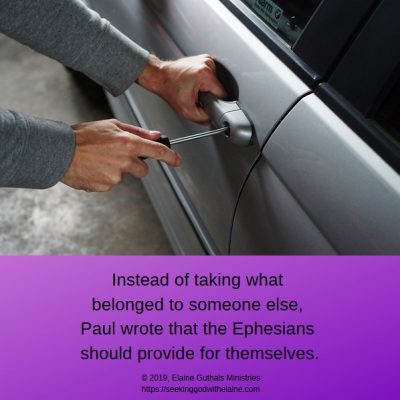
    Instead of taking what belonged to someone else, Paul wrote that the Ephesians should provide for themselves. Instead of being idle except when stealing, he said that they should labor.

    Thief breaking into a car

    But Paul didn’t stop there. He went on to say “… so that he may be able to give to those in need” (Eph. 4: 28 RSV).

    Wow! Paul turned the whole agenda. It went from focusing on the thief to focusing on someone else who really was in need.

    Opposite of Cut Down

    “Let no evil talk come out of your mouths, but only such as is good for edifying, as fits the occasion, that it may impart grace to those who hear” (Eph. 4: 29 RSV)

    It is so easy these days to cut people down. Yes, some of it is done in jest. Unfortunately, much of it today is people who think they have the right to rip up one side and down the other on someone who has a different opinion than theirs.

    David knew our mouths get us in trouble. In Psalm 141: 3, he said, “Set a guard over my mouth, Lord; keep watch over the door of my lips” (NIV). Can’t you see that image in your head — an angel standing guard right by lips.

    There is good reason to want a guard. “But no one can tame the tongue; it is a restless evil and full of deadly poison” (Jas. 3: 8 NASB). We can’t do it ourselves.

    “But no one can tame the tongue; it is a restless evil and full of deadly poison” (Jas. 3: 8 NASB).

    Sometimes, we may think our words don’t matter. They do matter, because they produce actions. Remember in the last devotion, we talked about conflict and anger. The genesis of those could have been by something someone said.

    To read a related devotion, click the appropriate button below.

    Paul knew what he was talking about when he said, “Let no evil talk come out of your mouths …” (Eph. 4: 29 RSV). Again, he suggested the opposite: “… but only such as is good for edifying, as fits the occasion …” (Eph. 4: 29 RSV).

    The old saying is so wrong. Words do harm. They can elicit emotions that can just bubble over and take situations to places we never intended

    Listen to Hawk Nelson’s song Words. It follows what Paul says.

    Related Links

    Hawk Nelson

    Remember, we are talking about unity of the early church in Ephesus. If they would have splintered, things would have been much different today.

    We don’t want to cause injury – even through our words – to our fellow disciples. Remember, “Owe nothing to anyone—except for your obligation to love one another …” (Rom. 13: 8 NLT) includes loving other disciples.

    But the opposite of cutdown is build up. We are called to be encouragers. “Therefore encourage one another and build one another up, just as you are doing” (I Thess. 5: 11 ESV). We are to bear each other’s burdens (Gal. 6: 2), not alienate them.

    Making the Connections

    Did you get the idea that Paul wasn’t suggesting that the end result of the work would be to hoard wealth? It was so that others who couldn’t work were supported.

    It speaks to the belief that all we have is given to us by God. “You, Lord, are all I have, and you give me all I need; my future is in your hands. 6 How wonderful are your gifts to me; how good they are!” (Ps. 16: 5-6 GNT). We are to use what we have to His glory and honor.

    When you think about it, that was the mindset of the early church. “All the believers were one in heart and mind. No one claimed that any of their possessions was their own, but they shared everything they had. … And God’s grace was so powerfully at work in them all that there were no needy persons among them. For from time to time those who owned land or houses sold them, brought the money from the sales and put it at the apostles’ feet, and it was distributed to anyone who had need” (Ac. 4: 32-35 NIV).

    It worked because people were willing to do their part. They were unified in their goals (there is that word again). Whether they had a little or a lot, they considered it God’s, not theirs.

    Because they were unified and giving, God blessed them. They had put Him and others first.

    They had to put others first when it came to the words they used. That happens easier when we are truly putting God above all.

    How Do We Apply This?

    Isn’t respect what this is really about? We have to recognize their worth as people. We have to appreciate similarities and differences.

    No, that does not mean we have to tolerate their sin. We have to lovingly show them their need to admit their sins, believe on Jesus as Redeemer, and confess God as Sovereign Lord. Then they have to demonstrate that commitment by working to change their lifestyle more align with God’s laws and commandments.

    We need to measure our words. I know that is hard when we are living in a world trying to move faster than the speed of sound. I think we have to learn the art of conducting a conversation again. Let me clarify that — face-to-face conversation. The internet has its benefits (I am talking to you, right?).

    But I think we have lost some of the skill sets needed to carry on a conversation and resolve issues right there while we are looking the person in the eye. I think accountability has been taken away.

    I think we’ve lost the art of staying silent. It seems to me that we have gotten to a point where we are more likely to respond— and not well — to something that triggers us. We’ve got to get the sound of silence back.

    We need to make sure we speak God, not ourselves. We want to expand His kingdom, not glorify ourselves. When we think on Him and meditate on Him, His words are going to come out of our mouths.

    We have a resource at our hands that I don’t think we tap into enough to help us with our conversations. We have the grace of God.

    What did Paul say? “assuming that you have heard of the stewardship of God’s grace that was given to me for you” (Eph. 3: 2 RSV). God gives us grace to pass on to others.

    Grace is a free and unmerited gift from Heavenly Father given through His Son, Jesus Christ that enables salvation and spiritual healing to believers. Because of God’s infinite grace, He devised the plan of salvation that made Jesus our Redeemer in order to forgive us of our sins.

    That is what God’s grace is. In a nutshell, it is where He provided more than we deserved. We can exhibit that to others.

    We also need to take a lesson out of God’s mercy book. Mercy is the unexpected way God responds in love to our needs. It is where He didn’t judge us to the extent He could have. We can do that, too.

    Paul said something else. “I therefore, a prisoner for the Lord, beg you to lead a life worthy of the calling to which you have been called, with all lowliness and meekness, with patience, forbearing one another in love, eager to maintain the unity of the Spirit in the bond of peace” (Eph. 4: 1-3 RSV emphasis added).

    Let’s chase a rabbit a second by looking at the fruits of the spirit: “… love, joy, peace, patience, kindness, goodness, faith, gentleness, self-control” (Gal. 5: 22-23 HCSB emphasis added). Paul mention almost half of the fruits. That is how we are supposed to live.

    Unfortunately, we aren’t fruit-of-the-spirit perfect. When we mess up, we need to ask forgiveness — from God and from others.

    Hopefully, we won’t steal. We know our words will hurt others. There will be times we put ourselves before others.

    We have to keep shooting for the perfection God wants from us. We can only do that with His guidance.

    Loving Father. Our relationships with others would go so much better if we would respect them. Instead, this world wants to tear us apart because of the differences. Help us to use our words wisely and lovingly. Use us to guide them to You. May we never compromise what You want us to be to fit into this world. Amen.

    What do you think?

    Leave me a comment below (about this or anything else) or head over to my Facebook group for some interactive discussion.

    If you don’t understand something and would like further clarification, please contact me.

    If you have not signed up for the email daily or weekly providing the link to the devotions and the newsletter, do so below.

    If God has used this devotion to speak with you, consider sharing it on social media.

  • How Are We Supposed to Live?

    Paul was the consummate teacher. He not only showed the Ephesians what was wrong, but he also told them how to do it right. This devotion look at how God has called us to live.

    Nuggets

    • Liars are children of the master deceiver, Satan.
    • It isn’t the anger itself that is the sin.
    • Just as nature fills a vacuum quickly, Satan will quickly take advantage of any opportunity too get us to sin or keep us sinning.
    Flowers with title How Are We Supposed to Live?

     Earlier in Ephesians 4, Paul was biting on the Ephesians for returning to a sinful way of life. He reminded them that they knew better. To close out the chapter, he gave a list of what they — and we — should be doing.

    To read a related devotion, click the appropriate button below.

    Be a Person of Integrity

    “Therefore, putting away falsehood, let every one speak the truth with his neighbor, for we are members one of another” (Eph. 4: 25 RSV)

    When God gave Moses the Ten Commandments, He said that “you shall not bear false witness against your neighbor” (Ex. 20: 16 ESV). In other words, they shouldn’t lie about their neighbor.

    God did say it more straightforwardly and didn’t qualify it. “You shall not steal; you shall not deal falsely; you shall not lie to one another” (Lev. 19: 11 ESV). Why should we put away telling lies?

    Handshake

    John 14: 6 says, “Jesus said to him, “I am the way, and the truth, and the life. No one comes to the Father except through me” (ESV). We are to be like Jesus. “For to this you have been called, because Christ also suffered for you, leaving you an example, so that you might follow in his steps” (I Pet. 2: 21 ESV).

    John 1: 14 says, “And the Word became flesh and dwelt among us, and we have seen his glory, glory as of the only Son from the Father, full of grace and truth” (ESV).

    Contrast that with what Jesus said of liars. “You are of your father the devil, and your will is to do your father’s desires. He was a murderer from the beginning, and does not stand in the truth, because there is no truth in him. When he lies, he speaks out of his own character, for he is a liar and the father of lies” (Jn. 8: 44 ESV). Ouch.

    Liars are children of the master deceiver, Satan. Well, Satan did tell the first lie. “But the serpent said to the woman, ‘You will not surely die’” (Gen. 3: 4 ESV).

    There are several consequences to lying. Liars will be punished. “But as for the cowardly, the faithless, the detestable, as for murderers, the sexually immoral, sorcerers, idolaters, and all liars, their portion will be in the lake that burns with fire and sulfur, which is the second death” (Rev. 21: 8 ESV).

    Let’s put it into the context of what Paul had been talking about — unity of the church. Those who are not telling the truth are not going to be promoting unity. Quite to the contrary, they will cause dissension as their deceit is uncovered.

    Paul said, “Therefore, putting away falsehood …” (Eph. 4: 25 RSV). He said it was a choice. We can choose to lie, or we can put away the urge.

    Don’t Be the Hulk

    “Be angry but do not sin; do not let the sun go down on your anger, and give no opportunity to the devil” (Eph. 4: 26-27 RSV)

    In the first Avenger movie, Bruce Banner tells Captain America that his secret of turning into the Incredible Hulk is that he is angry all the time. Paul said, “Don’t be the Hulk.”

    Did anyone read that as “don’t be angry?” That isn’t what Paul said.

    What Paul said was, “Be angry but do not sin …” (Eph. 4: 26 RSV). So, it isn’t the anger itself that is the sin.

    Anger is an emotion. Yes, you can control your emotions, but you are still going to feel them.

    Jesus was angry when he cleared the money changers out of the temple (Jn. 2: 13-22). But that was a holy anger. He was angry at sin.

    Most of the time, our anger is not a holy anger. It could be an unjust or excessive anger. It could be a selfish anger. Usually, it is a personal anger.

    What are the causes of our anger? Pride is a big one.

    Conflict with others is probably a close second. That can pull in anything from envy to controlling to hurt. When that conflict with others creates anger in the workplace sure decreases productivity.

    What Paul was saying was, don’t let your anger be a big volcanic eruption. Control your anger.

    I love Paul. He basically says, “Deal with it — quickly.” What he actually said was, “… do not let the sun go down on your anger …” (Eph. 4: 26 RSV).

    Ooo baby. Don’t let that anger just sit in you and stew. It will eat you up!

    I know Paul probably said that because we interact more during the day. It will rob our sleep if we let it.

    What I first thought of, though, was Sabbath began at sundown. Tying it into the unity theme — don’t be holding a grudge against a fellow disciple while you are worshiping God.

    There is another big reason for a speedy resolution to anger. “… and give no opportunity to the devil” (Eph. 4: 27 RSV).

    You know Satan. If he sees a toe hole that he can finagle his way in, he is going to slide in quicker than the cherries slid off a Black Forrest cake my sister and I made when we were younger — and that was instantaneously.

    Just as nature fills a vacuum quickly, Satan will quickly take advantage of any opportunity too get us to sin or keep us sinning. He wants dominance of us.

    Man

    Making the Connections

    You know, if you have to put away lying, at one point you had to have picked it up. Again, it was your choice. Why? It is a choice because we have a choice to follow God or not.

    I can hear you jumping up and down, saying, “But kids lie, and they haven’t made that choice yet.“ The choice was made for them by Adam and Eve. When they first bit and lied, the choice was made for all of us. Sin entered the building.

    I looked at an article Beth Arky’s article entitled Why Kids Lie and What Parents Can Do About It: How to help kids find honest alternatives to bending the truth. She talked about kids — besides trying to manipulate the situation — experimenting with behaviors, trying to increase self-esteem, deflecting attention, and speaking before thinking. The only time she mentioned lying as being hardwired into the kid was with kids suffering from ADHD. Other than those diagnosed with an illness (which they did not choose), it was their choice or a consequence of an action they chose to do.

    So, you can pick up and put away lying. Paul counseled us to put it away.

    Have you ever been around someone who is angry all the time? Not a very fun atmosphere, is it?

    If that person is a disciple, how would you characterize the witness to a nonbeliever? The nonbeliever would be wondering why we would think they would want to become that.

    I loved this quote I found. “The soul that is not filled with good thoughts and desires is left empty for the enemy to enter” (Norton).

    We got to fill our hearts and our minds with God and His desires for us. We can’t focus on this world. We have to stop being tolerant of what He clearly calls sin.

    How Do We Apply This?

    To fill our hearts with God, we have to be seeking Him. Probably most of us focus on the reading and hearing of His Word and praying to Him. (Yep, we could probably do better.)

    Searching for and Seeking God

    Hearing His Word (Rom. 10: 17 NLT).
    Reading His Word (Rev. 1: 3 ESV).
    Praying to Him (Heb. 4: 16 ESV).
    Studying His Word (Ac. 17: 11 NLT).
    Meditating on His Word (Ps. 1: 1-2).
    Memorizing His Word (Ps. 119: 11 NLT).

    To read Has God Provided Everything We Need?, click the button below.

    I think most of us (myself included) have to up our game on the meditating part. That is where we really apply it to our lives.

    I know. I know. Those lives are filled to the brim. We are going to go bonkers if we add one more thing to the schedule — and we will because the holidays are coming up.

    But we have to get our focus turned onto Him. (Oh, I love that. Autocorrect changed Him to I’m. He is I AM!).

    We/I have to do a better job at seeing what I AM is saying to us. Because He is talking to us — we are just usually so focused on talking to Him that we don’t listen.

    Lying and anger. One should be nonexistent, and the other should be short. One is a sin; the other could lead to sin if not controlled. Self-control is a fruit of the spirit (Gal. 5: 22-23).

    Let’s work on producing more fruit.

    Loving Father. Thank You for Paul. Thank You for his knowledge of You that He was able to share with us. Thank You that he loved us so much that he wrote down how we should live. Help us to take the focus off this world and put it on You. Help us to live as You have called us to so that Satan does not get a toe hold in us. May we live that life for You. Amen.

    What do you think?

    Leave me a comment below (about this or anything else) or head over to my Facebook group for some interactive discussion.

    If you don’t understand something and would like further clarification, please contact me.

    If you have not signed up for the email daily or weekly providing the link to the devotions and the newsletter, do so below.

    If God has used this devotion to speak with you, consider sharing it on social media.

  • What Does Regeneration Mean?

    We are made new creatures through regeneration. God is the only one who can make this change. This devotion looks at how regeneration is both instantaneous and an ongoing process.

    Nuggets

    • Regeneration comes after repentance from sins.
    • Learning about Christ is getting to know Him as our personal Savior.
    • God gives us free will to choose Him or not.
    Flowers with title What Does Regeneration Mean?

    Paul said in II Corinthians 5: 17 that we are “… a new creation; the old has passed away, and see, the new has come!” (II Cor. 5: 17 CSB). He can say that because of the regeneration.

    Let’s Put It into Context

    “He saved us, not on the basis of deeds which we have done in righteousness, but according to His mercy, by the washing of regeneration and renewing by the Holy Spirit” (Ti. 3: 5 NASB)

    Oh, no. Two more churchy words. Regeneration is the change in us that God brings about when we go from being spiritually dead to spiritually alive. It is where God breaks Satan’s hold on us.

    Only God has the power to do that, and He only does when we admit our sins, believe on Jesus as Redeemer, and confess God as Sovereign Lord. The admitting of our sins should include repentance.

    Repentance is expressing sorrow for things we’ve done wrong. But it is not just feeling sorry for doing those things. It is making the commitment to changing ourselves as led by the Holy Spirit and accomplished by God so that we no longer do the wrong things.

    This is what Jesus was talking about when He told Nicodemus “…I am telling you the truth: no one can see the Kingdom of God without being born again” (Jn. 3: 3 GNT). Yes, Nic was scratching his head, trying to figure out what that really meant.

    No, we don’t know how that is actually accomplished. Yes, it can — and does — happen. “… With men this is impossible, but with God all things are possible” (Mt. 19: 26 NKJV).

    What Paul is talking about here in Ephesians is what happens when we are regenerated. Remember, he just got off of a couple of verses chiding some of the Ephesians for going back to their sinful nature. Let’s see what he says next.

    Church steeple

    Regeneration, Then Learning

    “You did not so learn Christ! — assuming that you have heard about him and were taught in him, as the truth is in Jesus” (Eph. 4: 20-21 RSV)

    After getting on the Ephesians for going back to the dark side, Paul reminded them “that was not what you learned about Christ!” (Eph. 4: 20 GNT). They were taught that regeneration comes after repentance from sins.

    Regeneration is the change in us that God brings. Unfortunately, God doesn’t zap us, and we get changed all at once. We have to work out our salvation (Phil. 2: ##).

    The Disciple’s Job Description

    To access the complete job description, click the button below.

    Job Duty #1
    Be a Living Sacrifice (Romans 12: 1-2)

    This is what the Ephesians — and we — have been taught. We have to change everything that is a sin. Everything that is not in line with how God wants us to live has to be changed.

    We can’t do that on our own. Only God can accomplish that.

    Learning about Christ is getting to know Him as our personal Savior. We have to learn Who He is and how to imitate Him. We do that by seeking Him.

    Searching for and Seeking God

    Hearing His Word (Rom. 10: 17 NLT).
    Reading His Word (Rev. 1: 3 ESV).
    Praying to Him (Heb. 4: 16 ESV).
    Studying His Word (Ac. 17: 11 NLT).
    Meditating on His Word (Ps. 1: 1-2).
    Memorizing His Word (Ps. 119: 11 NLT).

    To read Has God Provided Everything We Need?, click the button below.

    The good part is, when we truly seek Jesus, He will reveal Himself to us. We won’t be seeking in vain.

    When we seek Jesus, we are learning the truth. “Jesus said to him, “I am the way, and the truth, and the life; no one comes to the Father but through Me’” (Jn. 14: 6 NASB). Learning His Truth makes us want to change.

    Let’s look at it this way. When we are seeking, we are looking to be taught. That means we want to learn. When we learn, we change to how God wants us to be. Our goal is to be more like Christ.

    That goal is attainable. We can become more like Christ here in this life.

    When we get to the eternal life part, we will be like Christ. “My dear friends, we are already God’s children, though what we will be hasn’t yet been seen. But we do know when Christ returns, we will be like him, because we will see him as he truly is” (I Jn. 3: 2 CEV).

    We Choose Regeneration

    “Put off your old nature which belongs to your former manner of life and is corrupt through deceitful lusts” (Eph. 4: 22 RSV)

    It is all about our choice. God gives us free will to choose Him or not. Yes, we will be infinitely better off choosing Him, but He still gives us the option to chose what is harmful to us.

    Oh, yes. It is more difficult than changing our outfit. Keeping our thoughts and desires controlled is very difficult. Saying no to all the bright, shiny temptations can be painful at times.

    But we get to choose to change our lifestyles. We choose to not follow the deceitful desires. So much in this world is deceitful. We chase after things we think will bring us happiness and security but end up being disappointed.

    Instead, we choose to put our faith in the Creator of the universe. We choose regeneration. We look to Him to make the necessary changes in our lives because we know we can’t change on our own.

    Universe

    Regeneration and Renewal

    “and be renewed in the spirit of your minds, and put on the new nature, created after the likeness of God in true righteousness and holiness” (Eph. 4: 23-24 RSV)

    We’ve talked before about renewing our minds by seeking Him when we looked at Romans 12: 1-2. We also talked about how faith was in our minds. We have to reason it out in our minds – and then just believe – that there is a Superior Being in control of the universe.

    To read a related devotion, click the button below.

    Remember, we are talking regeneration — God brings about change. Our initial confession renews our relationship with God. God restores our relationship and makes us spiritually alive.

    But God also knows we need renewal daily because we have to change our mindset. That takes time — our whole lives, in fact. It is a progression.

    What does Lamentations 3: 22-23 say? “The faithful love of the LORD never ends! His mercies never cease. Great is his faithfulness; his mercies begin afresh each morning” (Lam. 3: 22-23 NLT).

    What is mercy? Mercy is the unexpected way God responds in love to our needs.

    Every day, God gives us His love in new, inventive ways to help us renew our minds. He wants us to succeed in making the change. He wants our regeneration complete.

    Look back at Titus 3: 5. It says we are “… [renewed] by the Holy Spirit” (Ti. 3: 5 NASB). We have help.

    I know what some of us are saying. God does the change. God gives us mercies every day.

    We don’t have to do anything.

    Wrong.

    1. We have to decide to turn our lives over to God.
    2. We have to study His Word and listen to Him to cut out the sin in our lives.
    3. We have to live morally as God would have us.

    So, how are we made new? Since we are putting God first, we have new motives. We have different frames of mind, habits, and tempers. We think differently and feel differently. That is because we find our joy in Him, not in this world.

    Making the Connections

    We have to truthfully look at our lives and weed out all the sin in our lives. It is going to be a lifelong undertaking that may be painful at times. It is lifelong because God is probably going to work at them one at a time.

    That might make us be disappointed at times. We may think the regeneration process needs to speed up. We have to be careful that we do not start counting what all we have given up, making sure we have gained just that many good things. We have to factor in the quality of what we are receiving — a relationship with and protection of the Father, blessings we would not otherwise received, and eternal life.

    To read a related devotion, click the button below.

    How Do We Apply This?

    There are several things we can do when we are doing our self-evaluation. We can ask ourselves these questions:

    • What sin(s) is/are present in our lives that we don’t hate as we should?
    • What weakness(es) are present that can trip us up?
    • What do we have to do to conquer sinful tendencies?
    • What is our action plan to address what we found?

    We need to learn to find the joy of the moment. We tend to say that we will be happy when something is completed. Instead, we need to find the joy in completing it.

    As with salvation, regeneration is an immediate and daily occurrence. We are immediately saved when we confess Jesus as Lord. But then we have to work out our salvation and regeneration.

    Don’t worry, God will be there guiding us every step of the way.

    Father. You make us new when we invite You into our hearts. No, Lord, we don’t understand how, but we are so thankful You do. Then comes the hard part — regenerating and renewing our minds every day. Help us through the process. May we always keep our eyes on You and live as You have called us. Amen.

    Related Links

    I have created a worksheet of the questions above. Click on the button below to access it.

    What do you think?

    Leave me a comment below (about this or anything else) or head over to my Facebook group for some interactive discussion.

    If you don’t understand something and would like further clarification, please contact me.

    If you have not signed up for the email daily or weekly providing the link to the devotions and the newsletter, do so below.

    If God has used this devotion to speak with you, consider sharing it on social media.
  • Don’t Go Back to the Sinful Lifestyle

    Paul warned the Ephesians to no longer live in sin as they had before their conversions. This alienated them from God. This devotion looks at why we sometimes return to a sinful lifestyle and resources we can acquire to strengthen our relationships with God.

    Nuggets

    • When we become believers, we will have different priorities than we did before becoming a believer.
    • We’ve got to have God as our moral compass.
    • Upon conversion, the physical life or darkness should decrease its pull.
    Flowers with title Don't Go Back to a Sinful Lifestyle

    Starting at the beginning of this chapter, Paul told the Ephesians how to put into practice what he had told them in the first three chapters. He started out talking about different gifts God has given his people: apostles, prophets, evangelists, preachers and teachers.

    In these verses, it seems like Paul has taken a wild turn. He is talking about either going back to or not changing from the nonbeliever way of living their lives.

    Let’s Put It into Context

    Remember, we are talking about Ephesus here. It was one of the largest cities of the ancient world. It was a commercial city, being on several trade routes and having its own harbor. It also was home to the temple of Diana and all the pagan culture that went with it.

    Those who had formerly embraced that culture were probably struggling with change needed to be made to live as God wanted them to live. It would have been very easy for them to revert back to their old way of living.

    Watch How We Live

    “Now this I affirm and testify in the Lord, that you must no longer live as the Gentiles do, in the futility of their minds” (Eph. 4: 17 RSV)

    But Paul could affirm that lives could be changed. He was living proof. He had the testimony to back it up.

    When we become believers, we will have different priorities than we did before becoming a believer. Then, we probably wanted to climb the corporate ladder, find happiness in possessions, and bask in our accomplishments.

    Now, we want to become disciples. We want to spend time with our Heavenly Father, learning more about Him. We want to live the lives He has called us to live.

    The Disciple’s Job Description

    To access the complete job description, click the button below.

    The phrase “… in the futility of their minds” (Eph. 4: 17 RSV) is an interesting one. Many of the translations say futility — either of the mind or thoughts. Others say, “… hopelessly confused” (NLT) or “… vanity …” (KJV).

    The Good News Translation has an interesting take. “In the Lord’s name, then, I warn you: do not continue to live like the heathen, whose thoughts are worthless” (Eph. 4: 17 GNT).

    The Contemporary English Version gets downright harsh. “As a follower of the Lord, I order you to stop living like stupid, godless people” (Eph. 4: 17 CEV).

    Whoa! Isn’t that strong wording?

    What Paul was saying is that some of the Ephesians were pursuing the empty ways of the world. The were going back to being enslaved by the devil.

    Look at it this way. They were now disciples of Jesus. They had given their lives over to God to be changed.

    But they hadn’t changed, really. Yes, they may be attending church more or praying before eating (even in a restaurant).

    Still, they hadn’t completely given themselves over to God. They were keeping some of their pet moral sins.

    We’ve got to have God as our moral compass so we are not pulled back into the sinful lifestyle. We’ve got to look different than those in the world.

    Yes, that can be difficult. We open ourselves up to ridicule and harassment when we live as Jesus would.

    We have to obey God’s laws and commandments. If we don’t, we wreck our witness.

    Compass

    Alienated from the God

    “they are darkened in their understanding, alienated from the life of God because of the ignorance that is in them, due to their hardness of heart” (Eph. 4: 18 RSV)

    Upon conversion, the physical life or darkness should decrease its pull. We now know of the spiritual life or Light, which will last for a far longer time than this transient physical life.

    Unfortunately, it didn’t for some of the Ephesians. It sometimes happens to us, too.

    But let’s start at the beginning.

    We know sin separates us from God. “But your iniquities have made a separation between you and your God, and your sins have hidden his face from you so that he does not hear” (Isa. 59: 2 ESV). Iniquities is another word for sin.

    Who have sinned? “For all have sinned and fall short of the glory of God” (Rom. 3: 23 ESV). It is critical for us to rectify that because “… the wages of sin is death …” (Rom. 6: 23 ESV).

    Fortunately, God provided the way to fix that. “For by grace you have been saved through faith, and that not of yourselves; it is the gift of God” (Eph. 2: 8 NKJV).

    To read a devotion in the Foundations of Salvation series, click the appropriate button below.

    But we are still here in our physical bodies. God doesn’t just throw a switch and we sin no more.

    Our continuing to sin separates us from God. It keeps us from having the right relationship with God.

    It could have some really nasty consequences. “For if we deliberately sin after receiving the knowledge of the truth, there no longer remains a sacrifice for sins, but a terrifying expectation of judgment and the fury of a fire about to consume the adversaries” (Heb. 10: 26-27 HCSB).

    Sometimes, we can claim ignorance about not knowing about needing a Savior. We talked about this in the last devotion, where Jesus told Pharisees they now had to make a choice because they were no longer ignorant.

    To read a related devotion, click the button below.

    But we can’t claim that if we have already admitted our sins, believed that Jesus should be our Savior and Redeemer, and confessed God as our Sovereign Lord. If we are pulling back from that, it means we have hardened our hearts to Him.

    If we have a hardness or blindness of the heart, we are past feeling — past caring. It is hard to change someone’s mind when they don’t care one way or the other.

    Being uncaring about spiritual matters takes the filter away. We could end up committing some serious sins that have serious consequences, especially since the sinning is deliberate.

    Filter

    Given to Licentiousness

    “they have become callous and have given themselves up to licentiousness, greedy to practice every kind of uncleanness” (Eph. 4: 19 RSV)

    This is the sad part. They “… have given themselves up …” (Eph. 4: 19 RSV). It was deliberate. It was intentional.

    Licentiousness is an everyday word, right? Not.

    Let’s see how the other translations handled this word. The word was translated sensitivity (NIV), lustful pleasure (NLT), sensuality (ESV, NASB), lewdness (NKJV), lasciviousness (KJV), vice (GNT), and promiscuity (CSB, HSCSB).

    We’ve talked a couple of times about Paul’s list of sins. They are found in Galatians 5: 19-21, Ephesians 5: 3-6, and I Corinthians 6: 9-10. A partial list includes sexual immorality, impurity, homosexuality, idolatry/covetousness, jealousy, fits of anger, rivalries, dissensions, divisions, envy, greed, drunkenness, filthiness, and all impurity. Did you see that a couple of them deal with sexual sins?

    To read a related devotion, click the button below.

    Part of it was fueled by greed. The churchy word is covetousness. The Ephesians wanted more than they had.

    Whatever the reasons, the result was all kinds of sin. Sometimes, we sin because we have become hardened to the sin.

    Making the Connections

    What God is looking for people with a clean heart. He is looking for people who are willing to ask Him to be their Sovereign God.

    God knows that Satan is going to try to throw big obstacles in our way. He wants to knock us away from loving and serving God.

    How Do We Apply This?

    How do we make sure we don’t get off track? We make sure our relationship God is strong.

    I am in a couple of Christian blogger groups. Here are some links you can use to access resources developed by these bloggers to grow in your faith.

    Almighty Father. You have called us to live pure lives. That is very hard to do in these sinful bodies. Lord, forgive us when we slip and follow the ways of this world. Lord, we pray that we do not do this intentionally. We know, though, there are times that we do. Convict us of our sins so that we may confess them to You. Strengthen us as we seek You. Show us the lives we are to live in You. Amen.

    What do you think?

    Leave me a comment below (about this or anything else) or head over to my Facebook group for some interactive discussion.

    If you don’t understand something and would like further clarification, please contact me.

    If you have not signed up for the email daily or weekly providing the link to the devotions and the newsletter, do so below.

    If God has used this devotion to speak with you, consider sharing it on social media.
  • Job’s Confidence in His Savior

    Job may have hit a rough patch in his life, but he had his priorities straight. He was mature in his relationship with God. This devotion looks at Job’s confidence in his expectation of a Savior.

    Nuggets

    • Satan wanted to make a point that it was easy to follow God when we were getting all the good stuff.
    • God let Satan take away the good stuff from Job.
    • Job had confidence there was a Savior even though he hadn’t seen Him.
    • We all have to consider what will happen when we die.
    • Job chose God when he put his faith and trust in God to save him.
    Flowers with title Job's Confidence in His Savior

    Job had everything going for him. He had a large, loving family. He was well off financially. He had close friends.

    All of this, however, was not the most important thing in Job’s life. He was described as “… a good man, careful not to do anything evil” (Job 1: 1 GNT). God had #1 priority.

    Then everything fell apart — on purpose. “But now suppose you take away everything [Job] has — he will curse you to your face!” (Job 1: 11 GNT). Satan wanted to make a point that it was easy to follow God when we were getting all the good stuff.

    God let Satan take away the good stuff. “‘All right,’ the Lord said to Satan, ‘everything he has is in your power, but you must not hurt Job himself’ …” (Job 1: 12 GNT).

    Things didn’t work out as Satan envisioned. Quite to the contrary.

    Job gave us a sound bite on the coming Messiah. Let’s see what he has to say.

    Job’s Confidence

    “I know that my Savior lives …” (Job 19: 25 CEV)

    When we know something, we are absolutely sure about it because we have researched the information, seen it with our own eyes, or looked into the matter. In other words, we’ve built some type of a relationship with it — or with someone.

    There is that element in faith. Faith is the belief that the doctrines stated in God’s Word are true, even if we do not understand all aspects of them. The writer in Hebrews put it this way: “Now faith is confidence in what we hope for and assurance about what we do not see” (Heb. 11: 1 NIV).

    Yep, Job had confidence there was a Savior even though he hadn’t seen Him — couldn’t have. Jesus had not come down to earth yet.

    But Job had observed enough to know God reigns. He had researched enough to know that God had already stated that He would send a Messiah. “I will put enmity between you and the woman, and between your offspring and her offspring; he shall bruise your head, and you shall bruise his heel” (Gen. 3: 15 ESV).

    More importantly, Job has the right relationship with God — even God said so. “‘Did you notice my servant Job?’ the Lord asked. ‘There is no one on earth as faithful and good as he is. He worships me and is careful not to do anything evil’” (Job. 1: 8 GNT). Yep, God told Satan that Job was His poster child.

    So, somewhere along the line, Job figured out that God already had the plan of salvation in place and Jesus was just waiting in the wings for his cue. He had confidence in his God to do what He said He would do.

    To read a related devotion, click the button below.

    Even when things were at their worst, Job knew his Savior and Redeemer was coming. “The end of my life is near. I can hardly breathe; there is nothing left for me but the grave” (Job 17: 1 GNT). He may not have believed he would get out of his present troubles, but he knew he had a Savior and couldn’t have that taken away.

    Job’s Expectation

    “… and at the end he will stand on this earth” (Job 19: 25 CEV)

    It is one thing to believe a Savior is living off somewhere we don’t have access to — or so we think. It is something entirely different to think He is coming.

    We react differently when we know people are coming. I always have a Christmas Eve celebration at my house. But I still have bins sitting around after the move because I still haven’t figured out where the stuff is going. Figuring that out got a higher priority when the word company popped in my mind.

    Job knew a Savior was coming to earth. There was no “well, maybe He’ll come sometime.” It was all “… and at the end he will stand on this earth …” (Job 19: 25 CEV).

    The only uncertainty is on our part. Is Job talking about when Jesus came to be born as a baby or when He is going to come as a judging Messiah?

    Either way, we were and will be in Jesus’ presence. He did and will stand in victory.

    But let’s look at it this way. When we stand with someone, we know how they feel. We have their backs.

    That takes on a whole different look, doesn’t it? Jesus does stand with us. “… Christ Jesus is the One who died, but even more, has been raised; He also is at the right hand of God and intercedes for us” (Rom. 8: 34 HCSB).

    And when we think this is Job saying this, we can marvel. Job experienced the highest of highs and the lowest of lows. Circumstances didn’t change his belief. His confidence didn’t waiver because he always had the expectation of Jesus’ presence.

    Job’s Frailty

    “… My flesh may be destroyed …” (Job 19: 26 CEV)

    Yep, the body is going to die. Death is a consequence of the original sin.

    To read a related devotion, click the appropriate button below.

    We just talked about Job thinking his end was near (Job 17: 1). We all eventually have questions about mortality — whether it is ours, our parents, our spouses.

    A couple of years ago, I got to thinking would Adam be prepared if something happened to me. So, I focused on making sure he could cook. No, he doesn’t do much actual cooking, but I know he can follow a recipe, measure, and stir. He can do things on top of the stove and put a dish in to bake.

    We all have to consider what will happen when we die. We won’t be worm food, so we have to make arrangements for when that happens.

    Job did.

    Job’s Future

    Bible Verse“… yet from this body I will see God” (Job 19: 26 CEV)

    Job chose God. He put his faith and trust in God to save him.

    It didn’t matter if it was good times or bad times. It didn’t matter if his friends — or even his wife — agreed with him or not.

    Job chose God and the Savior He was (at that time) going to send.

    Making the Connections

    Satan was wrong about Job — really probably about disciples in general. When things are going well, it is easy to forget about God. It is when things are spiraling out of our control that we finally latch on and cling to God. It is in those times that we have to say, “I know my Redeemer lives.

    Related Links

    HumptyFell

    How Do We Apply This?

    The Savior still lives, and He can be ours. We just have to choose Him.

    If you have not admitted that your relationship is not right with God,

    have not asked Jesus to be your Lord and Savior,

    and have not confessed your sins,

    please read through the Plan of Salvation and prayerfully consider what God is asking you to do.

    Then we live the lives God wants us to. We follow or job description.

    The Disciple’s Job Description

    To access the complete job description, click the button below.

    Nope, it isn’t easy because now Satan has put a target on our backs, just like he did Job.

    To read a related devotion, click the button below.

    But remember, Jesus is standing right here with us. He is interceding for us. So, we’ve got this.

    We’ve got this when we have Him.

    Father God. So many trials come our way. Some are designed to help us grow. Some are to test our faith in You. Whatever we are facing right now, help us to be like Job. “[We] know that [our] Savior lives and at the end he will stand on this earth” (Job 19: 25 CEV). That gives us confidence to withstand any battle we face. Strengthen us so that we won’t sin. Prepare us for when we do see You. Amen.

    What do you think?

    Leave me a comment below (about this or anything else) or head over to my Facebook group for some interactive discussion.

    If you don’t understand something and would like further clarification, please contact me.

    If you have not signed up for the email daily or weekly providing the link to the devotions and the newsletter, do so below.

    If God has used this devotion to speak with you, consider sharing it on social media.

  • Is It the Law or Faith?

    The law served a specific purpose before Jesus came to pay the price for our sins. Once He did, the purpose of the law changed. This devotion looks at how the law prepared us for faith in Jesus.

    Nuggets

    • Sin isn’t a good-bad issue.
    • It is a spiritually alive-spiritually dead issue.
    • That takes faith.
    • The law is all the do’s and don’ts of the Bible.
    • The purpose of the law was to show us we needed a Savior.
    Flowers with the title Is It the Law or Faith?

    It may be easy to question what role the law plays now that Jesus has become our Savior and Redeemer. Galatians 3: 22-25 gives us the answer to that question.

    Confined All Under Sin

    “But the Scripture has confined all under sin …” (Gal. 3: 22 NKJV)

    Do we hear today about people who think there is no sin? That could be due to the insistence that sin is a good-bad thing. So, they think they are a good person, so everything is hunky-dory.

    If it were a good-bad issue, we would be able to earn our way into heaven. That would make it about us.

    It isn’t a good-bad issue. It isn’t about us.

    Paul said, “For all have sinned, and come short of the glory of God” (Rom. 3: 23 KJV).

    The sentence has already been pronounced — there is no more debate.

    The sentence has been pronounced for all. There are no exceptions.

    Scales

    Faith in Jesus

    “… that the promise by faith in Jesus Christ might be given to those who believe …” (Gal. 3: 22 NKJV)

    It is a spiritually alive-spiritually dead issue. It is about God and Jesus.

    Yes, the sentence has been pronounced, but a Substitute has been found.

    That takes faith. Faith is the belief that the doctrines stated in God’s Word are true, even if we do not understand all aspects of them.

    It isn’t a blanket substitution, however. We need to do our part.

    “And Jesus said, ‘For judgment I have come into this world, that those who do not see may see, and that those who see may be made blind.’ Then some of the Pharisees who were with Him heard these words, and said to Him, ‘Are we blind also?’ Jesus said to them, ‘If you were blind, you would have no sin; but now you say, “We see.” Therefore your sin remains’” (Jn. 9: 39-41 NKJV).

    You see, what Jesus was saying here was that the Pharisees could not claim ignorance. Because Jesus told them that He was the Way to salvation, they had to say, “Yes, we believe,” or they would still be sinners.

    It is kind of like those who used to believe the world was flat. All they could see was their little piece of the world.

    It took someone else to tell them that the world was, in reality, round. It took someone with a bigger perspective, a bigger picture.

    Jesus had a bigger picture than the Pharisees. They just saw their little corner.

    The kicker is, now that they had been told, they had to make a decision. “They would not be guilty if I had not come and spoken to them. But now they have no excuse for their sin” (Jn. 15: 22 NLT).

    I wonder if some people read that as we would not be sinners if Jesus hadn’t come. That isn’t what He said. He said, “They would not be guilty if I had not come and spoken to them …” (Jn. 15: 22 NLT emphasis added).

    So, Jesus had to come, and people have to be told. That is why “And this gospel of the kingdom will be preached in the whole world as a testimony to all nations, and then the end will come” (Mt. 24: 14 NLT).

    To read a related devotion, click the button below.

    Did you see the last bit of the section we are looking at here? “… might be given to those who believe …” (Gal. 3: 22 NKJV).

    You have now been told. You can no longer claim ignorance. You have to act. You have to ABCD.

    The ABCDs of Salvation

    A – admit our sins

    B – believe His Son Jesus is our Redeemer

    C – confess God as Sovereign Lord

    D – demonstrate that commitment by making any changes needed in our lives to

    live the way in which God has called us

    If you have not become a believer in Christ, please read through the Plan of Salvation and prayerfully consider what God is asking you to do.

    We have to hear the message of our need for a Savior. We have to believe it. We have to turn our hearts and lives over to God. Then we have to change our lives so that we are living in the way to which He is calling us.

    It isn’t enough for us to know. We have to believe and live.

    Guarded by the Law

    “… But before faith came, we were kept under guard by the law, kept for the faith which would afterward be revealed” (Gal. 3: 23 NKJV)

    What is the law? It is all the do’s and don’ts of the Bible.

    We were given the law for several reasons. The first reason was to show us sin existed. The second reason was to set boundaries to show us the ideal. That would begin to train us in the way Christ wants us to live. The third reason was to separate those to whom the law was given.

    The problem is we can’t keep all of the laws while we are in these sinful physical bodies. There is no way we can.

    Before Jesus came, that is how they obeyed God. Deuteronomy 28: 1 says, “And if you faithfully obey the voice of the Lord your God, being careful to do all his commandments that I command you today, the Lord your God will set you high above all the nations of the earth” (ESV).

    That doesn’t say anything about gaining eternal life. That is because the law can’t bring life.

    Tutor Is Gone

    “Therefore the law was our tutor to bring us to Christ, that we might be justified by faith. But after faith has come, we are no longer under a tutor” (Gal. 3: 24-25 NKJV)

    The purpose of the law was to show us we needed a Savior. “… In fact, it was the law that showed me my sin …” (Rom. 7: 7 NLT).

    Sometimes, we get like the Pharisees — thinking that the do’s and don’ts are the end-all, be-all. We think they have to keep all the laws to live. Once they break the laws, we are dead in the water.

    Instead, we have a Savior. We have a loving Father Who will forgive us when we ask.

    Boy with Bible

    Making the Connections

    Mankind graduated from the law a long time before we ever showed up on this earth. It no longer is a good/bad issue.

    Look at it this way. The rich young ruler asked Jesus what He had to do to inherit eternal life. Jesus rattled off some of the Ten Commandments.

    Ruler Guy was thinking, “Great. I’ve nailed those.” He puffed up His chest and said that.

    Look at Jesus’ response. “…You still lack one thing. Sell all that you have and distribute to the poor, and you will have treasure in heaven; and come, follow Me” (Lk. 18: 22 NKJV).

    Ruler Guy — and some of us — get tripped up on the sell part. We don’t want to give up anything.

    But I don’t think that really was really what Jesus was saying.

    What Ruler Guy was lacking was following Jesus. For Rich Guy, the material things had priority #1, not God. Jesus wanted to switch things up.

    But it could have been Jesus was asking Rich Guy to give up what he knew. Give up the comfortable to gain the necessary.

    It doesn’t matter if we are rich or poor. What matters is what priority do we give God in our lives. God wants to be #1.

    How Do We Apply This?

    We have to have faith in Jesus. We have to ask Him to be our Savior and Redeemer. Then we have to continue to seek Him.

    We have to practice living the laws here. This is how we are going to live in heaven. There won’t be any sin, and we will have changed bodies so that we can live these out.

    How do we start living them?

    You know, the questions may change. The topics may change. However the answer never will.

    The answer is we need to work on our relationship with God. Yep, I even made this fancy graphic so I don’t have to keep retyping it.

    Searching For and Seeking God

    Hearing His Word (Rom. 10: 17 NLT).
    Reading His Word (Rev. 1: 3 ESV).
    Praying to Him (Heb. 4: 16 ESV).
    Studying His Word (Ac. 17: 11 NLT).
    Meditating on His Word (Ps. 1: 1-2).
    Memorizing His Word (Ps. 119: 11 NLT).

    To read Has God Provided Everything We Need?, click the button below.

    While we are seeking God, we have to show those changes in our lives. We do that by living out the Disciple’s Job Description.

    The Disciple’s Job Description

    To access the complete job description, click the button below.

    Too many times, I think we forget we have to crawl before we walk. We have to gibberish before we can talk. We have to have the law before we can know Jesus.

    We don’t want to stay in the crawl, gibberish, law stages. We want to have our Lord and Savior in our lives. We need Jesus.

    Father God. We are searching for You to be our Savior, Redeemer, and Sovereign Lord. We are seeking to strengthen our relationships with You. Help us to live as You would have us live. Amen.

    What do you think?

    Leave me a comment below (about this or anything else) or head over to my Facebook group for some interactive discussion.

    If you don’t understand something and would like further clarification, please contact me.

    If you have not signed up for the email daily or weekly providing the link to the devotions and the newsletter, do so below.

    If God has used this devotion to speak with you, consider sharing it on social media.

  • How Did Peter and Paul Settle Their Conflict?

    Conflict happens even among believers. Paul and Peter had one such conflict. This devotion looks at how they resolved their conflict.

    Nuggets

    • Conflict can happen even among believers.
    • Both Paul and Peter had gotten an attitude adjustment regarding the Gentiles; but Peter wasn’t consistent.
    • After Paul called Peter on it, Peter could have gotten even.
    • Instead, Peter called Paul his beloved brother.
    • Peter acknowledged that sometimes people try to twist Paul’s words to justify their beliefs.
    • Twisting the meaning of scriptures is dangerous.
    Flowers with title How Did Peter and Paul Settle Their Conflict?

    Peter is always listed first when Jesus’ apostles are listed. He was also the most vocal.

    Paul, at first, would have been hunting Peter down to kill him. However, that changed one day on the Damascus Road. Jesus specifically called Paul to be a missionary.

    To read a related devotion, click the appropriate button below.

    So, Peter and Paul should have been good buddies, right? But they did have some conflict. Let’s look at the problem and then see how it was resolved.

    Let’s Put It into Context

    “When Peter came to Antioch, I told him face to face that he was wrong. He used to eat with Gentile followers of the Lord, until James sent some Jewish followers. Peter was afraid of the Jews and soon stopped eating with Gentiles” (Gal. 2: 11-12 CEV)

    Conflict can happen even among believers. Think about what courage Paul had to have to confront Peter. Yes, Paul was very defensive regarding his apostleship.

    But this was Peter. There was no controversy on his. He had spent three years with Jesus. Peter had walked on water!

    And Paul had to say, “Excuse me, Buddy. You’re wrong.”

    We have to remember that Paul probably used to feel the say way as Peter did. Paul used to be a Pharisee. He got an attitude adjustment. Peter had, too; but he wasn’t consistent.

    To read a related devotion, click the button below.

    So, Paul called Peter on it. Paul doesn’t come across as being timid as Peter was, but it still had to be hard to correct a friend.

    Why did Paul correct Peter? It is like Bishop Hall said. “There cannot more worthy improvement of friendship than in a fervent opposition to the sins of those whom we love.”

    Paul doesn’t elaborate much here as to how he corrected Peter. He probably listened to his own advice. “Don’t think of them as enemies, but warn them as you would a brother or sister” (II Thess. 3: 15 NLT). “Let the word of Christ dwell in you richly, teaching and admonishing one another in all wisdom …” (Col. 3: 16 ESV).

    So, Peter got even with Paul, right? Let’s see.

    Is It a Dig or Not?

    “Some of his comments are not easy to understand …” (II Pet. 3: 16 LB)

    I laugh at these words every time I read them. I can just hear Peter snipping at Paul.

    Also, here is the guy who was with Jesus for three years saying he finds the words confusing that we’re written by a guy who met Jesus once on the street.

    However, not understanding scripture is not a laughing matter. We need to understand what God is trying to tell us.

    Still, we could read this a couple of different ways.

    Peter could have been getting a dig at Paul, and it was probably where it would have hurt. Paul wrote his letters to instruct his readers on the mystery of the gospel. He was trying to clear things up, not confuse people more.

    More than likely, Peter was teasing Paul as a brother. If we look back in II Peter 3: 15, we see Peter called him “… our beloved brother Paul …” (KJV).

    Maybe Peter was just stating a fact. We have to remember Peter was a fisherman. He would have been educated until he was 13.

    Paul was a Pharisee. He probably would have been educated until he was 17.

    Maybe Peter was just recognizing their differences. He could have been acknowledging the fact that Paul wrote at a higher level than he could always comprehend. (If you don’t think it happens, try reading a study that has a lot of statistical jargon in it.)

    Paul was writing at his level (with his enthusiasm) to a specific group of people. They did not have the knowledge that we have today. They probably had their own code or sayings that just haven’t survived.

    If God’s thoughts are so much higher than ours (Isa. 55: 8-9), how can we even think we are going to understand everything? That is why God says, “Trust in the Lord with all your heart, And lean not on your own understanding” (Prov. 3: 5 NKJV). God is going to continue to reveal Himself to us through His Word. How could we expect to understand it at the first reading?

    Person

    I think Peter was good with Paul. Peter had read what Paul had written. He didn’t question what was written.

    Some Tough Words

    “… and there are people who are deliberately stupid, and always demand some unusual interpretation – they have twisted his letters around to mean something quite different from what he meant; just as they do in other parts of the Scripture …” (II Pet. 3: 16 LB)

    Ummm. Did I say Peter was timid before? Not in this translation!

    Now, most of the time, we escalate the situation when we call someone stupid. That garners the direct opposite response of soothing ruffled feathers.

    There is one key word in there — deliberately. We all can have our ditzy moments. (Oh, yes. I can go from Super Mom to Ditzy Mom in 0.00002 seconds sometimes.)

    Maybe we aren’t really paying attention. Maybe we just misunderstand something. Maybe we are looking for something that really isn’t there.

    But that is not on purpose. Peter accused people of misunderstanding on purpose.

    And it wasn’t just Paul’s writing they twisted. It was the Scriptures.

    Oooo, baby. That is a serious accusation.

    Not only were those people twisting what they read, but they were also “demand[ing] some unusual interpretation …” (II Pet. 3: 16 LB). They were expecting others to give them the explanation they wanted to hear. They were wanting scriptures rewritten.

    To read a related devotion, click the button below.

    Why the Tough Words?

    “… and the result is disaster for them” (II Pet. 3: 16 LB)

    I think Peter followed Paul’s advise, too. He saw something wrong, and he addressed it.

    No, Peter wasn’t as polished as Paul was. He was, however, every bit as committed to doing God’s work as Paul was. He, too, gave his life for kingdom work.

    Why?

    Peter knew that people need Jesus as their lord and Savior. Not turning our lives over to God will have disastrous results.

    To read a related devotion, click on the appropriate button below.

    Jesus will come down and judge us. Judgement will be based on the ABCDs.

    The ABCDs of Salvation

    A – admit our sins

    B – believe His Son Jesus is our Redeemer

    C – confess God as Sovereign Lord

    D – demonstrate that commitment by making any changes needed in our lives to

    live the way in which God has called us

    If you have not become a believer in Christ, please read through the Plan of Salvation and prayerfully consider what God is asking you to do.

    Making the Connections

    Peter knew the bottom line. People either always have to searching for or seeking God. If we haven’t ABCDed, we need to. If we have, we are never going to know it all. There will always need to be some sin we are cutting out of our lives.

    Get two people together, it is possible that conflict is going to happen — even disciples. No, we want unity, but we are human. There is going to be differences of opinion. Someone is going to say something that someone else will take wrong.

    Even disciples are going to continue to sin — even Peter. Grace doesn’t flip a switch so disciples no longer sin. We have to work out our salvation.

    To read a related devotion, click the button below.

    We have to be forgiving. We have to try to live in peace with each other.

    Yes, the letter circulated among the churches, but they still would have been private letters. In no way, shape, or form did Paul expect these letters to make up the bulk of the New Testament. He would have said, “What New Testament?”

    Paul was writing at his level (with his enthusiasm) to a specific group of people. They did not have the knowledge that we have today. They probably had their own code or sayings that just haven’t survived.

    If God’s thoughts are so much higher than ours (Isa. 55: 8-9), how can we even think we are going to understand everything. That is why God says, “Trust in the Lord with all your heart, And lean not on your own understanding” (Prov. 3: 5 NKJV). God is going to continue to reveal Himself to us through His Word. How could we expect to understand it at the first reading?

    How Do We Apply This?

    Conflict can be hard to deal with on many levels. We have conflict within our families, our friends, our workplace, our society, and through the world.

    It saddens me that there are so many people who think that, just because someone believes the opposite of them, they have the right — and sometimes duty — to just rip that person up one side and down the other.

    Is that really going to change a person’s mind and belief? No. That isn’t going to change anything.

    Go back to what Paul said in II Thessalonians 3: 15. Don’t treat them as an enemy; treat them as a brother. Don’t be a dictator.

    Our discounting someone’s feelings and beliefs is not where Paul — and Jesus — started. They started where the person was.

    To read a related devotion, click the button below.

    When we are witnessing, they are going to tune us out if we are confusing them. If we assume they believe something and don’t or we completely ignore what they do believe, they may not make the needed connections to evaluate what they already know with the new information.

    That is what learning us all about — making the connections with what we already know and changing our knowledge based on how new information impacts that. We’ve got to make sure we connect the dots. (That is one reason I say below, if I haven’t sufficiently connected the dots for you, let me know.)

    It would probably depend on the situation as to whether it is worse to not try to resolve conflict or try the wrong way. Trying the wrong way may potentially make it worse.

    We have to be like Peter. We can’t let people rewrite the scriptures because they want to continue sinning. We need to be concerned with spiritual life.

    Loving Father. You did not make mankind to suffer conflict. That is a consequence of the original sin. You have shown us in Your Word how to resolve that conflict. Help us as we deal with others so that we can live in peace. Most importantly, help us to not be a stumbling block when witnessing. We know people need to know of Your love and forgiveness. Amen.

    What do you think?

    Leave me a comment below (about this or anything else) or head over to my Facebook group for some interactive discussion.

    If you don’t understand something and would like further clarification, please contact me.

    If you have not signed up for the email daily or weekly providing the link to the devotions and the newsletter, do so below.

    If God has used this devotion to speak with you, consider sharing it on social media.

  • Does Jesus Condone Sin If Disciples Sin?

    It is easy to think that Jesus was not successful because He did not stamp out sin when He died on the cross. Disciples still sin, even though they have given their lives to Him as their Savior. This devotion explores whether Jesus is a minister of sin, condoning sin because it is still prevalent in the world today.

    Nuggets

    • While we need to highlight sin so that we can cut it out, the law points out that we can’t rely on us changing ourselves.
    • Jesus was strong – mentally, physically, and spiritually.
    • The purpose of Jesus coming down the first time was to pay the price for our sins, not to eliminate sin.
    • Every day, we make so many decisions that seem to us to be little; however, those small decisions ultimately reflect whether we are following God or not.
    Flowers with title Does Jesus Condone Sin If Disciples Sin?

    Let’s Put It into Context

    Galatians 2 talks about being justified through faith, not through works. We just covered that because we have been walking through Ephesians. The gospel in a nutshell is housed in Ephesians 2: 8-9.

    To read devotions in the Foundations of Salvation series, click the appropriate button below.

    We also just talked about whether God ignored our sins. Nonbelievers sometimes believe that, by God’s “silence” in eliminating and/or punishing sins to their standard, He is saying there really isn’t anything wrong with people’s behaviors.

    To read a related devotion, click the button below.

    Don’t worry. We are going to come at this from a different angle.

    One more background piece, though. We’ve talked before about why disciples keep on sinning after they have admitted their sins, asked Jesus to be our Savior, and confessed God as Sovereign Lord.

    This is because there are three different tenses in one verb in the Bible. There is the past, present, and future – we were justified, we are being justified, we will be justified. We have been justified because our relationship has been restored, and we now can be changed into a spiritual being. We still are, however, a physical, human being.

    To read a related devotion, click the button below.

    Christ a Minister of Sin???

    “But if, while we seek to be justified by Christ, we ourselves also are found sinners, is Christ therefore a minister of sin? Certainly not!” (Gal. 2: 17 NKJV)

    This devotion, I want to talk about verse 17 by itself. What consequences does our continuing to sin have on Jesus and us?

    So, while we are a believer, going along in our Christian walk (“… while we seek to be justified by Christ …” (Gal. 2: 17 NKJV), we still have the capacity to sin. Does that make Christ weak? Does that mean Christ promotes sin? Does that mean Christ really allows sin? Doesn’t that really mean our actions don’t matter? Let’s find some answers to those questions.

    Is Jesus Weak?

    “Jesus understands every weakness of ours, because he was tempted in every way that we are. But he did not sin!” (Heb. 4: 15 CEV).

    Weak? Jesus? Where in the world did you get that idea?

    Jesus knew exactly Who He was — He was the Son of God (Jn. 11: 4). He had every confidence that He could and would succeed in His mission — to be the Savior of the world (Jn. 3: 16).

    Physically, Jesus was a carpenter, which required strength. Yes, He may have gotten to ride in a boat every once in a while, but for the most part, He probably walked. All over. He didn’t exactly stay in one spot.

    Jesus was strong – mentally, physically, and spiritually. That is what He wants for us, also.

    Does Jesus Promote Sin?

    “What shall we say, then? Should we continue to live in sin so that God’s grace will increase?” (Rome 6: 1 GNT)

    I struggled whether promote was really the word I wanted to use. What I mean is, if we don’t sin, God and Jesus don’t get to continue to shower us with the grace. So, wouldn’t Jesus want us to keep sinning so He can appear to be that much more gracious?

    Didn’t Paul just say that? “Law was introduced in order to increase wrongdoing; but where sin increased, God’s grace increased much more” (Rom 5: 20 GNT).

    Oh, no. That isn’t the point. The point is we need to highlight the sin so that we can cut it out. The law points out that we can’t rely on us changing ourselves.

    Mirror

    Sin in our lives is one of the things we are to work on when we are working out our salvation (Disciple’s Job Description #2). We are supposed to be identifying and removing sin from our lives in order to not continue to sin.

    The Disciple’s Job Description

    To access the complete job description, click the button below.

    Job Duty #2
    Work Out Our Salvation (Philippians 2: 12)

    Our lives post-conversion is to prepare us for our lives in eternity. Sin won’t be around in eternity, which is why are are called to be holy. “Since we have these promises, beloved, let us cleanse ourselves from every defilement of body and spirit, bringing holiness to completion in the fear of God” (II Cor. 7: 1 ESV).

    Jesus wants us to kill sin dead in our lives now. Not sorta dead, but dead dead.

    Does Jesus Allow Sin?

    “For everyone has sinned; we all fall short of God’s glorious standard” (Rom. 3: 23 NLT)

    Sin entered the world when Adam and Eve bit when Satan told them to bite. Some may think that, because Jesus “failed” to remove sin from this world when He came the first time, He is allowing it to continue.

    To read a related devotion, click the button below.

    The purpose of Jesus coming down the first time was to pay the price for our sins, not to eliminate sin. He is coming back again someday to eliminate the sins. Until then, we could possibly argue that Jesus is allowing the sin to continue.

    Why is Jesus doing that? Everyone has to hear about the plan of salvation before the end.

    Everyone has to have the opportunity to choose whether they are going to turn their lives over to God or are they going to continue to live for Satan. God will not tell Jesus to grab the cloud and sickle and scoot until all who are going to have turned their lives over to Him.

    Wouldn’t we hate it if God said, “I am getting tired of waiting. Okay, Jesus, go do your thing. We are going to stamp out sin right now. I know Tom, Sally, and Elaine were supposed to do the ABCDs, but I am getting tired of waiting for them. They will just have to lose because they didn’t act fast enough.” No, we are glad God is waiting for everyone who is going to become a believer to become a believer.

    A consequence of that sin continues. This world will be controlled by Satan until Jesus returns. Satan wants sin to abound.

    To read a related devotion, click the button below.

    Do Our Actions Matter?

    “Jesus replied, ‘If you only knew the gift God has for you and who you are speaking to, you would ask me, and I would give you living water’” (Jn. 4: 10 NLT)

    Life is filled up with so many little actions. How many times have we been told that the little things end up being the big things?

    Maybe that is true. Every day, we make so many decisions that seem to us to be little. However, those small decisions ultimately reflect whether we are following God or not.

    I think sometimes, we are so focused on the big things – no, we haven’t murdered anyone lately – that we don’t consider how the small things impact our relationship with God. We try to follow God by loving others, but we end up tolerating their sins.

    Making the Connections

    No, Jesus did not die so that we could continue to sin. Jesus came to this earth to fulfill the law of God. He came to pay the price of our sins.

    Because of that substitution, we can now be free from the consequences of sin. He has secured our pardon.

    How Do We Apply This?

    We have to admit our sins, believe on Jesus as Redeemer, confess God as Sovereign Lord and demonstrate that commitment by following our job description. We have to ask Jesus to be our personal Savior.

    Then we have to live like we have made that decision. We have to make the changes in our lives necessary to become more like Jesus.

    The ABCDs of Salvation

    A – admit our sins

    B – believe His Son Jesus is our Redeemer

    C – confess God as Sovereign Lord

    D – demonstrate that commitment by making any changes needed in our lives to

    live the way in which God has called us

    If you have not become a believer in Christ, please read through the Plan of Salvation and prayerfully consider what God is asking you to do.

    We have to work out our salvation. We have to follow God’s laws and commandments. We have to share our newfound joy with others.

    We have to live a life that is holy – a life that will prepare us for our eternal lives.

    Father God. You are perfect; we are not. Nonbelievers see us rather than You. Lord, help us to show You in us. May we live our lives following Your law and commandments. Our goal is not only to live as You want us to, but also to lead others to You. Amen.

    What do you think?

    Leave me a comment below (about this or anything else) or head over to my Facebook group for some interactive discussion.

    If you don’t understand something and would like further clarification, please contact me.

    If you have not signed up for the email daily or weekly providing the link to the devotions and the newsletter, do so below.

    If God has used this devotion to speak with you, consider sharing it on social media.