Category: Doubt

  • A Visit from an Angel

    Zechariah was about to get his workday interrupted by a special visit. This devotional reading looks at the announcement of the conception of John the Baptist.

    Nuggets

    • Heaven and earth overlapped in the Temple with the incense and the angel.
    • The angel was direct, corrective, and enforced consequences.
    • Gabriel told Zechariah who and what his son would become.
    • Zechariah and Elizabeth’s son was going to be great in Jehovah’s eyes, but that came with some different requirements.
    • John would carry Elijah’s mission.
    • Zechariah doubted what the angel said and so paid the consequences.
    • There are consequences when we sin, and Zechariah was about to find out his.
    • All the time that Zechariah was having his discussion with Gabriel, there were people waiting for him to come out of the Holy Place.
    • What Gabriel said would happen came to pass.
    If the lots had already been cast, Zechariah was very excited when he woke up that morning. He knew it was going to  perform a once-in-a-lifetime task.

    I wonder what Zechariah felt when the day was over?

    Let’s Put It into Context

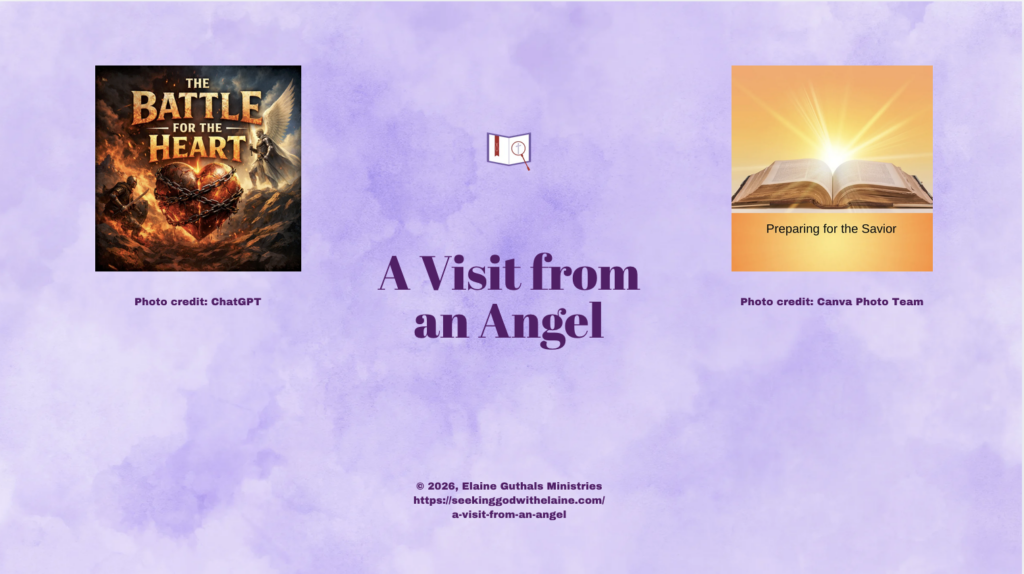
    To read devotions in The Battle for the Heart theme

    Devotions in the Preparing for the Christ Child series

    An Angel Showed Up

    “While Zechariah was in the sanctuary, an angel of the Lord appeared to him, standing to the right of the incense altar. Zechariah was shaken and overwhelmed with fear when he saw him. But the angel said, ‘Don’t be afraid, Zechariah! God has heard your prayer. Your wife, Elizabeth, will give you a son, and you are to name him John. You will have great joy and gladness, and many will rejoice at his birth, for he will be great in the eyes of the Lord. He must never touch wine or other alcoholic drinks. He will be filled with the Holy Spirit, even before his birth. And he will turn many Israelites to the Lord their God. He will be a man with the spirit and power of Elijah. He will prepare the people for the coming of the Lord. He will turn the hearts of the fathers to their children, and he will cause those who are rebellious to accept the wisdom of the godly’” (Lk. 1: 11-17 NLT)

    An Angel of the Lord Appeared

    Heaven and earth overlapped in the Temple with the incense and the angel.

    Ooo, baby. Did Zechariah get a surprise at work or what!?!?

    Second Temple Jewish thought recognized angels as messengers of Jehovah. Named angels, like Gabriel, were associated with messages and end-time expectation.

    We aren’t told exactly how the angel appeared. That wasn’t supposed to be the focal point.

    Put yourself in Zechariah’s sandals for a minute. Zechariah had probably longed to be chosen to perform the task of burning the incense and offering the prayer. Today was the day that dream would come true.

    Zechariah would have had his mind on his agenda. He was probably like us –concentrating real hard to do it right.

    Then – suddenly – an angel was standing beside the altar of incense.

    And the day Zechariah was waiting for was trumped by a visit from an angel! I bet he was a little thrown off his game and downright afraid.

    Maurice had an interesting – and true – comment. Zechariah didn’t enter the supernatural realm merely because an angel appeared to him. Temple worship itself presupposed an established relationship between the visible and invisible worlds.

    Resource

    Whether the angel was beautiful or frightening, Zechariah’s first reaction was fear. That seems the standard reaction to angel encounters – with everyone except Abraham and Jacob.

    God Has Heard Your Prayer

    The angel was direct, corrective, and enforced consequences.

    The angel told Zechariah that his prayers had been heard. Zechariah and Elizabeth were finally going to get the baby for which they had previously prayed.

    That really was the last thing Zechariah had expected out of the day. He and Elizabeth had given up asking for a child.

    Unanswered prayers aren’t ignored – they are answered on Jehovah’s timeline.
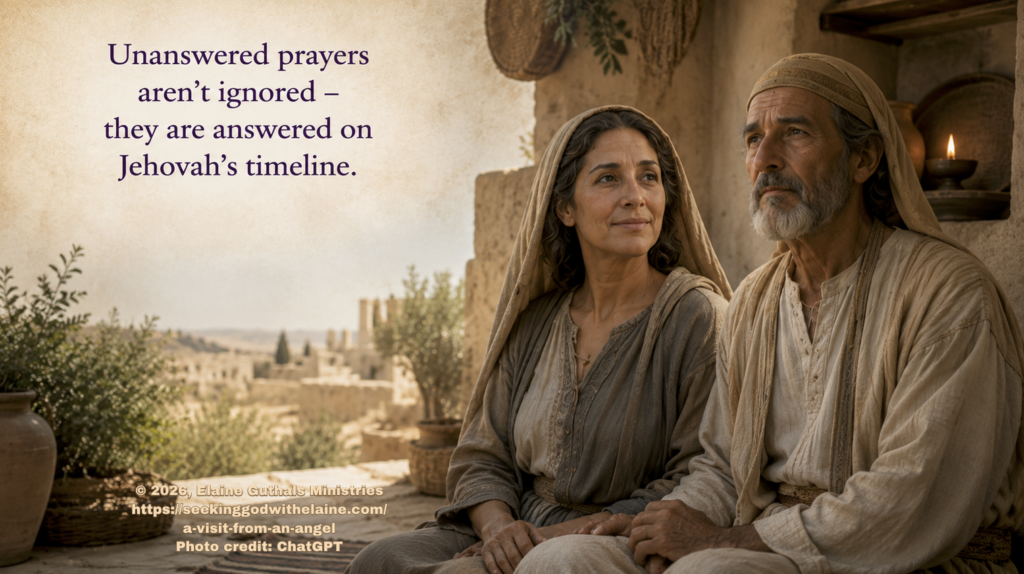
    This is a reminder that God doesn’t always answer our prayers the first time. Or second or third or four thousand, four hundred forty-fourth time.

    Still, shouldn’t our expectation – and goal – be to connect with Jehovah every time we worship? If we don’t shoot for that, are we really worshiping?

    We may pray for years before the timing is right for God to answer our prayers. He will answer our prayer in His timing. 

    • “Confess your sins to each other and pray for each other so that you may be healed. The earnest prayer of a righteous person has great power and produces wonderful results” (Jas. 5: 16 ESV).
    • “And we are confident that he hears us whenever we ask for anything that pleases him. And since we know he hears us when we make our requests, we also know that he will give us what we ask for” (I Jn. 5: 14-15 ESV).
    • “The Lord is far from the wicked, but he hears the prayers of the righteous” (Prov. 15: 29 ESV).
    • “In those days when you pray, I will listen” (Jer. 29: 12 ESV).

    But isn’t it easy for us to tell ourselves our prayers aren’t heard? That is much easier to take than acknowledging He told us no.

    Oh, yes. Jehovah will refuse to give us what we ask — when we are asking for something that isn’t in His plan for us. His plan is best for us.

    But Zechariah was a priest. I’m sure he didn’t just pray for a son. He prayed for national redemption, too. And that prayer was going to be answered, too.

    Will Give You a Son

    Gabriel told Zechariah who and what his son would become.

    John’s name is also important. It means Yahweh has shown favor.

    Did you realize the significance of what Gabriel said? He said that we mere humans are known in Heaven before we even take residence in our mother’s womb. We have a purpose. He has a plan for us.

    Yes, Gabriel was talking about John the Immerser. He could have been talking about Tom. Or even Sally. Even Elaine.

    Yes, Jehovah has a purpose and a plan for everyone.
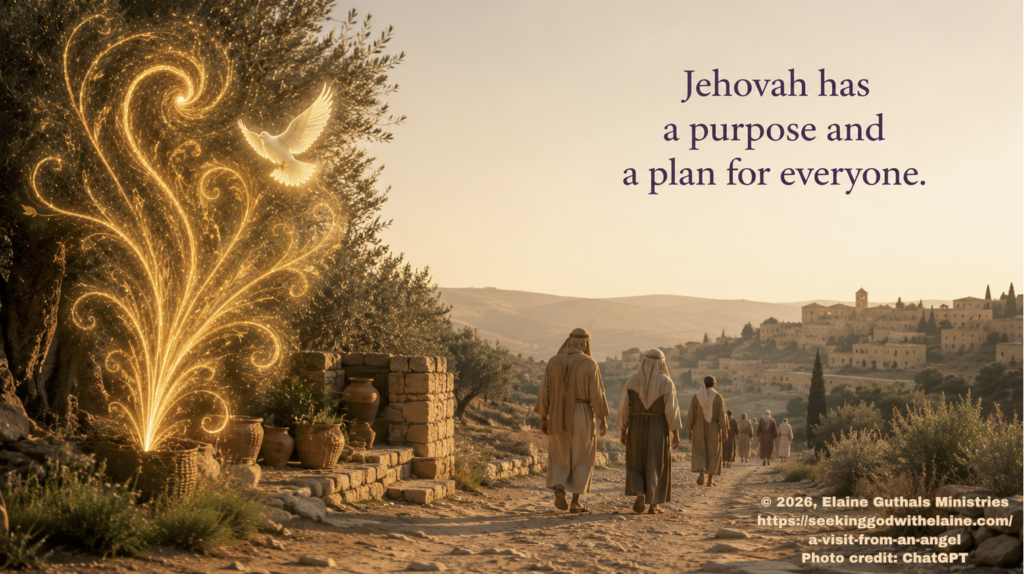
    Look what Parker said. He said, “Human life is intended to be the realization of a heavenly plan.”

    Resource

    This life is temporary. Our purpose in this life  prepares us for the next.

    Zechariah and Elizabeth had probably offered many prayers over the years for a baby. Those prayers did get to Jehovah.

    He Must

    Zechariah and Elizabeth’s son was going to be great in Jehovah’s eyes, but that came with some different requirements.

    Zechariah and Elizabeth’s son was going to have a specific mission from Jehovah. John’s role was to restore the nation’s faith, awaken a spiritually indifferent people, preach repentance, announce the coming kingdom of heaven, and introduce a new era.

    John was well suited for these tasks.

    The angel gave a very detailed explanation of what the baby could and could not do as he grew. The Nazirite Vow, as explained in Numbers 6, shares some of the restrictions given to John.

    The Nazirite Vow represents separation, dedication, and visible holiness. Some visible acts include abstaining from wine, avoiding contact with the dead, and allowing their hair to remain uncut.

    “Therefore be careful and drink no wine or strong drink, and eat nothing unclean, for behold, you shall conceive and bear a son. No razor shall come upon his head, for the child shall be a Nazirite to God from the womb, and he shall begin to save Israel from the hand of the Philistines” (Jdg. 13: 4-5 ESV).

    While most Nazirite vows were temporary, John — like Samson and Samuel — was set apart from birth for a lifelong mission. His unusual lifestyle wasn’t an end in itself; it visibly demonstrated that his entire life belonged to God.

    What the Nazirite vows to is to be consecrated or separated for God.

    Spirit of Elijah

    John would carry Elijah’s mission.

    Several times in Scripture, we see when John was asked if he were Elijah. Yeshua Himself said that John was not Elijah. He was an Elijah-type.

    It was a Messianic expectation that Elijah would return before the Messiah would come. “Look, I am sending you the prophet Elijah before the great and dreadful day of the Lord arrives. His preaching will turn the hearts of fathers to their children, and the hearts of children to their fathers. Otherwise I will come and strike the land with a curse” (Mal. 4: 5-6 NLT).

    But Gabriel said John would “… be a man with the spirit and power of Elijah …” (Lk. 1: 17 NLT). What did that mean?

    It means that John would pick up Elijah’s mission. Spirit here carries the sense of attitude, disposition, and prophetic calling. He would carry the same prophetic calling and authority.

    Further, Elijah and John called for repentance. They wanted Israelites/Jews to return to Jehovah.

    We think of John’s ministry as just that – calling the Jews to repentance for their sins. It was more than that.

    John’s ministry was calling them to covenant restoration. The Hebrew word shuv (שׁוּב) means return, turn back, and restore.

    We get the turn-back-from-our-sins part. But we focus on ourselves.

    Jehovah is calling humans to return to the Garden of Eden existence. He is calling us back to covenant faithfulness.

    Both were fearless, uncompromising, and zealous for God’s covenant.

    The Priest Doubted

    “Zechariah said to the angel, ‘How can I be sure this will happen? I’m an old man now, and my wife is also well along in years.’ Then the angel said, ‘I am Gabriel! I stand in the very presence of God. It was he who sent me to bring you this good news! But now, since you didn’t believe what I said, you will be silent and unable to speak until the child is born. For my words will certainly be fulfilled at the proper time’” (Lk 1: 18-20 NLT)

    How Can I Be Sure

    Zechariah doubted what the angel said and so paid the consequences.

    Put yourself in Zechariah’s shoes. Would we expect to get a visit from an angel? No – we may secretly hope for it, but we never in a million years think it would happen. “Why would Sovereign God take His time to send someone to specifically talk to us?”

    Then it actually does!!!! Probably our first thought would be, “What have we done wrong?”

    Then we hear that thing we have been praying about for so long was going to be answered. We immediately start feeling unworthy. “We don’t deserve that!”

    All of a sudden, we stop. This is not humanly possible. Why are they getting my hopes up for nothing.

    But think of it. Zechariah was a priest – a family calling. Here he was going to have a son – and the son wasn’t going to be a priest.

    John wouldn’t continue his father’s priestly ministry that Zechariah had given his whole life to serve in faith and obedience – remember he had kept all the commandments.

    Instead of serving as a priest who represented the people before God, John would become a prophet calling the people back to God. He would be preparing the people for something new.

    Can we spell c-h-a-n-g-e?

    If Zechariah was thinking Messianic expectations, he wouldn’t be thinking change. He would be thinking the whole nation would get an atta boy.

    Instead — in Zechariah’s eyes  — John was going to be a radical. I wonder if Zechariah was worrying he wouldn’t be able to recognize him.

    Zechariah was gutsy – and not so smart. He asked the angel for proof. How was he supposed to be sure that this would happen?

    People are always asking for signs as proof of something. The more humanly impossible it is, the greater the sign we need to convince us anything is possible with Jehovah.

    Since You Didn’t Believe

    There are consequences when we sin, and Zechariah was about to find out his.

    Unfortunately, Zechariah questioned Gabriel because he doubted God. Because of his doubt, he couldn’t speak until John was born and named (Lk. 1: 20, 63-64).  

    We learn that the angel’s name is Gabriel. He has appeared on earth one time before and will appear one time in the near future – that we are told.

    Gabriel – Gavri’el ( גַּבְרִיאֵל) – the mighty messenger from God – first visited Daniel in Daniel 8: 16 and Daniel 9: 21-23. He was there to interpret the revelation and connect heavenly plans with human understanding of when the Messiah was coming. In six months, Gabriel would visit Elizabeth’s cousin, Mary, to tell her the good news.

    Did you catch that verse? “… I stand in the very presence of God. It was he who sent me to bring you this good news!” (Lk: 1: 19 NLT). That means Gabriel is part of Jehovah’s inner court.

    Think about the messages Gabriel gave when he made his visits. He told Daniel that redemption was coming. He told Zechariah and Mary that redemption was here.

    Goodwin noted that Zechariah’s doubt was the exact opposite of Abraham’s obedience. One gained righteousness because of belief. The other earned muteness because of sin.

    Resource

    Remember how Zechariah was described earlier. “Zechariah and Elizabeth were righteous in God’s eyes, careful to obey all of the Lord’s commandments and regulations” (Lk. 1: 6 NLT).

    If Zechariah obeyed all of God’s laws and commandments, isn’t that enough? No. We have to be obedient in everything that Jehovah asks us to do.

    We each have our own individual plan of what our mission in Jehovah’s kingdom will be. We have to perform it faithfully.

    Zechariah saw that it was impossible and took his eyes off Jehovah.
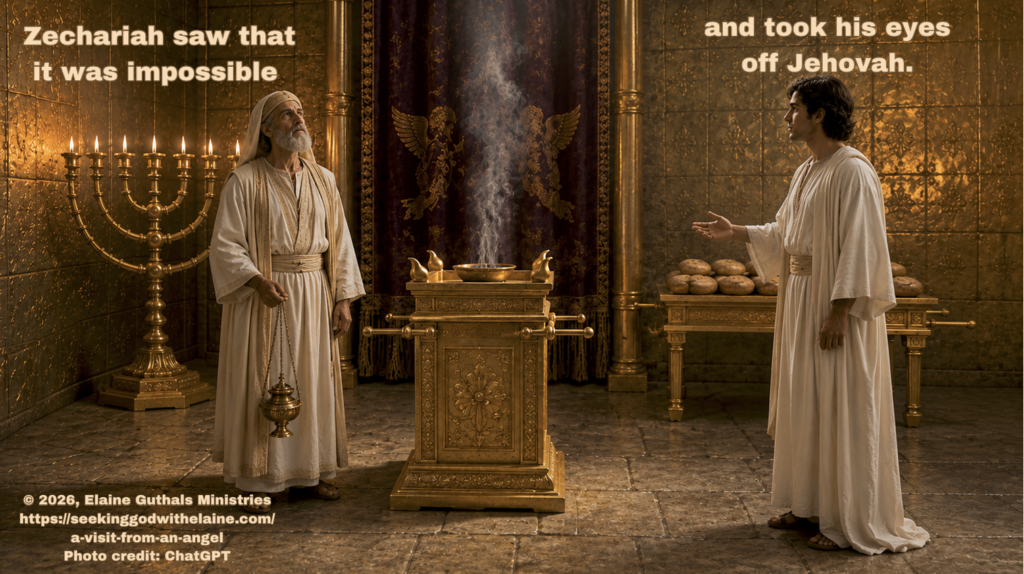
    By the time the audience was over, Zechariah realized Gabriel was a high-ranking messenger in Jehovah’s court, one who told of divine plans, was a bridge between heaven and earth, and was present at key turning points in redemption history.

    Aftermath

    “Meanwhile, the people were waiting for Zechariah to come out of the sanctuary, wondering why he was taking so long. When he finally did come out, he couldn’t speak to them. Then they realized from his gestures and his silence that he must have seen a vision in the sanctuary” (Lk: 1: 21-22 NLT)

    All the time that Zechariah was having his discussion with Gabriel, there were people waiting for him to come back out of the Holy Place.

    The people had been praying while Zechariah was burning the incense. “While the incense was being burned, a great crowd stood outside, praying” (Lk. 1: 10 NLT).

    The service would have gone on even though Zechariah was taking longer than usual. There were other priests performing those tasks.

    The problem was that burning the incense shouldn’t have been taking that long. The congregation was concerned because the delay was unusual.

    They had cause to be concerned. Other priests had lost their lives as consequences for impurity or disobedience.

    • “Aaron’s sons Nadab and Abihu put coals of fire in their incense burners and sprinkled incense over them. In this way, they disobeyed the Lord by burning before him the wrong kind of fire, different than he had commanded. So fire blazed forth from the Lord’s presence and burned them up, and they died there before the Lord” (Lev. 10: 1-2 NLT).
    • “But when they arrived at the threshing floor of Nacon, the oxen stumbled, and Uzzah reached out his hand and steadied the Ark of God. Then the LORD’s anger was aroused against Uzzah, and God struck him dead because of this. So Uzzah died right there beside the Ark of God” (II Sam. 6: 6-7 NLT).

    Additionally, the congregation were expecting a blessing. It more than likely would have been like “‘May the Lord bless you and protect you. May the Lord smile on you and be gracious to you. May the Lord show you his favor and give you his peace’” (Num. 6: 24-26 NLT).

    So, the congregation was waiting for the normal conclusion of the service. They got something better.

    They got the answer to prayer – Messiah was coming.

    A Barren Woman Conceived

    “When Zechariah’s week of service in the Temple was over, he returned home. Soon afterward his wife, Elizabeth, became pregnant and went into seclusion for five months. ‘How kind the Lord is!’ she exclaimed. ‘He has taken away my disgrace of having no children’” (Lk. 1: 5-25 NLT)

    What Gabriel said would happen came to pass.

    We don’t know which day of Zechariah’s week of service that he encountered the angel. We know that when he went home, he had a fantastic tale to tell Elizabeth.

    Soon afterward, Elizabeth became pregnant. Now it has long surprised me that Elizabeth went into seclusion for the first five months of her pregnancy.

    Why?

    Think about the time. Pregnancy in the first century – especially when the mother was of an advanced age – carried risks. This was particularly true in the early months of the pregnancy, when miscarriage was common.

    We also have to remember that Elizabeth was barren for many years. What would people think if she suddenly said, “Hey, I’m pregnant” and didn’t have the baby bump to prove it?

    Consider, too, how the proud parents learned about the upcoming pregnancy. It was a divine intervention. Within Jewish religious culture, extraordinary divine acts often were followed by withdrawal, prayer, and reflection.

    It is probably safe to say all of the above was at least considered in Elizabeth’s decision to seclude herself for five months. She had to go from the heartbreak of being barren to anticipating a new life. That probably would take a month or two.

    Making the Connections #1

    Is it interesting that Luke didn’t describe Gabriel’s appearance? He didn’t say he had wings. He didn’t say he was to be worshiped. He didn’t even say he was an archangel.

    Gabriel was there for one reason – to pass on the message of forgiveness and redemption.

    Making the Connections #2

    Ryle made an interesting observation. He said the missions of John and Yeshua were similar. Both were witnesses.

    Resource

    John’s mission was to witness for Yeshua. Yeshua’s mission was to witness for Jehovah.

    Yeshua was also a witness for Himself – for the light. The Memra – Light – was already shining. A prophet had been sent to identify Him. Now, Israel must decide to accept or reject the Light.

    Heart Check

    Think about the battle Yeshua is engaged in for your heart. Ask yourself the following questions.

    • Have I invited Jehovah to transform my entire life, or am I asking Him to change only the parts I’m willing to surrender?
    • Like Zechariah, am I faithfully serving Jehovah in the ordinary moments of life, allowing Him to shape my character while I wait on His timing?

    How Do We Apply This?

    • Expect Jehovah to speak through His Word, shape your heart, or answer a prayer every time.
    • Don’t assume a delayed answer means God isn’t listening.
    • Ask Jehovah how He wants to use you where you are today.
    • Keep your eyes on Jehovah, not your circumstances.
    • Remember that His power is not limited by your circumstances – even when  God’s promises seem impossible.
    • Choose obedience rather than demanding more proof when convicted.
    • Surrender our plans and trust that His are better.

    Father God. Forgive us when we focus on circumstances more than we focus on Your revelation. Forgive us when we limit You to physical confines. Help us to grow our faith so that we can surrender the first time to Your plan. Amen.

    If you don’t understand something and would like further clarification, please contact me.

    If you have not signed up for the email providing the link to the devotions and the newsletter, do so below.

    If God has used this devotion to speak with you, consider sharing it on social media.

  • Ensuring Our Salvation by Our Attitude

    In order to be sure of our salvation, we have to keep our attitude right. This devotional reading looks at rejoicing, praying, and giving thanks continually.

    Nuggets

    • Constant rejoicing in all circumstances is essential for ensuring our salvation.
    • Constant communication with God through prayer is essential for ensuring our salvation.
    • Constant thanksgiving in all circumstances is essential for ensuring our salvation.

    We’ve talked about habits that we have to cultivate in order to be sure of our salvation. We have to seek God and follow Jesus. We have to do what God requires. We have to be in Christ.

    In this devotion, we are going to discuss getting our attitude right. If that isn’t hard enough sometimes, we have to have the right attitude continually.

    Let’s check it out.

    Let’s Put It into Context

    To read devotions in the Habitual Holiness of Heart and Life theme, click the button below.

    Here is a running list of nuggets for the theme.

    Devotions in the The Surity of Our Salvation study

    Here is a running list of nuggets for the study.

    The foundation of this study is Beveridge’s sermon The Believer’s Safety

    Resource

    Assurance in Rejoicing

    “Rejoice always” (I Thess. 5: 16 ESV)

    Constant rejoicing in all circumstances is essential for ensuring our salvation.

    God has graciously and mercifully offered us salvation. It is cause for us to rejoice always.

    As much of a privilege to be able to rejoice, it is also a commandment. We are told to not be sticks in the mud.

    This tells me that it is our choice to rejoice. Even in the deepest of trials, we have reason to rejoice. We are not alone. God never leaves us.

    To me, cheerful is the outward expression of being happy. That is dependent on circumstances.

    Rejoicing ties in to being thankful. We can rejoice regardless of circumstances.

    I think we have trouble in rejoicing in the trials because we, too, see rejoicing tied with our happiness. It has no ties with the worldview ways of showing our happiness.

    It isn’t. We should rejoice because Sovereign God Who is all-knowing, all-seeing, and ever present is in control of what is happening to us. Our rejoicing has to come from God.

    As our understanding of God increases as we are sanctified, our rejoicing increases. We have to focus on God’s truth.

    Rejoicing always helps increase our faith and hope. If wills us with patience.

    We should rejoice in every aspect of the gospel. All the doctrines and promises lead us to God, the most important thing in our lives.

    Fewer doubts will creep in if we are rejoicing being God’s child, even in the worst of trials. Keeping our focus on Him calms us and strengthens our resolve to find contentment and rejoice in all circumstances.

    If we focus on the rejoicing side of things, we focus on what we gain after conversion. That is so much more than what we have chosen to give up.

    Rejoicing helps us when we to the point where we feel like we have lost the connection with God. We are assured that He hasn’t left us.

    We have to make a conscious decision to draw near to God. Yes, God calls us to salvation, but we cannot be careless or indifferent in approaching Him.

    Rejoicing always helps us have the right motives in service God. We use better judgment and are more obedient.

    When we have an attitude of rejoicing, we are more likely to cast our cares on God (I Pet. 5: 7-10). When we allow the anxiety to come in, we split our faith.

    Because we lack faith, we tend to see trouble where there is none or blow what there is out of proportion. That cuts down our rejoicing.

    We can only resist Satan when we are steadfast in our faith. Rejoicing leads to steadfast faith.

    The cost of discipleship is high. We have to be willing to pay it. We won’t be if our attitude is any less than rejoicing always.

    The first greatest commandment helps us get our attitude right. “And you shall love the Lord your God with all your heart and with all your soul and with all your mind and with all your strength” (Mk. 12: 30 ESV).

    We have to love God with all of our being.

    Assurance in Praying

    “pray without ceasing” (I Thess. 5: 17 ESV)

    Constant communication with God through prayer is essential for ensuring our salvation.

    It is very important that disciples have a consistent prayer life. More importantly, though, these prayers must be sincere in rejoicing in and worshiping God.

    We initiate the prayers, but it isn’t just that we pray. We have to mean the prayers and be submissive to God when we pray.

    The best time to communicate with God is when we are rejoicing. That contact brings the joy.

    That is talking about how we are to make praying a habit. Praying with0ut ceasing means it is habitual prayer.

    We get hung up, however,  on the pray without ceasing part. This is a broad term that makes it seem an unfulfillable commandment. We are practical people, so we ask how we can pray while we sleep.

    We shouldn’t be praying to God because it is our duty – especially in the dry times. We always need to talk to Him because we are His servants and friends and siblings of Jesus.

    The inconsistency of our prayers breaks our prayer habit. We have to keep the habit of praying regardless of the situation we are in.

    We are always thinking and feeling. They should be a result of our prayers.

    What it does tell me is the attitude of prayer is just as important as saying the words out loud. Prayer is an act of worship. We can worship anytime.

    Prayer keeps our focus on God. It builds the habit, instead of waiting until we are in the midst of a trial.

    The thing is, we face trials, get discouraged, and cease praying. God doesn’t want us to cease praying when our faith is weak. Even when we have faith of a mustard seed, we need to keep putting everything under His control.

    Again, that is where the doubts start to flood in.

    But then again, we cease praying when things are going well. We don’t think we need Him when we can handle everything.

    That can not only call into question the surety of our salvation, but it also undermines our view of the necessity of our salvation.

    The surety of our salvation also takes a hit when we feel that God no longer hears us when we pray.

    God is going to hear our consistent prayers. He will hear the prayers of those who have ABCDed. He will always hear the prayers when people ABCD.

    That leaves the question of whether He hears the prayers of those who haven’t/who aren’t ABCDing.

    If we stop praying, we’ve left Him, so He leaves us.

    We have to develop our prayer life. We do that as we navigate the Sanctification Road.

    We have to remain sincere in our prayer lives, or it become outward worship. That is just lip service.

    Assurance in Giving Thanks

    “give thanks in all circumstances; for this is the will of God in Christ Jesus for you” (I Thess. 5: 18 ESV)

    Constant thanksgiving in all circumstances is essential for ensuring our salvation.

    It is really hard to give thanks to God when we are knee-deep in doubt of our salvation. It is hard to take our eyes off the world wind of emotion caused by the uncertainty. Then to be thankful for it!

    Even in our confusion, God shows us mercy. “The steadfast love of the Lord never ceases; his mercies never come to an end; they are new every morning; great is your faithfulness” (Lam. 3: 22-23 ESV).

    Notice, it doesn’t say God’s love and mercies ebb and flow with our emotions. His love remains steadfast.

    God asks no less from us. He wants us to remain steadfast. He wants us to endure.

    What God is calling for here is our worship. Thankfulness is a product of our faith. It leads to praise.

    How are we supposed to give thanks to God? “And give thanks for everything to God the Father in the name of our Lord Jesus Christ” (Eph. 5: 20 NLT). It should be through the name of Jesus – the One through Whom our salvation is possible.

    Yes, a lot of our praise comes out in the form of prayer. “Continue steadfastly in prayer, being watchful in it with thanksgiving” (Col. 4: 2 ESV).

    Yep, there is that steadfastness again.

    ensuring-our-salvation-by-our-attitudeFB

    Making the Connections

    What do we do when we rejoice, pray, and are thankful? We sing. We stay in closer communion with God. We serve Him more.

    Rejoicing, prayer, and thankfulness really are connected. They produce peace and contentment. “And let the peace of Christ rule in your hearts, to which indeed you were called in one body. And be thankful” (Col. 3: 15 ESV).

    Peace really does comes from Jesus. “Peace I leave with you; my peace I give to you. Not as the world gives do I give to you. Let not your hearts be troubled, neither let them be afraid” (Jn. 14: 27 ESV).

    That is how I memorized the verse. Look at this translation. “I am leaving you with a gift — peace of mind and heart. And the peace I give is a gift the world cannot give. So don’t be troubled or afraid” (Jn. 14: 27 NLT).

    Look at that verse in Colossians again. “And let the peace of Christ rule in your hearts, to which indeed you were called in one body. And be thankful” (Col. 3: 15 ESV).

    When we have peace, we will be sure of our salvation. But it is all about being a heart issue. We have to get it down to the heart level.

    We must fight evil in our hearts. Therefore, our heart is what allows our peace to be stolen. If we aren’t alert, we let all these doubts and fears creep into our hearts and minds and steal our peace and the surety of our salvation.

    It is our choice whether we are going to remain peaceful. In order to keep that peace, we have to watch.

    We have to keep gratitude as a priority. We have to be ready to be thankful in every circumstance.

    We do that when God rules our hearts. When we give Him control of it lives, we know He is going to work things out (Rom. 8: 28) — even if it has to get bad for a while.

    Only God can create this peace. And He gives it to us freely when we admit our sins, believe on Jesus as Redeemer, confess God as Sovereign Lord, and demonstrate that commitment by following our job description.

    How Do We Apply This?

    • Rejoice in every situation and stage of life.
    • Pray regularly to form the habit of praying.
    • Persist in prayer, even when we feeling our prayers are not being answered.
    • Remain sincere and fervent – and reverent – in our prayers.
    • Focus on God, being thankful to Him in everything.

    Resource

    Father God. We want to be totally focused on You. We want our attitude to be of continual rejoicing, prayer, and thanksgiving. We are grateful that You are our Father and have given us salvation. Amen.

    What do you think?

    Leave me a comment below (about this or anything else) or head over to my Facebook group for some interactive discussion.

    If you don’t understand something and would like further clarification, please contact me.

    If you have not signed up for the email providing the link to the devotions and the newsletter, do so below.

    If God has used this devotion to speak with you, consider sharing it on social media.

  • Ensuring Our Salvation by Being in Christ

    We’ve been looking at habits needed to ensure our salvation. This devotional reading looks at what it means to be in Christ – a new, regenerated creation.

    Nuggets

    • We can’t forget the deadly place from which we came.
    • Paul wanted his reader to focus on what they have gained in their but now state.
    • As new creations, we imitate Jesus.
    • Regeneration occurs instantaneously at conversion.

    Let’s dig a little deeper into taking up our crosses. When we give up our desires and lusts, we need to replace them with something.

    We call that being in Christ. What habits do we need to form in order to do that?

    Let’s Put It into Context

    To read devotions in the Habitual Holiness of Heart and Life theme, click the button below.

    Here is a running list of nuggets for the theme.

    Devotions in the The Surity of Our Salvation study

    Here is a running list of nuggets for the study.

    The foundation of this study is Beveridge’s sermon The Believer’s Safety

    Resource

    What Does “in Christ” Mean?

    “Therefore remember that at one time you Gentiles in the flesh, called ‘the uncircumcision’ by what is called the circumcision, which is made in the flesh by hands — remember that you were at that time separated from Christ, alienated from the commonwealth of Israel and strangers to the covenants of promise, having no hope and without God in the world. But now in Christ Jesus you who once were far off have been brought near by the blood of Christ” Eph. 2: 11-13 ESV)

    Paul wanted his reader to focus on what they have gained in their but now state.

    The focus of Ephesians 2: 11-12 is to remember. Remember what used to be without Christ – without the restoration of that relationship.

    That is easy to do right after conversion. It is harder when we have years into being a child of God’s.

    Some may consider the “alienated … strangers … having no hope …” (Eph. 2: 12 ESV) the worst parts. Paul saw the worst was “… without God …” (Eph. 2: 12 ESV).

    Paul’s point was we have nothing without God. We are not blessed without God.

    Paul specifically wanted his readers to remember the time that they were without Christ. He wanted them — and us — to contrast without Christ to in Christ.

    Paul said eight — maybe nine depending on how you read one of the in Him references — times that we are in Christ. The but now time is much better than the without Christ time.

    • Before Christ, we were lost; after Christ, we are saved.
    • Before Christ, we were dead; after Christ, we are alive.
    • Before Christ, we were miserable; after Christ, we are joyful.

    Being a creature of God isn’t enough to make us children of God. Nor is being made in His image.

    Being made children of God occurs through regeneration and adoption. In order to become children of God, we have to come after Him – believe in Jesus.

    Believing that Jesus is the Messiah isn’t enough. “You believe that God is one; you do well. Even the demons believe — and shudder!” (Jas. 2: 19 ESV).

    We have to be in Christ.

    When I say I am into Pastor Steve, I mean that I get him. I understand who he is.

    • Who he is as a person.
    • His values.
    • How his mind works.
    • What he thinks about himself.
    • What is important to him.

    Understanding all that helps me to realize what Pastor Steve is looking for from me.

    Now, apply that to Christ. We have to know all that about Jesus.

    The focus should be on Christ. We are only saved because Jesus provided salvation from our sins.

    The bottom line in all of this is God is looking for a change in us.

    • We have to start loving God.
    • We have to follow all His laws and commandments, not try to rewrite them.
    • We have to stop doing things that He disapproves of — whether we agree with Him or not.

    How is this done? God creates a new us.

    What Does It Mean to be a New Creation?

    “Therefore, if anyone is in Christ, he is a new creation. The old has passed away; behold, the new has come” (II Cor. 5: 17 ESV)

    As new creations, we imitates Jesus.

    Once we are in Christ, we are made a new creation. Yes, we are still in our earthly bodies. We still have our sinful nature.

    What new things are we supposed to welcome?

    • New disposition
    • New character
    • New thoughts
    • New habits
    • New goals
    • New motivations
    • New preferences
    • New opinions
    • New boundaries
    • New views
    • New affections

    Being a new creation is all about being unified with Christ. That unity happens the moment we choose to have faith.

    The old is our old physical, sinful self. The new is all about conversion and regeneration.

    This change has to be a complete change — heart, mind, body, and soul. It has to be all of us.

    True, we can be with Jesus without imitating Him — without being in Christ. Well, we think we can because that isn’t real salvation “Not everyone who says to me, ‘Lord, Lord,’ will enter the kingdom of heaven, but the one who does the will of my Father who is in heaven” (Mt. 7: 21 ESV).

    Our goal should be to imitate Jesus. Our heart has to be that of Jesus’. Our mind has to be His mind.

    It has to be a growth process. God has to start with us where we are and work to get our character where we need to be. This is not starting from scratch. It isn’t an instantaneous overhaul. If He did that, free will would go out the window.

    Besides, what did Jesus tell Nicodemus? God’s kingdom has a specific entrance requirement. That requirement is that we be born again.

    The Holy Spirit works through us to make us new creations as we read God’s Word. He works individually with us — specifically with whatever issues we are dealing with at the time.

    One of the jobs of the Holy Spirit is to interpret Scriptures. Only then can we understand what God is telling us as well as teach us things that aren’t in the Bible.

    It is imperative that we read the Scriptures. When we diligently read the Scriptures, we leave less of an opening for sin to take hold. We have to approach reading the Scriptures with faith.

    We can’t expect instant understanding when we read Scriptures. Instead, change has to come from our heart as God reveals His mysteries to us.

    We have also talked about being crucified with Christ. “For we know that our old self was crucified with him so that the body ruled by sin might be rendered powerless so that we may no longer be enslaved to sin, since a person who has died is freed from sin” (Rome 6: 6-7 CSB).

    The bottom line is we are changed. We are no longer our sinful selves. We need to divest ourselves of what used to be.

    We are sinners saved by grace.

    Oh, yes. Every part of us will need to go under God’s microscope to make sure all sin has been cut out.

    And oh, yeah. We will probably be our own worst enemy.

    Don’t worry. That is a lifetime, progressive process called sanctification.

    What Does Regeneration Mean?

    “But when the goodness and loving kindness of God our Savior appeared, he saved us, not because of works done by us in righteousness, but according to his own mercy, by the washing of regeneration and renewal of the Holy Spirit, whom he poured out on us richly through Jesus Christ our Savior, so that being justified by his grace we might become heirs according to the hope of eternal life” (Ti. 3: 4-7 ESV)

    Regeneration occurs instantaneously at conversion.

    Really, what happens at conversion is the act of passing through the narrow gate. “Enter by the narrow gate. For the gate is wide and the way is easy that leads to destruction, and those who enter by it are many. For the gate is narrow and the way is hard that leads to life, and those who find it are few” (Mt. 7: 13-14 ESV).

    On the other side of the gate is regeneration. It makes us clean because we are washed.

    This washing allows the Holy Spirit to take up residence. One problem is, He has a lot of remodeling to do. We are still in our physical bodies, so we are still in our sinful bodies.

    That is where regeneration comes into play.

    Regeneration gives us a new character. However, during our lifetimes, we work on fusing that character with our physical character so that we imitate God. That part is called sanctification.

    It is easy to get the two mixed up. We may think that regeneration is a three-parter like salvation is – having a past, a present, and future aspect. This is especially true since we will be having a new body once we get to Heaven.

    I think the regeneration is just being changed from spiritually dead to spiritually alive. The rest of the changes under the resent aspect is sanctification.

    For example, we receive a new character upon conversion. That is part of being changed from spiritually dead to spiritually alive.

    But then we also have to build our character to be more like God’s when we navigate the Sanctification Road. This change can only take place through the workings of the Holy Spirit.

    God alone regenerates us. Only He can change us. When we show we have faith and accept God’s Plan of Salvation, we are changed to be holy, as the Sovereign Lord is.

    Our initial confession renews our relationship with God. God restores our relationship and makes us spiritually alive.

    What we have to remember is regeneration begins instantaneously at conversion. It ushers in God’s grace when we put or faith and trust in Him and allows grace to reside in our hearts.

    Regeneration is where we get our spiritual nature back. That spiritual nature is being righteous.

    Let’s put those two concepts of righteousness and regeneration together. We only become righteous when we become holy.

    Being righteous means we are free from sin because we are following God’s moral laws. We are only free from sin when we are set apart. We are only set apart when we have been given the internal new birth obtained through salvation.

    That is why we cannot work our way into salvation. We ourselves cannot make those changes.

    You see, it isn’t just about reconciliation. Oh, yes. We need forgiveness for our sins. We are separated from God and are disobeying His laws and commandments.

    But regeneration is about restoration. Restoration is bringing our relationship with God back to what it was.

    What God wants to bring us back to is what Adam and Eve had before the original sin. That can only be accomplished through grace. Grace leads to faith, which leads to salvation, which leads to regeneration.

    God can do this.

    How being born again is different than regeneration? Being born again is a principle of grace, something that is infused instead of acquired, due to the power of God, an inward change, and the birth of all of our graces.

    Is maybe being born again the what and regeneration the how? Or is it like sanctification: navigating the Sanctification Road, working out our salvation, and growing from milk babies to steak adults? To me, those are all names of the same thing.

    We have to be in Jesus to do this. Everything is built on Jesus because He is the only way we get reconciled with God.

    ensuring-our-salvation-by-being-in-christFB

    Making the Connections

    Regeneration, new creation, circumcision of the heart – it is all the same way to say that we are restored to being in Christ. “But now in Christ Jesus you who once were far off have been brought near by the blood of Christ” (Eph. 2: 13 ESV).

    That restoration has been made because of the power “… by the blood of Christ” (Eph. 2: 13 ESV). His blood sealed the everlasting covenant.

    But we have to more than just remember our sinful condition. We have to keep away from it.

    “Put to death therefore what is earthly in you: sexual immorality, impurity, passion, evil desire, and covetousness, which is idolatry. On account of these the wrath of God is coming. In these you too once walked, when you were living in them.” (Col. 3: 5-7 CSB).

    God doesn’t just raise us from the dead — forgive us of our sins — and let that be the ultimate goal. The ultimate goal is obtaining His character — becoming more like Him.

    Becoming like God means we become pure like Him. Being pure means not having sin in our lives.

    It is only through changing our character that we test our acceptance of and implementation of doctrine into our lives.

    God is building our character as we navigate the Sanctification Road, but it is also proving that we are on the Road. We are following His Will.

    We can’t put our belief in God down on our nightstand when we get up in the morning and may or may not look at it right before we go to sleep. We can’t go on sinning through the day while our beliefs are cozy at home.

    They have to be a part of our lives. We must live out our beliefs.

    What we sometimes don’t want to think about is that being in Christ means being forged by the fire. The Sanctification Road isn’t some beautiful country path loaded with flowers and butterflies.

    It is the potters’ wheel and the kiln.

    How Do We Apply This?

    • Open our hearts and minds to accept Jesus as our Savior to become children of God.

    Father God. We want to be in Christ. We not only want to be new creations, we also want to be creations that have Your character. Amen.

    What do you think?

    Leave me a comment below (about this or anything else) or head over to my Facebook group for some interactive discussion.

    If you don’t understand something and would like further clarification, please contact me.

    If you have not signed up for the email providing the link to the devotions and the newsletter, do so below.

    If God has used this devotion to speak with you, consider sharing it on social media.

  • Ensuring Our Salvation by Living for God

    In determining the habits need to ensure our salvation, we need to see what Micah said God requires of us. This devotional reading looks at what is good and how we are to do justice, love kindness, and walk with God.

    Nuggets

    • We get surety in our salvation when we follow what God has specifically told us is good.
    • We get surety in our salvation when we are just as God is.
    • We get surety in our salvation when we exhibit loving kindness as God does.
    • We get surety in our salvation when we remain in sync walking with God.

    We are called to salvation. Then we are called to obedience.

    God tells us exactly what is required of us to live for Him. He used Micah to pass the word on to us.

    Let’s Put It into Context

    To read devotions in the Habitual Holiness of Heart and Life theme, click the button below.

    Here is a running list of nuggets for the theme.

    Devotions in the The Surity of Our Salvation study

    Here is a running list of nuggets for the study.

    The foundation of this study is Beveridge’s sermon The Believer’s Safety

    Resource

    What Is Good?

    “He has told you, O man, what is good; and what does the Lord require of you but to do justice, and to love kindness, and to walk humbly with your God?” (Mic. 6: 8 ESV)

    We get surety in our salvation when we follow what God has specifically told us is good.

    In God’s Word, good is more than just contrasted with bad. It is contrasted with evil.

    Good, in the biblical sense, is the workings of God within His people through His holy, pure, and righteous behavior.

    • Holy means to be set apart — because of our devotion to God — to become perfect, and morally pure while possessing all virtues.
      • Perfection means we reach a state of maturity because the combination of the spiritual graces form, when all are present, spiritual wholeness or completeness — holy, sanctified, and righteous.
        • Spiritual graces are worldly morals that have been submitted to God to further His kingdom instead of enhancing this world.
        • Sanctified means to be set free from sin.
        • Righteous means we are free from sin because we are following God’s moral laws.
      • Pure means not being sinful or having the stain of sin. 
      • Virtues are standards of moral excellence.

    Evil is equated with sin because it is that which goes against God and His purposes.

    • Sin is not believing that Jesus is our Savior to save us from our actions by humans that disobey God and break one of His reasonable, holy, and righteous laws and commandments, goes against a purpose He has for us, or follows Satan’s promptings.

    Glossary

    When Scriptures tell us about good, they mean the Good News – the gospel. It shows us our loving God. Following His laws and commandments is good for us.

    God told us point blank what we need to do in order to please Him. Being good is all about being sinless and pure in God’s eyes. There is only one way to obtain that status.

    God doesn’t hide what that way is. “We know that He is adamant that there is only one way to salvation.

    • “And there is salvation in no one else, for there is no other name under heaven given among men by which we must be saved” (Ac. 4: 12 ESV).
    • “You shall have no other gods before me. You shall not make for yourself a carved image, or any likeness of anything that is in heaven above, or that is in the earth beneath, or that is in the water under the earth” (Ex. 20: 3-4 ESV).
    • “Jesus said to him, ‘I am the way, and the truth, and the life. No one comes to the Father except through me’” (Jn. 14: 6 ESV).

    To read a related devotion, click the button below.

    But we’re not really talking about gaining salvation. We are talking about walking with God.

    How do we please God? We do what He calls us to do: do justice, love mercifully, and walk in humility with Him.

    We call our journey with God our walk. Walking is the term used to describe how we live our lives, specifically our habitual state of mind, behavior, and manners. Walking with God means we are humble, reverent, teachable servants of God. 

    Our walk is much easier when we grow closer to God. Micah gave us practical ways to do that.

    If we look at these three requirements, Hall noted how practical they are, rather than theoretical. Interesting enough, Micah told them — and us — this has nothing to do with our worship.

    It had everything to do with our lives.

    What? You think that is difficult to do? It isn’t if we are obedient to God.

    Remember, “[we] can do all things through him who strengthens [us]” (Phil. 4: 13 ESV). We can’t do it on our only. We can only do it through God’s strength.

    Doing Justice

    We get surety in our salvation when we are just as God is.

    The just are those men and women who have been regenerated and who live lives showing evidence they are following God’s laws and commandments and fulfilling every moral obligation.

    Regeneration is being changed from spiritually dead to spiritually alive and the internal new birth and requickening that God brings about through the work of the Holy Spirit to give us new character.

    • Spiritual death is the separation from God that occurred as a consequence of Adam and Eve’s original sin.
      • The spiritually alive are those who have ABCDed, so they are no longer separated from God.

    Glossary

    The ABCDs of Salvation

    If you have not become a believer in Christ, please read through the
    Plan of Salvation and prayerfully consider what God is asking you to do.

    A – admit our sins
    B – believe His Son Jesus is our Redeemer
    C – confess God as Sovereign Lord

    D – demonstrate that commitment by making any changes needed in our lives to live the way in which God has called us

    The Disciple’s Job Description

    Don’t gloss over the part of the definition where it talks about following God’s laws and commandments and fulfilling every moral obligation. We know that the laws show us God’s character. They give us our morals or spiritual graces.

    We must act with honest and integrity toward each other. On doing that we have to believe God’s truth and submit to Him.

    Submitting to God is actions by humans that obey God and keep His reasonable, holy, and righteous laws and commandments, follow His purpose for us, and do not follow Satan’s promptings.

    In order to be just, we must walk with God. Many qualifiers have been used. Walk blamelessly. Be upright. Walk faithfully.

    Doing justice and being a just person is all tied up in righteousness. Righteousness is the indwelling goodness that is the result of a solid relationship with God built by a sincere life of conscientious obedience to God’s laws and commandments and from which all virtues flow.

    Loving Kindness

    We get surety in our salvation when we are exhibit loving kindness as God does.

    We as disciples are called to love one another. That is the second greatest commandment. “The second is this: ‘You shall love your neighbor as yourself.’ …” (Mk. 12: 31 ESV).

    Glossary

    We have to watch how love is interpreted, though. Nowhere in the Scriptures does it say that Christianity is to ensure that everyone has a job and that job pays a living wage. It does not mean we are tolerant of what other do and do not consider sins.

    Jesus did not come as a social savior. He came as our spiritual Savior. We can sum love up as follows.

    • Love is a main theme of the New Testament.
    • Charity (dearness, affection or high regard) is used to translate agape (God love).
    • Today, we think of charity as acts of benevolence.
    • What is meant is agape (love) flavored with benevolence.

    Love and kindness are related, but kindness is an element of love. Put another way, love is the feeling with kindness as the way it is expressed.

    Love is to bubble out of us and shine on others in the same way that God’s glory filled the temple! This comes out of faith, goodness, knowledge, self-control, patience, and godliness. We don’t have the others, we really aren’t going to have to love — not true love, not God’s type of love.

    Hear that loud and clear. We don’t have the godliness — we won’t have the love.

    We have to remember the why we are loving others. We love them because they, like us, are children of God. That is an equalizer.

    Let’s look at it another way. We are equating kindness and love. God’s character is love — it is who He is. That triggers the thought (godliness), which triggers the act itself (righteousness). So, Who God is — in fact — is controlling thoughts and behaviors.

    That makes sense.

    This love comes out of renovated, regenerated, and sanctified hearts.

    Yes, we are to love our neighbors (Mk. 12: 31) and our enemies (Mt. 5: 44). But even though we are all made in God’s image, we are not all children of God.

    • “Do not be unequally yoked with unbelievers. For what partnership has righteousness with lawlessness? Or what fellowship has light with darkness?” (II Cor. 6: 14 ESV).
    • “Do not be deceived: ‘Bad company ruins good morals’” (I Cor. 15: 33 ESV).

    We have to watch with whom we associate. Yes, it says don’t ruin our morals. What are virtues? Moral excellence.

    We have got to make sure we focus on God and be obedient to Him. Obedience means to hear and carry out the instructions that God gives us. We don’t let someone else talk us into lowering our moral standards.

    We are to focus on God, not this world. Our job is to proclaim the gospel and make disciples so that the whole earth can be united under God’s love. God’s love shining out through us is an effective witness to those with whom we come into contact.

    I am thinking godliness is the end of the continuum, but kindness and love overarch the whole continuum. God as love is involved every step of the way.

    Walk Humbly with God

    We get surety in our salvation when we remain in sync walking with God.

    I see this verse as totally addressing the test of character. Micah started it out by saying what we were talking about in the first devotion of this series.

    Christianity is the test of character. Micah told us the standard we are to use — that what God told us is good, as opposed to the evil of the world.

    It is only through God’s goodness that we will become like Him. That removes us from the damaged character of this world and gives us a character worth having.

    Micah noted that there we prove that we love goodness by walking humbly with God.

    What Micah was saying was that, when we approach God’s throne room, we should do so with the right attitude. We have to focus on God and our worship of Him.

    We do have unity with God. Sovereign God wants a relationship with sinful man. We have the privilege of walking with him.

    We submit our lives and hearts totally to Him. We depend totally on Him. We agree with Him.

    It is God Who inspires us to have good character. This manifests itself by the surrendering of our hearts.

    Making the Connections

    A life with God is all about obedience.

    The original sin began with disobedience. We have to switch to obedience.

    ensuring-our-salvation-by-living-for-godFB

    How Do We Apply This?

    Above all, we need to acknowledge God’s sovereignty, accepting His requirements for our lives.
    We need to genuinely ABCD, submitting totally to God.
    Accept that faith in God is the only way to become perfected in this life and the next.

    Resource

    Father God. We see that You are good. We submit to You and want to have Your character. Help us to have Your character that seeps down into our being. Amen.

    What do you think?

    Leave me a comment below (about this or anything else) or head over to my Facebook group for some interactive discussion.

    If you don’t understand something and would like further clarification, please contact me.

    If you have not signed up for the email providing the link to the devotions and the newsletter, do so below.

    If God has used this devotion to speak with you, consider sharing it on social media.

  • Following Christ to Ensure Our Salvation

    We are continuing to look at how we should live to please God. This devotional reading looks at how we take up our crosses and follow Him.

    Nuggets

    • We get surety in our salvation when cheerfully accept the trials God uses to sanctify us.
    • We get surety in our salvation when cheerfully follow Jesus.

    In the Surety of Our Salvation study, we’re to the point where we are applying what we’ve learned that ensures our salvation. These, too, are the habits we need for habitual holiness.

    We’ve looked at seeking God. In the last devotion, we started looking at what salvation is really about – coming after Him and denying ourselves. In this devotion, we look at what sanctification is really about – taking up our crosses and following Him.

    Let’s Put It into Context

    To read devotions in the Habitual Holiness of Heart and Life theme, click the button below.

    Here is a running list of nuggets for the theme.

    Devotions in the The Surity of Our Salvation study

    Here is a running list of nuggets for the study.

    The foundation of this study is Beveridge’s sermon The Believer’s Safety

    Resource

    Taking Up Our Crosses

    “And he said to all, ‘If anyone would come after me, let him deny himself and take up his cross daily and follow me’ (Lk. 9: 23 ESV)

    We get surety in our salvation when cheerfully accept the trials God uses to sanctify us.

    Taking up our crosses can be a scary thing sometimes. It is especially so when we think it is a literal definition.

    Crucifixion was the chosen as a form of punishment because it was painful and degrading. Offenders were usually impaled on the stakes, but their wrists could have just been tied to the crossbeam.

    Depending on the method, it could take days for offenders to die. This was because the cause of death was usually loss of blood circulation or heart failure. To hasten death, soldiers would break the offenders’ legs so they could not support the weight of their bodies.

    There is a powerful message given here. When we “see” Jesus on the cross, we see Him giving up His will for God’s Will. We know that Jesus was hoping some other way could be created to accomplish redemption. That was His prayer in the Garden of Gethsemane (Mt. 26: 36).

    But Jesus said — regardless of how it had to shake out — He would do God’s Will. He couldn’t have been looking forward to the pain and humiliation. He went through with the plan anyway.

    That submission is what Paul meant when he said that we should be crucified with Christ. He used the symbolism of baptism to describe how we are now dead to our old way of life — one controlled by our sinful nature.

    Christ is the start of our reconciliation with God. “… ‘I am the way, and the truth, and the life. No one comes to the Father except through me’” (Jn. 14: 6 ESV).

    Boston made a great observation. He wrote, “God will lay down the cross for every one who seeks heaven, that they shall have nothing ado but to take it up.”

    Resource

    Too many times today, we think taking up our crosses is all about self-denial. I don’t think Christ would have said it two different ways if He mean the same thing.

    To me, self-denial is more like giving up our old selves. Taking up our crosses is us becoming our new selves.

    When we take up our crosses, we are united with Him. “For if we have been united with him in a death like his, we shall certainly be united with him in a resurrection like his” (Rom. 6: 5 ESV).

    When we take up our crosses, we take up what is needed for us to navigate the Sanctification Road. That entails the following:

    • We sentence sin to death and execute it by accepting Jesus as our Lord and Savior.
    • We strive to grow in grace and knowledge so that we can imitate Him.
    • We make this decision – and decisions every day – to follow Him of our own free will.

    It is in taking up our crosses – daily – that we are truly free. “So if the Son sets you free, you will be free indeed” (Jn. 8: 36 ESV).

    Just so we are perfectly clear. “For one who has died has been set free from sin” (Rom. 6: 7 ESV). Denying ourselves is an integral part of taking up our crosses. It is making the decision daily to come after Him.

    When we take up our crosses, we will suffer trials that are painful and humiliating. We aren’t promised an easy road.

    In fact, we know it will not be easy. “Since therefore Christ suffered in the flesh, arm yourselves with the same way of thinking, for whoever has suffered in the flesh has ceased from sin” (I Pet. 4: 1 ESV).

    Did you catch that last part? If we don’t suffer, we are still sinning. If we suffer, we are a true disciple.

    When we take up our crosses, we take up our ministry. Each of us has been called to a ministry to serve God. We are all called to be priests.

    We are to share our knowledge with others. What? You don’t feel like you know enough to share with others?

    But as disciples we are commanded to grow in grace and knowledge (II Pet. 3: 18).

    That shouldn’t be our excuse. We should share what knowledge we have and be working to gain more.

    We are working toward gaining sanctified ability – being equipped by God in order to complete the ministries He has for us.

    So, we might not have the ability right now, but God is working on us to get us to have that ability.

    That job description is for everyone. It doesn’t make exceptions. We are all called to be ministers.

    We aren’t saved just for ourselves. We are saved so that we can further God’s kingdom.

    That isn’t going to be easy. In fact, some days, it is really going to feel like hanging on a cross.

    We aren’t called to do the easy stuff. We are called to persecution and being in the world but not of it.

    Yeah, it is going to be a daily exercise. That is understandable.

    We are called to completely submit our lives to God, not just on Sundays and Wednesdays. We don’t get a day off from being His child.

    But then God provides for us daily. “Therefore do not be anxious about tomorrow, for tomorrow will be anxious for itself. Sufficient for the day is its own trouble” (Mt. 6: 34).

    Elaine-speak. God will provide us what we need for the day.

    How do we know? “The steadfast love of the Lord never ceases; his mercies never come to an end; they are new every morning; great is your faithfulness” (Lam. 3: 22-23 ESV).

    We want to be very, very careful if we choose to reject a cross God has placed on our road. Remember, the cross is a sign of salvation. We’re talking about the surety of our salvation.

    There is no better way to be sure of our salvation than by accepting the cross God gives us to bear.

    Following Him

    We get surety in our salvation when cheerfully follow Jesus.

    If we are going to follow God, that assumes that He will lead us. We know that He will.

    God doesn’t offer us the Plan of Salvation, say “yay!” when we accept, and then ride off into the sunset to be seen no more.

    God never leaves us. He, Jesus, and the Holy Spirit live in our hearts. He takes a very hands-on approach to our lives.

    God leads us through His Word. “Your word is a lamp to my feet and a light to my path” (Ps. 119: 105 ESV).

    We have a guidebook all written down so that we can follow it. It leads us to God.

    Yes, there are a lot of laws and commandments in it that we need to follow. Those show us the character of God – the character that we need to make our own.

    We have to follow God so that He can sanctify us and change us to be like Him.

    God leads us through the promptings of His Holy Spirit. “When the Spirit of truth comes, he will guide you into all the truth, for he will not speak on his own authority, but whatever he hears he will speak, and he will declare to you the things that are to come” (Jn. 16: 13 ESV).

    That means we have to listen carefully. “Be still, and know that I am God. I will be exalted among the nations, I will be exalted in the earth!” (Ps. 46: 10 ESV).

    Did you catch that? We have to be still because God isn’t going to beat a drum to get our attention. “And after the earthquake a fire, but the LORD was not in the fire. And after the fire the sound of a low whisper” (I Kgs. 19: 12 ESV).

    The prompting of the Holy Spirit is a gentle whisper, as soft as a breeze.

    We have to be in tune with it to catch it.

    It is easy now with the digital tuners on radios. Remember when we had to spin the dial and get it just so to get the station to come in clearly?

    We’re in control of the dial, and no, it isn’t digital.

    That doesn’t mean the radio station isn’t there. God is there. He is expecting us to turn the dial, not just mindlessly go to the correct frequency.

    God leads us to how we are supposed to be. “He leads the humble in what is right, and teaches the humble his way” (Ps. 25: 9 ESV).

    Sometimes, I think we are too concerned about the where we are going. We have to be more concerned about the how.

    Yes, we are going to what is right – the laws and commandments written in God’s Word. But we have to be changed by the journey. That is why we have to fiddle with the radio dial.

    following-christ-to-ensure-our-salvationFB

    Making the Connections

    Self-denial and cross-bearing should be, as Thompson said, the directive of our lives.  Think about it.

    Resource

    Salvation is the foundation. None of the others – denying ourselves, taking up our crosses, and following Him – are wanted – or even possible – if we don’t have salvation.

    Salvation is all about self-denial. We must submit to God rather than lead with our pride.

    It isn’t about us. It is about what Jesus has done for us.

    Because of that, we then follow Jesus. That is sanctification.

    How Do We Apply This?

    • Work out our salvation.
    • Know that taking up our crosses has an element of self-denial.
    • Be cheerful in taking up our crosses and ministering for God.
    • Follow Christ’s example.
    • Accept that we can’t choose our own crosses.
    • Take up our crosses, not kick them out of the way.
    • Don’t run away screaming when we see our crosses but endure.
    • Don’t exit the Sanctification Road because we see our crosses as roadblocks.
    • Don’t pick up a cross that isn’t ours.
    • Don’t flat out refuse a cross because we can’t be children of God without it (Heb. 12: 8).
    • Submit to the cross willingly regardless of how heavy it is.
    • Navigate the Sanctification Road.
    • Follow God’s laws and commandments.

    Resource

    Father God. We want salvation because it restores us to You. We want sanctification because it makes us as You are. Help us grow in grace and knowledge until we are perfected. Amen.

    What do you think?

    Leave me a comment below (about this or anything else) or head over to my Facebook group for some interactive discussion.

    If you don’t understand something and would like further clarification, please contact me.

    If you have not signed up for the email providing the link to the devotions and the newsletter, do so below.

    If God has used this devotion to speak with you, consider sharing it on social media.

  • Living as Becomes Christians to Ensure Our Salvation

    As we tie up the Surety of Our Salvation series and the Habitual Holiness of Heart and Life theme, we start looking at how we should live to please God. This devotional reading looks at how we come after Jesus and deny ourselves.

    Nuggets

    • We get surety in our salvation when we genuinely ABCD.
    • We get surety in our salvation when we strengthen our faith in Him.
    • We get surety in our salvation when we accept His grace.
    • We get surety in our salvation when we truly ask for forgiveness of our sins.
    • We get surety in our salvation when we change to become as He is.
    • We get surety in our salvation when we arrive in Heaven.
    • We get surety in our salvation when we submit our lives to God by denying ourselves.
    • The best act of faith we can give God is denying ourselves.
      Even after we ask God to be our Lord and Jesus our Redeemer, we will still struggle with urges and cravings that do not reflect the way God wants us to live our lives.
    • Denying ourselves does not play a role in salvation.
      When we don’t deny ourselves, we are actually deluding ourselves.

    There are some things that every disciple can put into practice to combat the doubts Satan tries to slip in to undermine our salvation.

    Let’s Put It into Context

    To read devotions in the Habitual Holiness of Heart and Life theme, click the button below.

    Here is a running list of nuggets for the theme.

    Devotions in the The Surity of Our Salvation study

    Here is a running list of nuggets for the study.

    The foundation of this study is Beveridge’s sermon The Believer’s Safety

    Resource

    Come after Me

    “Then Jesus told his disciples, ‘If anyone would come after me, let him deny himself and take up his cross and follow me’” (Mt. 16: 24 ESV)

    We get surety in our salvation when we genuinely ABCD.

    What does come after me mean? God wants us to build a relationship with Him.

    Plain and simple, it means we accept the gift of salvation.

    God always knew that mankind was going to disobey Him. Before He even created us, He designed the Plan of Salvation to fix that.

    No, it isn’t an easy concept to wrap our heads around. Paul gave us a pretty good framework to follow when he gave us the Roman Road.

    Faith and Belief

    We get surety in our salvation when we strengthen our faith in Him.

    You see, our salvation is a three-parter. We have the initial salvation experience.

    We seek salvation in God because we believe the essential doctrines. God initially forgives us of our sins and restores our relationship with Him. He makes us spiritual alive.

    Glossary

    Faith isn’t just knowledge about those doctrines. It’s about belief (Heb. 11: 6 CSB).

    Glossary

    Our faith starts with this knowledge, but it is more than that. We have to know the evidence presented and believe it to be true. But we know we have limited understanding.

    When we don’t understand, we have to trust God (Prov. 3: 5-6 CSB). Trust is confidence that the promises of God are true.

    Grace

    We get surety in our salvation when we accept His grace.

    To Paul, the foundation of salvation is grace (Eph. 2: 8-9 ESV). God didn’t have to extend grace to us.

    Glossary

    When Adam and Eve first disobeyed Him, He could have said, “I’m done here.” But He didn’t.

    But we question if God really has this much grace. If He does, why would He give it to those who willfully disobey Him?

    Satan tries to convince us that grace isn’t free — we have to earn it. Satan is wrong.

    We have to accept God’s grace toward us. That is the only way we will find salvation.

    Look at Scriptures. They show that God wants His grace to instill in us a confidence — in Him and in ourselves (Isa. 32: 17 NLT).

    Forgiveness

    We get surety in our salvation when we truly ask for forgiveness of our sins.

    When we ABCDed, God forgave us of our sins and granted us salvation.

    Glossary

    We often question the extent of God’s forgiveness. We may think God has given us a conditional forgiveness. In other words, we think God has forgiven us – until we sin again, and He yanks His forgiveness away.

    Conversely, we may think there is this one sin that God can’t or won’t forget – like murder or adultery. That isn’t true. God forgives all our sins.

    One element is repentance. We have to be so sincere in our asking that we get to the turning away part. We have to “… from now on sin no more” (Jn. 8: 11 ESV).

    We don’t get to keep our pet sin.

    Yes, we are going to sin again – sometimes, keep committing the same sin. God will continue to forgive us when we ask.

    Sin interferes with our ability to respond to those things spiritual. Satan tells us we don’t need God — that He isn’t omnipotent as He says. He says there is no reason for atonement and that Jesus doesn’t love us because we aren’t worthy.

    What we do or don’t do with the do’s and don’ts is important after God has forgiven us and restored our relationship. The evidence of saving faith is the existence of good works in the lives of Jesus’ disciples (Col. 1: 10 ESV).

    Sanctification

    We get surety in our salvation when we change to become as He is.

    Then comes the hard part. That salvation changes us, but we are still in this earthly body. We have a long way to go to learn about who God wants us to be and make those changes. That makes us a work in progress called being sanctified.

    Salvation starts internally, but then it moves externally. If we don’t confess, we don’t have the faith; if we don’t have the faith, we don’t have the salvation.

    We have to work out our salvation. Getting us to change to be more like God isn’t flipping a switch.

    We aren’t doing the right thing because it is the right thing to do. We are doing it because it brings us closer to being what God wants us to be.

    That is where discernment comes in. We have to evaluate the situation and recognize right from wrong. 

    We show God that we love Him by enduring. We obey His laws and commandments. Perseverance is all about calmly enduring going from milk babies to steak adults.

    Working out our salvation will not be an easy undertaking. The only way we are going to succeed is through diligence.

    We are on our way to being made holy, sanctified, and righteous when we realize how much we need God. Our most important need from Him is for gift of salvation.

    We do have to build our characters in the ways God wants. That is a decision we need to make at conversion and grow into along the walk. Salvation has to make a difference in our lives.

    Our desires are still within us after conversion. Dealing with them is working out our salvation.

    God’s Word was designed by God to be a teaching book. No, its purpose is not to tell us how the earth was created. Its purpose is to introduce us to the Creator and His plan to restore our relationship with Him. It tells us of His grace and love.

    We get so caught up in God’s laws and commandments. We — and worldview people — get the mistaken notion that we have to 100% perfect in doing all the do’s and not doing any of the don’ts.

    Problem is, we can’t do that. If we were able to follow God’s law, we wouldn’t need a Savior. We can’t, so we do. That lowers the priority of obedience. No, it doesn’t take it off the table, but we don’t need law obedience for salvation.

    All we do should have one purpose — working out our salvation so that we become mature disciples. We are going to need to discipline ourselves so that we don’t give up.

    Perfection

    We get surety in our salvation when we arrive in Heaven.

    The last part of the three-part salvation is we won’t “arrive” at where God wants us to be until we get to heaven either after we die or when we are called home. We will be changed into a spiritual body then (I Cor. 15: 52).

    Only then will we reach perfection. Until then, Satan is going to keep chipping at our assurance of our salvation.

    We can’t let Satan convince us anything contrary to what God has told us.

    Denying Ourselves

    “Then Jesus told his disciples, ‘If anyone would come after me, let him deny himself and take up his cross and follow me’” (Mt. 16: 24 ESV)

    We get surety in our salvation when we submit our lives to God by denying ourselves.

    What It Means

    The best act of faith we can give God is denying ourselves.

    Denying ourselves is not giving into our sinful natures. It doesn’t mean we are giving up something we really want because we are making some supreme sacrifice. When we come after Jesus, we give up our appetites, passions, and desires that are contrary to God’s Will.

    In other words, we deny ourselves by disassociating ourselves from our sinful and selfish nature. No, that is no mean feat.

    Yes, God is the One Who sanctifies us. We can’t change ourselves.

    But we must choose to be obedient to God by renouncing anything that does not fit into God’s Will. Doing that it’s called denying ourselves.

    We must give up our old selves and become new creations. The focus isn’t on what we are starting. The focus is on what we are giving up — our old sin.

    Glossary

    The focus shouldn’t be on what we give up. We give up sinful ways that are dangerous to our spiritual and physical health.

    Instead, we should focus on the fact that we voluntarily give them up because we love, worship, and humbly submit to God. We give up sinful things to gain eternal blessings.

    We especially have to give up things that would lead us astray. This isn’t a one-day deal. This is a persevering-until-the-end deal.

    Unfortunately, we may be called to give up friends. If those friends would take us down a bad path, we need to find other friends.

    To read a related devotion, click the button below.

    How do we do it, then? “I can do all things through him who strengthens me” (Phil. 4: 13 ESV).

    Our denial of ourselves is rooted in our love for Christ. It has to be the product of our salvation.

    Jesus willingly gave up His Deity to become like mankind to save us from the penalty of our sins (Phil. 2: 5-8 ESV). For His time here on earth, He gave up being eternal, infinite, and self-existent. He gave up His all-knowing wisdom.

    That is self-denial to the max!

    Denying ourselves is another way of saying that we are true to God. The focus is off us and on Him. Paul called that being crucified with the flesh (Gal. 5: 24 ESV).

    To deny ourselves means we have to have the mind of Christ. Basically, that plays out that we have His thoughts, feelings, and will — we have His attitude.

    To read a devotion in the Committing Our Ways to God series, click the button below.

    Jesus’ mind controlled His body, and God controlled His mind.

    We have to make the conscious decision to deny ourselves — submit to God. That decision can’t be forced on us in any way.

    When we don’t make a conscious decision one way or the other — we just ignore God — we are still making a decision against Him.

    In essence, we are ignoring — and denying — the fact that we are God’s creation. He has control over us whether we like it or not.

    We also have to ask ourselves if we are coming after God for the right reason. Are we truly going to submit our lives and Will to Him? Or are we just after fire insurance?

    We’ve already been condemned, so fire insurance isn’t going to do us any good if we don’t submit.

    What It Means for the Long Haul

    Even after we ask God to be our Lord and Jesus our Redeemer, we will still struggle with urges and cravings that do not reflect the way God wants us to live our lives. We are our own worst enemy!

    No, renouncing the world is not easy. Being a disciple is counterculture to it.

    How do we reconcile denying ourselves with loving ourselves? To me, denying ourselves is giving up all things contrary to God. Loving ourselves is embracing ourselves because our character is like God’s.

    One thing we tend to forget is this love is sacrificial. Giving up is an integral part of it. This giving up can only be self-sacrificial.

    What It Doesn’t Mean

    Denying ourselves does not play a role in salvation.

    Oh, Satan wants us to think it does. But no. We don’t have to clean up our acts before we approach God to accept His gift of salvation.

    We come as we are. 

    Self-denial has nothing to do with our guilt. Nor can we think denying self is that for which God is looking.

    Salvation is only about what God planned and Jesus accomplished.

    It doesn’t mean we put ourselves into bondage under God. Jesus freed us from the bondage of sin (Jn. 8: 36 ESV).

    No, we aren’t giving up our personality and reasoning. God isn’t a dictator Who wants us to be robots.

    It doesn’t mean we give up our personal interests.

    It means we make the motivation a godly one. We are to deny ourselves the sinful things that take our focus off God and puts it on our own righteousness, abilities, and wisdom.

    We aren’t to give up everything because we think we can never live up to what God is wanting from us. Yes, God is wanting perfection — when we get to Heaven.  He is wanting maturity now.

    It doesn’t mean we do something just because it is disagreeable — or don’t do something because it is agreeable. It is about submitting to God and doing His Will.

    When We Don’t Deny Ourselves

    When we don’t deny ourselves, we are actually deluding ourselves. We are looking at God wrong, so we are looking at ourselves wrong.

    Too many times, we let ourselves get in the way of our relationship with God. We want our own desires. We want credit for the things we accomplish.

    Thomas gave us a list of the words we connect with self. Harris then added to it.

    • Self-indulgence
    • Self-dependence
    • Self-seeking
    • Self-sufficiency 
    • Self-will
    • Self-righteous 

    Resource

    But look at the title of Thomas’ sermon. It doesn’t say we keep self out of the initial confession. It says we keep self in the work we do for Christ.

    Have we known church members who are doing lots of “good” things for their glory? It looks like the work is being done to promote God’s kingdom — but it is a control issue or a pat-on-the-back issue.

    It is extremely bad when we don’t think we are going to get what we want — what we think we need — out of our relationship with God. We are not only not denying ourselves, but we are also denying God.

    • We are doing the work that we want to do, not what God is calling us to do.
    • We rely on our own abilities and skills instead of acknowledging they are from God.
    • We want recognition and are envious at those who are accomplishing more than we are.

    When we don’t deny self, it is usually because we are moment centered. We need to be future centered. 

    I know. That goes against the instant gratification that is so prevalent in society today.

    Our goal is being sanctified right now. We have to focus on the changes God is making in our lives so that we can serve Him.

    Can we deny ourselves without submitting to God? Well, yes, we can, but it won’t assure us of our salvation.

    Discernment plays a big role in denying ourselves. We have to know what God is calling us to deny and what He is calling us to embrace.

    We are called to deny everything that breaks God’s laws and commandments and revealed truth about Himself. We also are to give up everything that tempts us to serve two masters or outs stumbling blocks in front of others.

    I know. Sometimes, it is hard to renounce things as our master, especially when that means they won’t be eliminated completely from our lives and nature.

    Denying ourselves is more of a turning over to God rather than an elimination process. The soul must begin controlling the body.

    living-as-becomes-christians-to-ensure-our-salvationFB

    How Do We Apply This?

    The ABCDs of Salvation

    If you have not become a believer in Christ, please read through the
    Plan of Salvation and prayerfully consider what God is asking you to do.

    A – admit our sins
    B – believe His Son Jesus is our Redeemer
    C – confess God as Sovereign Lord

    D – demonstrate that commitment by making any changes needed in our lives to live the way in which God has called us

    The Disciple’s Job Description

    • Put our faith in God even though we cannot see Him or always understand His ways.
    • Believe that God is Who He says He is.
    • Accept God’s grace and understand that there is nothing we can do to earn salvation.
    • Believe God has really forgiven us when we ask.
    • Truly repent when we have sinned and turn from those sins.
    • Navigate the Sanctification Road through God’s guidance.
    • Love God with all our heart, soul, strength, and mind.
    • Discern what is right and wrong.
    • Exercise self-control, patience, and perseverance.
    • Understand we won’t be perfected until we reach Heaven.
    • Humbly submit to God.
    • Depend on God for all things, big and small.
    • Voluntarily submit to God.
    • Truly become new creations.
    • Endure to the end.

    Resource

    Father God. Thank You for offering us the gift of salvation. We commit to totally submit to You. Sanctify us so that we can become mature disciples here. Amen.

    What do you think?

    Leave me a comment below (about this or anything else) or head over to my Facebook group for some interactive discussion.

    If you don’t understand something and would like further clarification, please contact me.

    If you have not signed up for the email providing the link to the devotions and the newsletter, do so below.

    If God has used this devotion to speak with you, consider sharing it on social media.

  • Seeking God to Ensure Our Salvation

    We have to continue to seek God to ensure our salvation in Him. This devotional reading looks at meditating on and memorizing God’s Word while praying and submitting to Him.

    Nuggets

    • We have to meditate on God’s Word to apply what is heard, read, and learned to our lives.
    • We must memorize God’s Word so we can truly use it as a guide in every circumstance.
    • We must pray to God before and after we have heard, read, studied, meditated, and memorized God’s Word so we can submit our lives to Him.
    • We need to submit to God by trusting Him to know what is best for us.

    In the last devotion, we started looking at the part of Beveridge’s sermon entitled Uses. We are also looking at them to complete our Habitual Holiness for Heart and Life theme.

    Beveridge said that we should tend to the means which brings our souls to Christ. The first three items in the last devotion was how we seek God. We are going to look at the last three items in this devotion and look at committing our souls to God’s care.

    Let’s Put It into Context

    To read devotions in the Habitual Holiness of Heart and Life theme, click the button below.

    Here is a running list of nuggets for the theme.

    Devotions in the The Surity of Our Salvation study

    Here is a running list of nuggets for the study.

    The foundation of this study is Beveridge’s sermon The Believer’s Safety

    Resource

    The purple headings are Beveridge’s words.

    Carefully Attend Those Means which God Gives to Bring Your Souls to Christ, cont.

    Meditating

    “Keep this Book of the Law always on your lips; meditate on it day and night, so that you may be careful to do everything written in it. Then you will be prosperous and successful” (Josh. 1: 8 NIV)

    We have to meditate on God’s Word to apply what is heard, read, and learned to our lives.

    Hearing the Word depends on someone else’s schedule. We set aside our time for our daily devotion, but is that really reading God’s Word or someone’s application of a verse? That is usually a scheduled time – it can be a short one at that.

    Meditation is different. Meditation is consciously and systematically thinking of a chosen subject.

    Those thoughts are very important thoughts. They guide what our hearts become. They are the foundations of our decisions.

    God wants us to carefully consider what He is teaching us as we navigate the Sanctification Road. If we hear God’s Word but don’t evaluate it against what we believe, we may be led down a false path.

    If we read God’s Word but don’t understand it and don’t study it further – and don’t apply it to us – we aren’t going to make an informed opinion on what it is telling us.

    Meditation is the contemplation of all God is telling us — through the Holy Spirit, His Word, others — however He is talking to us. It is an examination of His holiness so we can compare it to ourselves and fix what isn’t right.

    We have to think about what we believe and apply what He is telling us.

    The time we spend meditating is really the first step to changing to live our lives more in line with that to which God is calling us.

    Isaiah told us how important it is to meditate on God. “You keep him in perfect peace whose mind is stayed on you, because he trusts in you” (Isa. 26: 3 ESV).

    Memorizing

    “I have stored up your word in my heart, that I might not sin against you” (Ps. 119: 11 ESV)

    We must memorize God’s Word so we can truly use it as a guide in every circumstance.

    We talk about burying ourselves in God’s Word. What we are really doing is getting it down to the heart level.

    Memorizing makes God’s Word a part of us. Getting it into our hearts allows it to change us.

    What better way to have God’s Word at our heart strings when we need it than to have it in our hearts already!

    Praying

    “My mouth shall speak wisdom; the meditation of my heart shall be understanding” (Ps. 49: 3 ESV)

    We must pray to God after we have heard, read, studied, meditated, and memorized God’s Word so we can submit our lives to Him.

    All through seeking God, we must be praying to Him for guidance, understanding, and praise.

    We can’t seek God on our own. He must guide us through it the entire way.

    God calls us to salvation – really, He is calling us to Himself. Our response is through prayer.

    Prayer is a two-way communication with God in which we pour out our soul to Him.

    We have to know we need God before we can come before His presence.

    We only have access to God when we believe. We can only believe if we have been told/read/decided.

    Our prayers have to come out of hearing, reading, studying, meditating on, and memorizing God’s Word.

    Commit Your Souls to Christ’s Care

    “Therefore let those who suffer according to God’s will entrust their souls to a faithful Creator while doing good.” (I Pet. 4: 19 ESV)

    We need to submit to God by trusting Him to know what is best for us.

    Entrusting our souls to the Creator. That kind of jumps out at us when we read that verse, doesn’t it?

    That is in the middle of the verse. Let’s start at the beginning as we usually do.

    Those who suffer would be everyone. I remember Pastor Tim saying that we are either in a trial, coming out of a trial, or fixing to start a trial.

    True, sometimes we suffer more in one trial than we do in another one. But a trial is anything from an annoyance to a hardship. It can be a full out battle.

    We have to remember two things. We are not alone in the battle. God is with us, fighting for us.

    Also, God allows the trials to happen for a couple of reasons. He uses those to grow us closer to Him helps us see the positive in the turmoil.

    The second is that we are just human. Sibbes put it this way. He wrote, “Because they [disciples] live among those that they cannot but suffer from, wheresoever they live. They must suffer also in regard of themselves; for the best of us all have many lusts to be subdued, and a great deal of corruption to be purged out, before we can come to heaven, that holy place into which no unclean thing can enter.”

    Resource

    Still, the trials are hard. Satan isn’t going to let up on us. He is going to hound us until we think we are going to crack.

    That is when we really entrust God with our souls. Yes, entrusting Him is an everyday occurrence.

    But when the going gets really rough, that is when we especially have to put our faith and trust in Him.

    It is going to take commitment. Our very first series this year was different aspects involved in commitment.

    • Consistency
    • Support
    • Communication
    • Agreement
    • Integrity
    • Trust
    • Engagement
    • Responsibility
    • Liability
    • Concept

    To read a devotion from the Committing to Grow Our Habits study series, click on the button below.

    It is going to take submission. We need to put everything in God’s hands and let Him call the shots. He knows the outcome where we don’t.

    How we react to suffering is important. We shouldn’t look for it or try to avoid it. When it comes, we have to endure it with grace.

    We get this grace from a faithful Creator. We can rely on His character and love.

    Smyth described God’s character as being a “… true, holy, righteous, merciful, supremely moral character.” These are just some of His attributes.

    To read a devotion in the Finding Our Center series, click on the button below.

    God doesn’t create us and then just cut us loose to fend on our own. He never leaves us.

    If God left us on our own, we wouldn’t be able to fulfill the purpose that He has for us — and He does have a purpose. “For by grace you have been saved through faith. And this is not your own doing; it is the gift of God, not a result of works, so that no one may boast” (Eph. 2: 10 ESV).

    God’s faithfulness to us includes designing the Plan of Salvation so that we can be restored to fellowship with Him. He didn’t have to — especially a Plan so costly — but He did.

    seeking-god-to-ensure-our-salvationFB

    Making the Connections

    I’ve said this before.

    So many times, we want a get-devoted-quick scheme. We don’t want to read devotions over two minutes at the screaming outside. We want a step-by-step plan to get our devotional life on track – preferably not involving the six steps listed here.

    It will always come down to we need to have more contact with God’s Word. This means both hearing and reading. But it can’t be a cursory glance. We have to study what we are hearing to make sure it is following God’s Word. We have to study what we are reading to make sure we understand what it is saying – not what we want it to say.

    Then we have to hold our lives up against what God is telling us. Are we following His Will?

    Oh, I know. Memorizing is not my strong suit unless it is put to music. I will struggle with this one.

    Overarching all of that should be prayer. We have to communicate with God. We have to give Him the honor and praise due Him.

    How Do We Apply This?

    The ABCDs of Salvation

    If you have not become a believer in Christ, please read through the
    Plan of Salvation and prayerfully consider what God is asking you to do.

    A – admit our sins
    B – believe His Son Jesus is our Redeemer
    C – confess God as Sovereign Lord

    D – demonstrate that commitment by making any changes needed in our lives to live the way in which God has called us

    The Disciple’s Job Description

    • Find a read the Bible daily plan.
    • Find good commentaries and other support materials.
    • Find on-line courses, such as the Torah class, to learn more.
    • Get God’s Word to our heart level – memorize, paraphrase, find examples from our own lives – so we can use it in times of trials.
    • Pray to God unceasingly.
    • Commit to God, especially through our engagement.

    Father God. We seek You because we are nothing without You. Through You, we can do all things that is Your Will. Help us to seek You in all we say and do. Amen.

    What do you think?

    Leave me a comment below (about this or anything else) or head over to my Facebook group for some interactive discussion.

    If you don’t understand something and would like further clarification, please contact me.

    If you have not signed up for the email providing the link to the devotions and the newsletter, do so below.

    If God has used this devotion to speak with you, consider sharing it on social media.

  • Using Our Habits to Ensure Our Salvation

    We’ve been looking at doubts that cause us to become uncertain about our salvation. This devotional reading begins to look at habits we can build to sure up our salvation.

    Nuggets

    • God gives us the means we need to seek Christ — we just have to do them.
    • We have to hear God’s Word to provide a solid foundation for our lives.
    • We have to read God’s Word on our own so that it will guide us in making decisions for our lives.
    • We have to study God’s Word and dig deeper in order to understand what we initially do not.

    This study has been the Surety of Our Salvation study. We just finished with the Christ’s Care Over His People Reaches the Day of Their Resurrection series.

    The last part of Beveridge’s sermon was entitled Uses. He didn’t have a lot of verses associated with it, but he had some great points that will not only complete the study but will also complete our Habitual Holiness for Heart and Life theme.

    Let’s Put It into Context

    To read devotions in the Habitual Holiness of Heart and Life theme, click the button below.

    Here is a running list of nuggets for the theme.

    Devotions in the The Surity of Our Salvation study

    Here is a running list of nuggets for the study.

    The foundation of this study is Beveridge’s sermon The Believer’s Safety

    Resource

    The headings are Beveridge’s words.

    Carefully Attend Those Means which God Gives to Bring Your Souls to Christ

    God gives us the means we need to seek Christ — we just have to do them.

    One thing God does not do is force Himself on us. He calls us to salvation, but it is our choice to accept His gift.

    When we do, God doesn’t just download all we need to know into our consciousness. We have to grow by seeking Him.

    We’ve looked at all the elements before, but it has been a while. Let’s look at them again.

    Searching for and Seeking God

    Hearing His Word (Rom. 10: 17)
    Reading His Word (Rev. 1: 3)
    Praying to Him (Heb. 4: 16)
    Studying His Word (Ac. 17: 11)
    Meditating on His Word (Ps. 1: 1-2)
    Memorizing His Word (Ps. 119: 11)

    Hearing

    “Therefore, everyone who hears these words of mine and acts on them will be like a wise man who built his house on the rock. The rain fell, the rivers rose, and the winds blew and pounded that house. Yet it didn’t collapse, because its foundation was on the rock” (Mt. 7: 24-25 ESV)

    We have to hear God’s Word to provide a solid foundation for our lives.

    It was imperative in Jesus’ and prior that God’s people hear His Word spoken in the synagogue. Books hadn’t been invented yet, and scrolls were not plentiful so that every house could have one.

    They needed to go to synagogue to hear God’s Word spoken to them.

    We have to hear the gospel preached. Unless someone tells us, we may never have the seeds planted that grows our faith.

    More than that, we have to hear what God is telling his servant to tell us. His messages will help us to grow what we know and fix things we have misinterpreted.

    Look at the Great Commission. “Go therefore and make disciples of all nations, baptizing them in the name of the Father and of the Son and of the Holy Spirit, teaching them to observe all that I have commanded you. And behold, I am with you always, to the end of the age” (Mt. 28: 19-20 ESV).

    The teaching goes on after we are made disciples. In fact, the teaching goes on for the rest of our lives.

    Nisbet showed us what we are supposed to do with what we hear. He wrote, “The gospel will not enrich us unless we receive it with faith.”

    Resource

    Faith allows us to accept the doctrines that are being presented to us.

    We just can’t stop at the hearing. Judas heard Jesus’ words and betrayed Him anyway. “But be doers of the word, and not hearers only, deceiving yourselves” (Jas. 1: 22 ESV).

    One thing we can’t overlook is that the people were probably really hearing the law for the first time. The language with which the Old Testament books were written was no longer the everyday language.

    Griffis explained that “The old Hebrew language in which the law was written had become, when the exile was over, the tongue of the learned. It was unknown to the common people, as that of Spencer and Chaucer is unknown to us. Interpreters were necessary.”

    Resource

    Especially when we are milk babies, we need someone who is a steak adult to interpret things for us. Hearing a Pastor Steve-type preach is an excellent way to do that.

    Reading

     “Your word is a lamp to my feet and a light to my path” (Ps. 119: 105 ESV)

    We have to read God’s Word on our own so that it will guide us in making decisions for our lives.

    Each of us have a path we walk. We have to choose which one we are going to walk. “Enter by the narrow gate. For the gate is wide and the way is easy that leads to destruction, and those who enter by it are many. For the gate is narrow and the way is hard that leads to life, and those who find it are few” (Mt. 7: 13-14 ESV).

    God’s Word is to be an integral part of our walk with God on that path. It is to be our guide.

    Poulter’s description is spot on. He wrote, “It shows the [traveler] how he may safely ADVANCE ALONG HIS JOURNEY STEP BY STEP.”

    Resource

    It can’t be a step-by-step guide if we aren’t in God’s Word daily. It can’t keep us on our path if we don’t access the Light.

    We do that by being living sacrifices. “I appeal to you therefore, brothers, by the mercies of God, to present your bodies as a living sacrifice, holy and acceptable to God, which is your spiritual worship” (Rom. 12: 1 ESV).

    That isn’t going to happen if we aren’t buried in God’s Word.

    What should we be reading? It should be all of God’s Word, not just the New Testament.

    New Testament writers often quote passages from the Old Testament. There are some themes that flow through all 66 books.

    It shows we are all God’s people. Now as then, we need regeneration and reconciliation to attain eternal life.

    • “For this is the covenant that I will make with the house of Israel after those days, declares the LORD: I will put my law within them, and I will write it on their hearts. And I will be their God, and they shall be my people” (Jer. 31: 33 ESV).
    • “And the LORD your God will circumcise your heart and the heart of your offspring, so that you will love the LORD your God with all your heart and with all your soul, that you may live” (Deut. 30: 6 ESV).
    • “Come now, let us reason together, says the LORD: though your sins are like scarlet, they shall be as white as snow; though they are red like crimson, they shall become like wool” (Isa. 1: 18 ESV).
    • “And no longer shall each one teach his neighbor and each his brother, saying, ‘Know the LORD,’ for they shall all know me, from the least of them to the greatest, declares the LORD. For I will forgive their iniquity, and I will remember their sin no more” (Jer. 31: 34 ESV).
    • As for me, I shall behold your face in righteousness; when I awake, I shall be satisfied with your likeness” (Ps. 17: 15 ESV).
    • “You guide me with your counsel, and afterward you will receive me to glory” (Ps. 73: 24 ESV).

    God will shower His mercy and grace upon us.

    • “Have mercy on me, O God, according to your steadfast love; according to your abundant mercy blot out my transgressions” (Ps. 51: 1 ESV).
    • “my God, incline your ear and hear. Open your eyes and see our desolations, and the city that is called by your name. For we do not present our pleas before you because of our righteousness, but because of your great mercy” (Dan. 9: 18-19 ESV).
    • “The Lord make his face to shine upon you and be gracious to you” (Num. 6: 25 ESV).
    • “The Lord is merciful and gracious, slow to anger and abounding in steadfast love” (Ps. 103: 8 ESV).

    So many of the Hall of Famers came from the Old Testament. God’s Plan of Salvation has to have been available to them or Noah, Abraham, Moses, David and all the rest would spent eternity in Hell.

    True, much of the Old Testament focuses on the law. The law was fulfilled by Jesus.

    But that doesn’t eliminate it. Jesus said so Himself.

    “Do not think that I have come to abolish the Law or the Prophets; I have not come to abolish them but to fulfill them. For truly, I say to you, until heaven and earth pass away, not an iota, not a dot, will pass from the Law until all is accomplished” (Mt. 5: 17-18 ESV).

    More importantly, the law shows us God’s character. “Your righteousness is righteous forever, and your law is true” (Ps. 119: 142 ESV).

    We’ve got to read all God’s Word to be introduced to all of Him.

    Studying

    “They read from the Book of the Law of God, making it clear and giving the meaning so that the people understood what was being read” (Neh. 8: 8 ESV)

    We have to study God’s Word and dig deeper in order to understand what we initially do not.

    Reading God’s word and listening to it is great. If we don’t understand a word, we wasted our time.

    Griffis told us exactly why we should study God’s Word. He wrote, “The soul was nurtured by Bible study.”

    Resource

    If we do not understand what we read, our worship is not elevated. Then, we have gained nothing.

    We may have the best of intentions to dig into something the Pastor-Steve types say that we don’t understand. But by the time we get home and get lunch, we’ve forgotten all about it.

    We can’t use that excuse in our daily devotions. But have we allowed enough time to do deep dives? Have we picked devotional that challenge us?

    Our willingness to take our time and study God’s Word shows the genuineness of our salvation. It shows our earnestness.

    It is important that we study God’s Word. He is revealing His mind to us within the Scriptures.

    using-our-habits-to-ensure-our-salvationFB

    Making the Connections

    How can we ensure our salvation any other way than of learning about God? We take what is written in God’s Word and apply it to our lives — exactly as it is written in Scriptures.

    How Do We Apply This?

    • Listen to God’s minister tells us what God wants us to hear.
    • Receive God’s Word through faith, putting it into practice by getting it to the heart level.
    • Bury ourselves in His Word so that we can use it to guide us in our decision making.
    • Seek to gain understanding in what we don’t know and be introduced to new revelations.

    Father God. We seek Your face. We seek to know You better. We seek Your Will for our lives. We seek You. Amen.

    What do you think?

    Leave me a comment below (about this or anything else) or head over to my Facebook group for some interactive discussion.

    If you don’t understand something and would like further clarification, please contact me.

    If you have not signed up for the email providing the link to the devotions and the newsletter, do so below.

    If God has used this devotion to speak with you, consider sharing it on social media.

  • God’s Justice Will Raise the Saints

    Disciples will be rewarded when they endure during this life. This devotional reading looks at a partial listing of our reward in Heaven, which is unimaginable to us now.

    Nuggets

    • Disciples will have freedom from evil that affects the quality of our lives.
    • We can’t imagine the splendor and reality of Heaven.

    We’ve been talking about our struggle when we wonder if we are really saved or not. This devotion is the second one in the Christ’s Care Over His People Reaches the Day of Their Resurrection series.

    We’ve been looking at how God’s justice judges, condemns, and punishes the wicked. In this devotion, we are going to finish up by looking at how God’s justice will raise the saints.

    The next devotion will be the last in the study. It will look how we use our habits to ensure our salvation.

    Let’s Put It into Context

    To read devotions in the Habitual Holiness of Heart and Life theme, click the button below.

    Here is a running list of nuggets for the theme.

    Devotions in the The Surity of Our Salvation study

    Here is a running list of nuggets for the study.

    The foundation of this study is Beveridge’s sermon The Believer’s Safety

    Resource

    The title and headings are Beveridge’s words.

    With Freedom from All Evil

    “He will wipe away every tear from their eyes, and death shall be no more, neither shall there be mourning, nor crying, nor pain anymore, for the former things have passed away” (Rev. 21: 4 ESV)

    Disciples will have freedom from evil that affects the quality of our lives.

    We just talked about eternal life. That isn’t just about quantity – when it starts. It talks about quality.

    We are supposed to start the quality now.

    Revelation 21: 4 gives us a good description of what that quality is all about.

    No Tears and No Crying

    When we get sad, the waterworks start. True, it might take a whole lot of sad to get them flowing good, but there is a continuum between a few tears and a lot of tears.

    True, there are also tears of joy. This is the other extreme.

    But think about it. God wants us to be sober minded – even keeled.

    We know it isn’t because God doesn’t want us to be joyful. Joy comes from Him.

    God wants us to be content in whatever feeling we have. “Not that I am speaking of being in need, for I have learned in whatever situation I am to be content. I know how to be brought low, and I know how to abound. In any and every circumstance, I have learned the secret of facing plenty and hunger, abundance and need” (Phil. 4: 11-12 ESV).

    Still, we usually associate the tears with sorrow.

    God will remove our tears. There are no tears in Heaven because there is no sin in Heaven.

    Every source of sorrow will be eliminated. Only God can do both.

    Jeffrey told us about the reasons for tears to be eliminated.

    • Christ is present.
    • We have been perfected.
    • ·We will be with other saints for eternity.
    • Heaven will be joyful.

    Resource

    We can’t belittle the fact that we will be with saints. Now, we are constantly surrounded by worldview people.

    Tears will be eliminated for eternity.

    What is the purpose of removing the tears? Jay told us that. He wrote, “Nothing shall be seen but joy and gladness — nothing heard but thanksgiving and the voice of melody.

    Resource

    God will clean out all the sin so that we will be allowed to worship. Peace and joy will remain.

    No Death

    Death brings much sorrow and many tears.

    We focus on physical death. We hate the thought of losing our lives and the lives of our loved ones.

    But die, we all must. “And as it is appointed unto men once to die, but after this the judgment” (Heb. 9: 27 ESV).

    We fear death. It may be because we have no experience with what happens next — the dying part.

    It may be because we fear it will hurt. Diseases and accidents can be very painful.

    The Christian Treasury had an interesting take on why nature hates death. Their sermon, What Is Death, said, “Death comes because nature has been outraged, because the heart of man has revolted against his God; and the rebel must therefore encounter all that is terrific, since he supposed there was a more excellent way than living in amity and walking in love with his Maker.”

    Resource

    We’ve long said that death was a consequence of the original sin. Death only entered the world when mankind rebelled against God.

    • “And the LORD God commanded the man, saying, ‘You may surely eat of every tree of the garden, but of the tree of the knowledge of good and evil you shall not eat, for in the day that you eat of it you shall surely die” (Gen. 2: 16-17 ESV).
    • “So when the woman saw that the tree was good for food, and that it was a delight to the eyes, and that the tree was to be desired to make one wise, she took of its fruit and ate, and she also gave some to her husband who was with her, and he ate. Then the eyes of both were opened, and they knew that they were naked …” (Gen. 3: 6-7 ESV).

    So, we could say our desire to gain knowledge that was above our station was what brought death into the world.

    But there is something worse than death. Judgment is worse if we have not put our faith or trust in Jesus. “For the wages of sin is death, but the free gift of God is eternal life in Christ Jesus our Lord” (Rom. 6: 23 ESV).

    We no longer have to fear sin and death. Christ has conquered it. “He himself bore our sins in his body on the tree, that we might die to sin and live to righteousness. By his wounds you have been healed” (I Pet. 2: 24 ESV).

    That is logical that Heaven won’t see sin and death. Death is the product of sin. Sin cannot exist in Heaven, eliminating tears and sorrow.

    No Mourning

    Do you see a pattern emerging here? We mourn when the death of a loved one occurs.

    They aren’t going to continue to die — hence, no more mourning.

    Beyond that, we do not have to mourn spiritually. When we did the The Beatitudes Show Us How to be Docile series, we talked about how we should cry out because of our sin.

    When we sin, we should mourn that we have broken God’s laws and commandments. We should be sad that we were not obedient as God expects — that we keep sinning.

    To read a related devotion, click the button below.

    Sin will be eliminated, removing the necessity for mourning.

    No Pain

    Many of us are allergic to pain. We avoid it like the plague.

    I loved Boyd’s definition of pain. He wrote, “Pain may be taken to mean everything that you would shrink from, from whatever source it may come everything that implies suffering, sorrow, anguish.”

    Resource

    At this point, I am wondering why I thought to to separate all these out. Pain causes sorrow and tears, making us mourn.

    But Boyd pointed out that pain was strictly physical. Since the physical will be eliminated in Heaven, pain will be, too.

    But let’s look at it this way. In this life, we endure the pain of fibromyalgia and other diseases. We are called to endure this life to truly gain salvation.  “But the one who endures to the end will be saved” (Mt. 24: 13 ESV).

    We won’t have to endure anymore once we get to Heaven.

    For the Former Things Have Passed Away

    The things of this life that hurt us now won’t be present then.

    Praise be to God! One day all the tears, death, mourning, crying, and pain will be no more.

    Storrs gave us some encouragement for this life. He wrote, “The former things are always passing away as one advances in knowledge and character and power.”

    Resource

    How do we do that? We navigate the Sanctification Road. We mature in our faith.

    The world as we know it isn’t just going to end. It is in the process of preparing for that even now. “Christ redeemed us from the curse of the law by becoming a curse for us …” (Gal. 3: 13 ESV emphasis added).

    Redeemed — past tense. But since salvation is one of those words that have past, present, and future elements, the curse won’t be totally removed until the future.

    With the Confluence of All Good

    “But, as it is written, ‘What no eye has seen, nor ear heard, nor the heart of man imagined, what God has prepared for those who love him” (I Cor. 2: 9 ESV)

    We can’t imagine the splendor and reality of Heaven.

    We really have no clue what Heaven is going to be like. We don’t know what it will look like or how it will be run.

    That is by design. If we knew now, we would have sight, not faith.

    Adam and Eve had sight, but they still disobeyed God.

    We may not be able to see it, but it has been written. God has revealed to us what we need to know now.

    The rest can wait.

    When we get there, Heaven will be more than we can imagine now.

    Heaven will be reserved for those who truly love God. Only those who have submitted to Him will be blessed.

    Jesus said that Heaven was being prepared for us. “Don’t let your hearts be troubled. Trust in God, and trust also in me. There is more than enough room in my Father’s home. If this were not so, would I have told you that I am going to prepare a place for you? When everything is ready, I will come and get you, so that you will always be with me where I am. And you know the way to where I am going” (Jn. 14: 1-4 ESV).

    But really, is Heaven being prepared, or are we being prepared? If Jesus said it, there is some sort of preparation going on.

    We know we have to be prepared. That means salvation and sanctification.

    That means what we see with the eyes of our hearts and hear with the ears of our hearts. It is all about the heart level.

    gods-justice-will-raise-the-saintsFB

    Making the Connections

    “If the righteous is scarcely saved, what will become of the ungodly and the sinner?” (I Pet. 4: 18 ESV)

    Beveridge said to just look at First Peter 4: 19. But verse 18 really fits the study.

    We’ve talked before about how disciples think we shouldn’t have trials and persecutions. We think – once we’ve made the commitment to serve God – we should have smooth sailing.

    It doesn’t work that way.

    What if not working that way means doubts are part of the difficulties?

    I could see this as playing out when we do doubt — and we will. Does this mean we lose our salvation? Does it mean God can no longer — or won’t— forgive us?

    Is doubt the unpardonable sin? Maybe, depending on the depth and focus of our doubt.

    If we are doubting that Sovereign God can forgive us or fix us, I can see that being described as quenching the Holy Spirit.

    If we are doubting why God would want to mess with us and spend His time fixing us when we have been fixed before but broke again, I would say no.

    It all boils down to “If the righteous is scarcely saved …” (I Pet. 4: 18 ESV). True, not exactly the point of the verse, but it does apply here.

    The depth of our doubt puts into question the depth of our salvation. Are we a little saved or a lot saved?

    Don’t get me wrong. A little faith is okay, too. “[Jesus] said to them, ‘Because of your little faith. For truly, I say to you, if you have faith like a grain of mustard seed, you will say to this mountain, “Move from here to there,” and it will move, and nothing will be impossible for you’” (Mt. 17: 20 ESV).

    Jesus wasn’t chastising the disciples for their little faith but explaining why they couldn’t perform a miracle. Instead, He told them even one with little faith can accomplish great things.

    I loved what Sedgfield had to say. He wrote, “

    That going to heaven is not so easy a thing as some imagine. It is not an empty profession of religion that will serve the turn.

    Resource

    The Sanctification Road that leads to Heaven is going to be rough, but we can’t get stuck on mustard-seed faith — or less.

    We have to commit to growing our faith. We need God’s grace to accomplish it.

    How Do We Apply This?

    • Praise God for the times we don’t have tears, sorrow, or pain.
    • Comfort those who do suffer and mourn.
    • Watch for sin that causes the pain and sorrow.

    Resource

    Father God. You have said that, if we endure in this life, You will reward us throughout eternity. Help us to endure the trials and temptations now so that we can live with You forevermore. Amen.

    What do you think?

    Leave me a comment below (about this or anything else) or head over to my Facebook group for some interactive discussion.

    If you don’t understand something and would like further clarification, please contact me.

    If you have not signed up for the email providing the link to the devotions and the newsletter, do so below.

    If God has used this devotion to speak with you, consider sharing it on social media.

  • God Will Condemn and Punish the Wicked

    God is Sovereign God, Who will judge us to determine if we have asked Jesus to be our Savior. This devotional reading looks at how those who are condemned for not believing in Him will be punished.

    Nuggets

    • If we do not have God’s salvation, we are condemned for eternity.

    • If we are condemned and do not have God’s salvation, we will be punished for eternity.

    We’ve been talking about our struggle when we wonder if we are really saved or not. This devotion is the second one in the Christ’s Care Over His People Reaches the Day of Their Resurrection series.

    In this devotion, we are going to finish up looking up how God’s justice will raise the wicked.

    Let’s Put It into Context

    To read devotions in the Habitual Holiness of Heart and Life theme, click the button below.

    Here is a running list of nuggets for the theme.

    Devotions in the The Surity of Our Salvation study

    Here is a running list of nuggets for the study.

    The foundation of this study is Beveridge’s sermon The Believer’s Safety

    Resource

    The headings are Beveridge’s words.

    To Condemn

    “Whoever believes in him is not condemned, but whoever does not believe is condemned already, because he has not believed in the name of the only Son of God” (Jn. 3: 18 ESV)

    If we do not have God’s salvation, we are condemned for eternity.

    It all boils down to two choices with God. Are we saved or condemned?

    We know that God is adamant that there is only one way to salvation.

    • “Salvation is found in no one else, for there is no other name under heaven given to mankind by which we must be saved” (Ac. 4: 12 NIV).
    • “You shall have no other gods before me. You shall not make for yourself an image in the form of anything in heaven above or on the earth beneath or in the waters below” (Ex. 20: 3-4 NIV).
    • “Jesus answered, ‘I am the way and the truth and the life. No one comes to the Father except through me’” (Jn. 14: 6 NIV).

    Unfortunately, worldview people we John 3: 16-17 and think that is all there is. They don’t continue on to read John 3: 18.

    Let’s read it all right now. “For God so loved the world, that he gave his only Son, that whoever believes in him should not perish but have eternal life. For God did not send his Son into the world to condemn the world, but in order that the world might be saved through him. Whoever believes in him is not condemned, but whoever does not believe is condemned already, because he has not believed in the name of the only Son of God” (Jn. 3: 16-18 ESV).

    There are only two options. Saved, aka sheep. Condemned, aka goats. There isn’t a third option of Matthew 7: 21 people.

    The thing is we have to make a conscious decision to accept God’s Plan of Salvation. He wants us to totally believe in Him and submit to His Will.

    We can’t neglect making this decision. We can’t put it off until later in life.

    We need to make the decision now to follow Jesus. “And he said to all, ‘If anyone would come after me, let him deny himself and take up his cross daily and follow me’” (Lk. 9: 23 ESV).

    Martin said something that really connected with our doubts about salvation. He wrote, “Identification with the sacrifice of Christ removes all personal guilt. So the believer is not regarded or dealt with by God as a sinner.”

    Resource

    Ooo, baby. Don’t we see ourselves as sinners still!

    Oh, yes we do. We are sinners saved by grace.

    Emphasis on sinners. Gloss over saved. Ignore grace.

    Oh, come on. Isn’t that what our doubts are all about? We don’t think God has enough grace to really save us from being sinners.

    That is because we have our focus wrong. We are focusing on us.

    We need to focus on God.

    • “For God so loved the world, that he gave his only Son, that whoever believes in him should not perish but have eternal life” (Jn. 3: 16 ESV).
    • “For one will scarcely die for a righteous person — though perhaps for a good person one would dare even to die — but God shows his love for us in that while we were still sinners, Christ died for us” (Rom. 5: 7-8 ESV).

    We want to be careful when we dishonor God by thinking He isn’t enough. It was.

    It Was Enough
    Vocalist: Elaine Guthals
    Keyboard: Chris Vieth

    God should be praised, not dishonored.

    We are condemned because we do not believe and submit to Sovereign God. We tell Him that His sacrifice of His Son to pay the penalty for our sins was unnecessary.

    We have to personally trust Jesus as our Savior and Lord. We have to acknowledge that He is the Messiah.

    What Mornet said should help us — but you may have to work with me while I explain what I am thinking. He wrote,

    “He that believeth not, whether he be serious or careless, whether he be the profane scoffer or the regular church-goer, is condemned already. Notice particularly, I pray you, the force of that word already. Sentence is not suspended till it be seen whether you succeed in attaining a certain pitch of moral excellence or fall below it. It is not unfixed and unsettled till the end of your life, and then for the first time shaped into a verdict. Then it will only be revealed and made manifest. Then it will only be pronounced and read aloud from the page of that book on which it now stands recorded. Already you are condemned if you do not believe in the only-begotten Son.”

    Resource

    Yes, Mornet is talking about church-goers being Matthew 7: 21 people. Yes, people who do not believe are already condemned.

    But look at the gem in the middle. We don’t have to wait until we get to the end of the Sanctification Road to see if we have enough quality miles under the hood.

    We aren’t trying to hit a certain goal in becoming a new creation. There is no cut off point to say Tom scored high enough on moral excellence (or what we would say is have enough of spiritual grace), Sally is borderline, but poor Elaine didn’t make it.

    Yes, we are to try to live as God would have us live. But that isn’t deciding factor. The one qualification for eternal life is this: do we believe in Jesus as God’s Son?

    We are condemned when we don’t believe in Jesus, not because we are sinful.

    But the unbelief does lead to sinfulness, doesn’t it? If we think something isn’t a sin, we could escalate in performing it. Maybe we do it more often. Maybe we do it longer each time.

    Maybe we move it up to the next level.

    We are becoming more sinful. Being sinful is being impure.

    We want to be pure like God. Unbelief doesn’t get us there.

    Belief and sanctification do get us to purity in God.

    At its core, doubt is unbelief. It is unbelief that God’s Word is true.

    To Punish

    “And these will go away into eternal punishment, but the righteous into eternal life” (Mt. 25: 46 ESV)

     If we are condemned and do not have God’s salvation, we will be punished for eternity.

    Condemnation requires punishment. We’ve broken God’s laws and commandments. We haven’t followed His Will for our lives.

    We’ve disobeyed the Sovereign God Who created us.

    We have earned the punishment we deserve because we disobeyed Sovereign God. “Whoever believes in the Son has eternal life; whoever does not obey the Son shall not see life, but the wrath of God remains on him” (Jn. 3: 36 ESV).

    Yes, we are accountable to God. “Now we know that whatever the law says it speaks to those who are under the law, so that every mouth may be stopped, and the whole world may be held accountable to God” (Rom. 3: 19 ESV).

    Did you catch that? It says two may bes. We escape punishment by believing Jesus is our Savor and Redeemer.

    No, it is fitting that those who don’t accept God’s Plan of Salvation be punished. “Anyone who has set aside the law of Moses dies without mercy on the evidence of two or three witnesses. How much worse punishment, do you think, will be deserved by the one who has trampled underfoot the Son of God, and has profaned the blood of the covenant by which he was sanctified, and has outraged the Spirit of grace?” (Heb. 10: 28-29 ESV).

    Remember, we were condemned from birth. It is only when we accept Him and begin obeying God that the punishment is suspended.

    god-will-condemn-and-punish-the-wickedFB

    Making the Connections

    I have to process what Mornet said. He wrote,

    “It was well he should know that however far he might be inclined to go in his acknowledgment of Jesus, nothing short of personal trust in Him as his [Messiah] would suffice. Nor is it enough, to make a man a Christian, that he accepts, in a general way, the teaching of Scripture, and seeks to bring his life into accord with the Divine commands. There must be something much more precise and radical than this. There needs an uprooting of the life out of its old soil, a transplanting of it into new conditions, the committal of your whole nature into the hands of a Divine Person, out of whose deep inexhaustible being it shall henceforward draw its [succor] and [support]. … Whatever your connection with Christianity may have done for you, if it has failed to connect you with Him it has failed of the one thing it seeks to accomplish.”

    Resource

    Do we agree with all of that?

    • We agree that we have to believe Jesus is Messiah, Savior, and God.
    • We agree that we have to believe God’s Word is real and our guidebook in life.
    • We agree that we have to become new creations.
    • We agree we have to have a personal relationship with God Himself.

    Maybe that is what allows the doubts to get a foothold. We only believe some of what God says and not all — or not to the level that is needed.

    How Do We Apply This?

    • Don’t let our guilt let the doubts take over.
    • Don’t downplay sin — it is real and evil.
    • Study why we should have faith and its benefits — then ABCD.

    Resource

    Father God. We believe Jesus is our Savior. We submit to You, Sovereign God. We repent of our sins and turn away from them to You. Amen.

    What do you think?

    Leave me a comment below (about this or anything else) or head over to my Facebook group for some interactive discussion.

    If you don’t understand something and would like further clarification, please contact me.

    If you have not signed up for the email providing the link to the devotions and the newsletter, do so below.

    If God has used this devotion to speak with you, consider sharing it on social media.