Author: admin

  • What Is Righteousness?

    What is righteousness, and how is it different than piety? The definition for piety did equate it with righteousness. This devotion looks at Abraham to determine what righteousness is and evaluates the two terms.

    Nuggets

    • Abraham was righteous because he believed in God.
    • Faith is the substitute for the product of being set apart, perfect, and pure.
    • We are credited for leading others to Christ.

    To read a devotion in the What Is Righteousness? series, click on the button below.

    Flowers with title What Is Righteousness?

    In the last devotion, we saw that sometimes the Hebrew word is translated as piety. Sometimes, it is translated as righteousness. Let’s look at righteousness.

    Let’s Put It into Context

    Bible Verse

    Righteousness is “the actions and positive results of a sound relationship within a local community or between God and a person or His people” (Holman Bible Dictionary). Unfortunately, our English definition does not do justice to the original definition. Instead of just “uprightness,” the original definition was based on fulfilling the covenant and building relationships with God and others.

    We’ve talked before how Abraham was considered righteous. Let’s take a more in-depth look to see if we can get a better handle on what it is.

    To read a related devotion, click the button below.

    Abraham Was Righteous

    “For what does the Scripture say? Abraham believed God, and it was credited to him for righteousness” (Rom. 4: 3 CSB)

    The scripture being referenced in Romans 4: 3 is Genesis 15: 6. “And he believed in the Lord; and he counted it to him for righteousness” (Gen. 15: 6). What does it and the verse in Romans tell us?

    • Abraham believed God.
    • Because of that belief, he was considered righteous.

    What did Abraham believe?

    • God was Sovereign God.
    • God created the universe, so it and all things in it were His.
    • God would do what He promised.

    To read a related devotion, click the appropriate button below.

    We are told Abraham was rich (Gen. 13: 2). However, that didn’t make him righteous.

    Abraham had an innate kindness to him that didn’t stand on the traditions of the day (Gen. 13: 9). He was a man of integrity (Gen. 14: 23-24). But that didn’t make him righteous.

    Abraham was righteous because he believed in God.

    Sometimes, we forget that Abraham questioned God. “Then Abraham fell upon his face, and laughed, and said in his heart, Shall a child be born unto him that is an hundred years old? and shall Sarah, that is ninety years old, bear?” (Gen. 17: 17 CSB). Sarah wasn’t the only one to laugh (Gen. 18: 12).

    This reminds me of the Colton Dixon song, Through All of It.

    Related Links

    Colton Dixon

    Sometimes, we get it right. Sometimes, we don’t.

    When did Abraham get it right?

    • Abraham followed God’s call (Gen. 12: 4).
    • Abraham gave his tithes (Gen. 14: 20).
    • Abraham and all of his household were circumcised (Gen. 17: 23).
    • He was concerned about his fellow men. (Gen. 18: 32).
    • He passes the test God put him through about sacrificing Isaac (Gen. 22: 3).
    • He didn’t take what wasn’t his without paying for it (Gen. 23: 13).

    When did Abraham get it wrong?

    • Abraham lied about Sarah being his wife (Gen. 12: 13).
    • Abraham and Sarah tried to hurry along the parenting process (Gen. 16: 3).
    • He lied again about Sarah being his wife (Gen. 20: 2).

    A righteous person isn’t going to get it right all of the time. When we don’t, we have to ask forgiveness.

    Even though Jesus hadn’t accomplished the plan of salvation in Abraham’s time, Abraham still believed. “For by grace you have been saved through faith. And this is not your own doing; it is the gift of God, not a result of works, so that no one may boast” (Eph. 2: 8-9 ESV). “Now faith is the assurance of things hoped for, the conviction of things not seen” (Heb. 11: 1 ESV).

    These verses are reinforcing the fact that it was not about Abraham getting it right or wrong. It was about him believing — and he had a whole lot of that. It is about a simple faith.

    Browne made a good point. Abraham believed “what God was pleased to reveal.” Abraham made sure that God was in control. Browne also gave us characteristics of that faith.

    “1. Firm faith (ver. 21).
    “2. Hopeful faith (ver. 18).
    “3. A faith that no seeming impossibilities could shake (ver. 20).”

    Can’t Work Our Way to Righteousness

    “But to the one who does not work, but believes on him who declares the ungodly to be righteous, his faith is credited for righteousness” (Rom. 4: 5 CSB)

    Huh? What does that even mean?

    Greenwood was scratching his head on this one, too. “What! is it, then, the idle or the vicious person, he that does nothing or nothing that is good, and merely has faith or belief, who is to be treated as righteous? And is God the justifier, not of the godly, but of the ungodly?”

    I don’t think so. Let’s break it down this way.

    • “But to the one who does not work …” (Rom. 4: 5 CSB) — We just looked at Ephesians 2: 8-9, which said salvation was based on faith, not works.
    • “… but believes on him who declares the ungodly to be righteous …” (Rom. 4: 5 CSB) — we are all ungodly until we accept that gift of salvation. When we do, we are declared righteous — and that has the past, present, and future aspect to it.
    • “… his faith is credited for righteousness” (Rom. 4: 5 CSB) — Faith = righteousness. No faith = no righteousness

    “… his faith is credited for righteousness” (Rom. 4: 5 CSB). His faith is counted for righteousness. It is a substitute???

    Faith is the belief that the doctrines stated in God’s Word are true, even if we do not understand all aspects of them. We’ve said before that righteousness is the product of being holy, created by having faith and loving as Jesus does. Holy means to be set apart, perfect, and pure. God gets to choose what is acceptable.

    Faith is the substitute for the product of being set apart, perfect, and pure. Is that what it is saying — it is okay if we aren’t perfect and pure as long as we have faith?

    Well, yes and no, in my opinion (and this is just an opinion). We just said we aren’t going to get it right all the time. Faith is what accepts the gift of grace when we are still sinners — far from being righteous.

    But that doesn’t give us license to keep on being far from perfect and pure. We have to go through the process of regeneration. Regeneration is the change in us that God brings about when we go from being spiritually dead to spiritually alive.

    Yes, we are changed from spiritually dead to spiritually alive at conversion. But it is also a process that happens for the rest of our lives to change us to what will ultimately culminate in our being spiritual beings.

    It doesn’t give us license to continue to sin. We have to have true repentance. Also, this does not mean we don’t have to submit to God — that He will just automatically forgive everyone without repentance.

    Repentance is expressing sorrow for things we’ve done wrong. But it is not just feeling sorry for doing those things. It is making the commitment to changing ourselves so that we no longer do the wrong things.

    Okay, but let’s take it from the flip side. “But to the one who does not work …” (Rom. 4: 5 CSB). There is nothing that we could do to earn our salvation. We don’t work for salvation.

    Jesus was the only One Who could secure it for us. The opportunity for our salvation was only available when Jesus shed His blood for us.

    To read a related devotion, click on the appropriate button below.

    Not Counted but Credit Given

    “But the words ‘it was counted to him’ were not written for his sake alone, but for ours also. It will be counted to us who believe in him who raised from the dead Jesus our Lord, who was delivered up for our trespasses and raised for our justification.” (Rom. 4: 23-25 ESV)Bible Verse

    Okay. Another path to follow. This is referring back to verse 5: “… his faith is credited for righteousness” (Rom. 4: 5 CSB). Faith is a substitute for righteousness. We cannot be a substitute for accomplishing the plan of salvation.

    Abraham gets credit for leading us to Jesus. Well, he witnessed to Isaac, who witnessed to Jacob, who witnessed to … all the way down to the person who led us to Christ. We are credited for leading others to Christ.
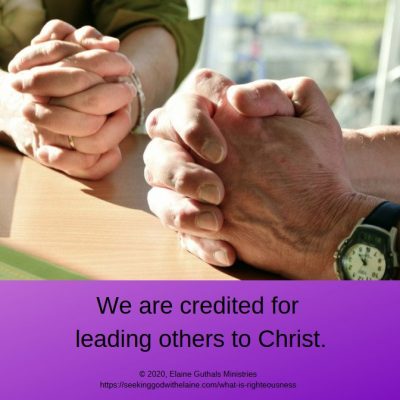
    Praying hands

    Making the Connections

    So, what does all this tell us what righteousness is, and how does that jive with piety?

    What I get out of all of this is righteousness is the result of faith and obedience. We believe God is the Sovereign Lord, and as we choose to obey Him, we become more like Him (Ps. 11: 7).

    In the last devotion, we said that piety was the following:

    • Piety comes from God by following His laws and commandments and imitating Him.
    • A pious person truly tries to be perfect in following God’s laws and commandments.
    • A pious person remains constant in devotion to God.
    • A pious person knows that communication with God is essential.

    While righteousness did not define itself as being related to piety, piety did. I would say that the list was synonymous with righteousness, which is the result of our relationship with God.

    Making the Connections to Self-Discipline

    If righteousness is the product of holiness, and holiness is the product of regeneration that comes with faith, it all begins with a choice. We choose to admit our sins, believe on Jesus as Redeemer, and confess God as Sovereign Lord. The righteousness comes when we demonstrate that commitment by following our job description.

    The ABCDs of Salvation

    If you have not become a believer in Christ, please read through the
    Plan of Salvation and prayerfully consider what God is asking you to do.A – admit our sins

    B – believe His Son Jesus is our Redeemer

    C – confess God as Sovereign Lord

    If you have not become a believer in Christ, please read through the Plan of Salvation and prayerfully consider what God is asking you to do.


    D – demonstrate that commitment by making any changes needed in our lives to

    live the way in which God has called us

    The Disciple’s Job Description

    The choice we make is one made out of obedience. We can — and should — discipline ourselves to obey God.

    How Do We Apply This?

    It may be a simple viewpoint, but I think it all boils down to trust. We have to trust that God is Who He says He is. We have to trust that God will do what He has promised.

    Once we have the faith and trust in God, He works on us to increase our righteousness.

    That is the end goal — being righteous as God is. We want to imitate Him.

    From here on out, we are going to use the term righteousness rather than piety. When I was pulling my research, it had some interesting groupings. In the next devotion, we are going to look at the fruits of righteousness. Then we will compare it to some other concepts.

    Lord. You are holy, and You are righteous. We are not — until we admit our sins, believe on Jesus as Redeemer, and confess You as Sovereign Lord. Then, through the process of regeneration, You make us like You. We also have to grow to be righteous like You, and You grow us throughout our lives. One day, we will be as You are. We long for that day. Amen.

    What do you think?

    Leave me a comment below (about this or anything else) or head over to my Facebook group for some interactive discussion.

    If you don’t understand something and would like further clarification, please contact me.

    If you have not signed up for the email daily or weekly providing the link to the devotions and the newsletter, do so below.

    If God has used this devotion to speak with you, consider sharing it on social media.

  • What Is Piety?

    What in the world does piety mean? This devotion looks at that meaning and how we can discipline ourselves to doing a better job at being pious.

    Nuggets

    • Piety comes from God by following His laws and commandments and imitating Him.
    • A pious person truly tries to be perfect in following God’s laws and commandments.
    • A pious person remains constant in devotion to God.
    • A pious person knows that communication with God is essential.
    Flowers with title What Is Piety?

    I don’t remember in what sermon I ran across the word piety. Hmmm. Maybe I should have included the word piety in the Churchy Word series. It surely fits.

    I quickly found that it is also translated to more familiar words. Let’s take a look.

    Let’s Put It into Context

    The Holman Bible Dictionary says there are a couple of words/phrases used to translate piety.

    • Fear of the Lord/reverence
    • Righteousness/blameless

    We’ve already looked at fear of the Lord — several times. We learned in What Does Fear of the Lord Mean? that the fear of the Lord means reverence and love, not terror.

    In Finding Favor by Acknowledging God, we talked about our following God’s laws and commandments shows that we fear God. We said that, when we fear God and give honor to Him, we want to serve Him in What Constitutes an Obedient Disciple?

    In What Does It Mean to Walk in the Spirit?, we said that walking in the Spirit should promote the fear of the Lord.

    So, let’s take a look at some verses that are translated piety. Then we will look at righteousness. We’ve scratched the surface of the latter a couple of times but have never really dug into it.

    Devotions in the What Is Righteousness? series

    The problem I ran into is that the verses that translated the word as piety really didn’t discuss what it was. The closest thing I came across was restrictions offered prayer.

    So, I thought we would look at the flip side of those. If our prayers are not restricted, we should be pious, right?

    Piety Has an Aspect of Humility

    “But you even undermine piety and hinder devotion to God” (Job 15: 4 NIV)

    God is Sovereign God. He doesn’t need us to be Sovereign. Regardless of whether we believe Him or not, He is the One true God.

    Because of that, we should not approach Him stuck on ourselves. We should not think we made ourselves what we are, can fix all our problems ourselves, and — most importantly — save ourselves.

    Piety doesn’t come from us. It comes from God by following His laws and commandments and imitating Him.

    We should approach God in humility. We have to realize we are sinners — even sinners saved by grace. We have to acknowledge that the only way we can gain eternal life is through belief in Jesus as our Savior and Redeemer.

    This submission to God creates in us a clean heart (Ps. 51: 10). This is needed because humility goes against what the worldview teaches. The worldview advocates that we value our knowledge and abilities.

    Piety Does Not Tolerate Sin

    God instituted those laws and commandments to reveal His character to us as well as establish boundaries under which we are to live. This are for our benefit.

    Sin is when we disobey God and break one of His laws and commandments. When we do that, we need to confess our sins and ask for forgiveness.

    Oh, yeah. It is really easy to want to keep that on pet sin. Maybe it is pride. Maybe it is lust. Maybe we love to gossip. Maybe we do things excessively.

    A pious person truly tries to be perfect in following God’s laws and commandments. No, we aren’t going to nail that every time. When we screw up, we repent.

    But remember, repentance is not only expressing sorrow for things we’ve done wrong. But it is making the commitment to changing ourselves so that we no longer do the wrong things.

    It is giving up that sin because, even though it may be pleasurable to us, it is against God’s Will. A pious person tries to do God’s Will.

    Piety Resists Temptation

    I know. I questioned whether I wanted to put this section in or just tack this on under sin. I think I can see the distinction to make it its own.

    Temptation is that period of time between conception and execution of doing what is sinful. So, we haven’t sinned yet — we’re just thinking about it.

    A pious person remains constant in devotion to God. We don’t give into temptation. We don’t compromise our beliefs to fit better into the world.

    What I see the takeaway in this section is we are mature enough and committed enough to withstand the temptations. That is because we seek God. We’ve scheduled it into our calendars. We have made it a priority.

    Piety Is Fueled by Prayer

    A pious person knows that communication with God is essential.

    • We want to keep in contact with God.
    • We want to praise and glorify His Name.
    • We acknowledge Him as Sovereign Lord.
    • We ask for forgiveness of our sins.
    • We want His guidance in our lives.
    • We acknowledge our dependence on Him.

    We must pray fervently and frequently. Buddicom noted that, “if this fervour of prayer be wanting, the deficiency originates in an evil heart of unbelief which departs from the living God.” He also said, “Our wants are continually recurring; but only the fulness [sic] of infinite mercy can supply them.”

    It is through this fervent, frequent prayer that we grow. We do this when our prayers are focused on God, not on this world and our wants and needs.

    A pious person is focused on eternal life, not this life. Because of that, we are trying to grow into the disciples we need to be for residency in heaven.

    Making the Connections

    Maybe the reason I didn’t find much is because it is an old-time word. We do hear righteousness more.

    I totally agree, though, with the flip side of what I found. A pious person is someone totally committed to God.

    How Do We Apply This?

    How do we become more humble? We have to become more aware of situations where we are and aspects that make us prideful. What are the triggers? How is God really at work there instead of us? What do we have to change to give Him the glory?

    We can combine sin and temptation here. How do we resist the temptation to sin? In an earlier devotion, I had some worksheets where we could question and evaluate temptations.

    To read a related devotion, click the button below.

    What about our prayer life? Are we consistent or sporadic in talking with God? Are our prayers more about us or more about Him? Have we scheduled time to communicate with God or do we leave it up to when we have a moment?

    Bottom line is a pious person is one who has totally  surrendered their lives to God. A pious person is doing surrendered a good job of imitating God.

    In the next devotion, we are going to look at verses that translate piety as righteousness.

    Father God. We want to imitate You. We were made in Your image — we want our characters to mirror Yours. Help us to grow in grace and knowledge of You. Amen.

    What do you think?

    Leave me a comment below (about this or anything else) or head over to my Facebook group for some interactive discussion.

    If you don’t understand something and would like further clarification, please contact me.

    If you have not signed up for the email daily or weekly providing the link to the devotions and the newsletter, do so below.

    If God has used this devotion to speak with you, consider sharing it on social media.

  • Lifting Our Eyes

    Isn’t it nice that disciples have help when we need it? This devotion looks at a familiar verse about God helping us when we seek Him.

    Nuggets

    • When we seek God, we will find Him.
    • We should want to lift our eyes because that is where God is.
    • It is comforting to know that, when things are at their worst, God will help us.
    Flowers with title Lifting Our Eyes

    Sometimes we inflate our egos. We become self-centered and self-important.

    We like to be able to depend on ourselves. We don’t like to have others tell us what to do.

    We think we’ve been down the road before, so we can handle it. We don’t need others — and we don’t need God.

    Let’s Put It into Context

    Life is like being in a car late at night in the country. We may or may not have been on the road before; however, we can’t see the destination. We can only see as far as the headlights show us.

    We may know the road, but our vision is limited. We have to travel before we can see more landscape in the headlights.

    Then think about driving in the city. There may be streetlights so we can see a little farther but think of all the distractions! It is easy to take our focus off the road. We have to watch out for other cars and pedestrians.

    We really only see what is happening today. We may be making our plans for tomorrow, but that doesn’t guarantee that they will be carried out. We don’t have any guarantee that the plans we make for the next hour or minute will be carried out.

    Even if we know the road, obstacles can pop up unexpectedly. The township workers may be working on the road. A deer may jump out in front of us. It may have rained, and there is water over the road.

    We may end up veering off the paths we are supposed to take. It may be a conscious or unconscious decision. But hurdling down the wrong road we go!

    What happens? People die. We lose our jobs. We miss our plane. The water heater takes a dive. [Insert your problem for the moment.]

    Things come up all the time that try to take our focus off God. We will always need God. We may think we don’t, but we do.

    Up

    “I will lift up mine eyes unto the hills, from whence cometh my help” (Ps. 121: 1 KJV)

    Heading

    When we seek God, we will find Him. “I will lift up mine eyes unto the hills …” (Ps. 121: 1 KJV)Psalm 121: 1 (KJV). We just have to look up — literally and figuratively.

    We have to look up from the sickness, the hassles, the trials. We shouldn’t focus as much on this life. We should take the focus off of us.

    We should focus on God and our eternal life. We should focus on our relationship with Him.

    Maclaren wrote that looking up was “a resolution, and a resolution born of intense longing. It comes to be a very sharp question with us professing Christians, whether the horizon of our inward being is limited by, and coterminous with, the horizon of our senses, or whether, far beyond the narrow limits to which these can reach, our spirits’ desire stretches boundless.”

    Oh, yes. We limit God by trying to run everything through our understanding — what we think, see, and feel.

    Instead, we have to look up in genuine faith. “Now faith is the assurance of things hoped for, the conviction of things not seen” (Heb. 11: 1 ESV).

    We associate “the best” with up. We “climb the ladder” to a better job. We want the “penthouse view.”

    We don’t want to be “down in the gutter.” Or at the “bottom of the totem pole.”

    We should want to lift our eyes because that is where God is. Robinson had an interesting take. He said, “If ever the eyes are strained towards heaven, it is by rose [sic] who go to the sanctuary, or long to do so.”

    Help

    “My help cometh from the Lord, which made heaven and earth” (Ps. 121: 2 KJV)

    When we are God’s children (Jn. 1: 12), we can expect His help. “I will lift up mine eyes unto the hills from whence cometh my help” (Ps. 121: 1 KJV)Psalm 121: 1 (KJV).

    It is comforting to know that, when things are at their worst, God will help us. “My help cometh from the Lord, which made heaven and earth” (Ps. 121: 2 KJV).

    But we have to remember that we can only reach our goals through God’s help. We have our knowledge and abilities only because God has given us the capacity to have them.

    People

    I loved what the Homilist said. “God is the only true help of the soul. He alone can raise it from its fallen condition, break its fetters, heal its wounds, energize its faculties, and set it on a course safe and prosperous.”

    Ooo, baby. The King of kings will help us. It is hard to fathom that at times. But it is always true.

    Making the Connections

    We do need God. Things go so much more smoothly when He is in control. God can see the whole road. He knows what obstacles are going to pop up. He knows the distractions we face. Most of all, He knows what is best for us.

    God is powerful enough to create this universe. He is powerful enough to help us in any situation in which we find ourselves.

    How Do We Apply This?

    • We have to give God control of our lives.
    • We want to look to God for help in the little stuff and the big stuff.
    • If we can just give up self and let Him take the steering wheel, things would be so much better.

    Robinson also said that is in a different direction than what we’ve been discussing, but it is something we need to think about. He said, “… it is possible to join the assembly of God’s saints, and not lift up our eyes to the hills. Some who make excursions seem to see all the meaning of their journey in what they take with them, others go chiefly to refresh themselves in the contemplation of God’s flowers and trees, rocks and rivers, valleys and hills. Of travellers climbing together to a mountain summit, there are those who, on reaching it, as if they had done all, lie down till the moment for returning; while their wiser companions, as if there were something for which they had been at the trouble of ascending, stand on the top, and look forth earnestly. They admire the prospect, and mark the direction of a more lofty mountain which they intend to gain, and how the road lies by which they will have to travel thither.”

    We want to make sure we are constantly looking at where God is leading us. We want to always strive for the next mountain top.

    We want to search for and seek God.

    O Lord. So often we get tied up in our lives and forget to look to You. Other times, we think we don’t need Your help. We do. Lord, You know best what we need. You have a plan for our lives that is so much richer and rewarding than what we come up with for our lives. We lift our eyes to You. We deflate our egos. We admit that we need You. Illuminate Your Will for our lives. Amen.

    What do you think?

    Leave me a comment below (about this or anything else) or head over to my Facebook group for some interactive discussion.

    If you don’t understand something and would like further clarification, please contact me.

    If you have not signed up for the email daily or weekly providing the link to the devotions and the newsletter, do so below.

    If God has used this devotion to speak with you, consider sharing it on social media.

  • Getting Obedience to the Heart Level

    How do we remember all of these laws and commandments so that we can obey them? We need to get them to change us. This devotion looks at getting God’s laws and commandments to our heart level.

    Nuggets

    • God’s Word is supposed to be a part of us.
    • His laws and commandments are supposed to affect our character or our core – our heart level.
    • We are to constantly be in teacher mode as we have to teach by example.
    • If we are to engrave God’s laws and commandments on our hearts, we internalize them, and they change us.
    • We remember better when we write things down.
    • Not only are we to obey the laws and commandments in our own homes, but they are also to be the laws of our cities.
    Flowers with title Getting Obedience to the Heart Level

    When we think about obeying God’s laws and commandments, that mean we have to actually live them. We do that by bringing them into our hearts – bringing it down to heart level.

    Engraved on Our Hearts

    “These words that I am giving you today are to be in your heart” (Deut. 6: 6 CSB)

    I know. We’ve talked about our hearts a lot lately. We talked about the greatest commandment before in How Do We Love God?. Depending on which book you read, it is love the Lord with all your heart, soul, strength, and mind.

    We’ve talked in Peace, Mercy, and Love about God’s peace, mercy and love is at our center. Our center is considered our hearts. That is our foundation.

    Also, we’ve talked in The Fullness of God’s Love about how Jesus is the Word (Jn. 1: 1) that we are to hide in our hearts (Ps. 119: 11). Jesus is a major part of that foundation.

    In Have We Lost Our First Love?, we talked about how we have to open our hearts to allow Jesus to take full residence within them. We lose our first love when we either don’t allow Him full control or we kick Him out after a while.

    To read a related devotion, click the appropriate button below.

    In this verse, we are told that God’s Word is supposed to be a part of us. We aren’t supposed to leave the Bible on the shelf and not read it. But then, we are supposed to do more than just read it.

    God’s laws and commandments are supposed to affect our character or our core – bringing it down to our heart level. They are to change us until we are more like Him. They are to make us holy and righteous.

    Yes, words can do that when they come from God. How?

    God’s Word leads to salvation. “Truly I tell you, anyone who hears my word and believes him who sent me has eternal life and will not come under judgment but has passed from death to life” (Jn. 5: 24 CSB).

    So, we have to hear God’s Word, read it, believe it, and let it change us. We have to choose it.

    Listen to what Adeney said about it. “Our religion must not be a mere matter of taste, of sentiment, and of philosophic speculation. It must be regarded as obedience to the will of our supreme Lord and Master.”

    If we choose not to believe — or make the choice by not making the choice — we will pay the consequences of our sins.

    But it isn’t a once and done choice. Having God’s Word engraved on our hearts is only the beginning. It has to permeate our lives.

    Permeating Our Homes

    “Repeat them to your children. Talk about them when you sit in your house and when you walk along the road, when you lie down and when you get up” (Deut. 6: 7 CSB)

    We just talked about teaching in How Did Moses Say Goodbye?. We talked about the reasons we should teach our children – and others.

    To read a related devotion, click the appropriate button below.

    We reviewed what we said in the When We Give Up on God series. We are expected to mature enough in our relationship with God so that we could teach others – not just children. We need to learn enough so that we can make disciples of others.

    To read a devotion in the When We Give Up on God series, click on the appropriate button below.

    So, we are going to concentrate on the last part of the verse. What I get out of that is we are to constantly be in teacher mode. To me, that means our heart level has to be ready to teach by example.

    Think about it. If we are to engrave God’s laws and commandments on our hearts, we internalize them, and they change us. So, when we others watch us, we are teaching by example.

    We are witnessing as people see us living our lives. Don’t get me wrong. We need to be doing more than that when we witness, but our lifestyles are also a witness.

    Witnessing begins at home with our family. They see us studying God’s Word. Not just reading – studying. They see us praying. They see our faithful attendance. They see how we treat others – as Jesus would.

    I like what Beecher said. He wrote, “Like produces like.” It amazes me sometimes how like me Adam is. My nut didn’t fall far from my mom’s tree.

    Yes, children can be the exact opposite of their parents. Children raised in a horrible situation can use that situation as a catapult to a better life in adulthood. Children raised in a Christian household can follow the worldview, instead.

    Where I was going with this was “Start a youth out on his way; even when he grows old he will not depart from it” (Prov. 22: 6 CSB). Teaching our family – especially when they are young – is important. They not only hear our words, but they also see our hearts.

    Children

    Use Props

    “Bind them as a sign on your hand and let them be a symbol on your forehead. Write them on the doorposts of your house and on your city gates” (Deut. 6: 8-9 CSB)

    Yep, back to remember. God wants us to remember His laws and commandments. He wants us to remember how He has provided for us in past trials.

    To read a related devotion, click the appropriate button below.

    God is also very fine with us using crutches to help us remember. No, I don’t know if God really is literal here with the binding and the writing. We know He can be symbolic.

    We do need to put this into context a little. During Moses’ time, they didn’t have books. They had stone tablets and scrolls which stayed with the priests. The average Tom, Sally, and Elaine couldn’t read them if they had them.

    Tom, Sally, and Elaine had to make do with memorizing. Taking nuggets of scripture and keeping it with them would be very helpful.

    Today, we may have other things. Remember my Warrior Princess bracelet? That is one of my props.

    To read a related devotion, click the button below.

    We’ve got good props these days. We have Bibles in a variety of translations. We have the internet to find devotions and other resources. We can have verses sent to our emails on a daily basis.

    I liked two things Moses had to say. “Write them …” (Deut. 6: 9 CSB). I liked the writing part. We remember better when we write things down. That is why we take notes in school.

    Moses had two interesting suggestions as to where to write them. “… on the doorposts of your house and on your city gates” (Deut. 6: 9 CSB). Not only are we to obey the laws and commandments in our own homes, but they are also to be the laws of our cities.

    Making the Connections

    Why all of the repetition? Well, the Wilderness Wanderers didn’t have it written down. If they were going to remember God’s laws and commandments, they had to hear it again and again.

    Yes, we are lucky because we have it written down. But do we take it to heart level? Or do we just keep it surface level?

    If obedience to God’s laws is going to get to our heart levels, we have to open our hearts and accept it all the way in us so that it changes us. Yes, that means repetition so it will get through our hard heads and hard hearts.

    Heart

    How Do We Apply This?

    We have to search for and seek God until we do have it at heart level.

    • Until we believe with all our hearts that Jesus is our Savior and Redeemer and God is our Sovereign Lord.
    • Until we are living God’s laws and commandments.

    Moses knew the Wilderness Wanderers needed the repetition. We do, too.

    Father God. We admit our sins, believe that Jesus is our Savior and Redeemer, and confess You as our Sovereign Lord. Lord, we will write Your words on our hearts. More than that, we will live out Your laws and commandments. Forgive us when we fail to do that. Remind us again and again until we imitate You. Amen.

    Searching for and Seeking God

    Hearing His Word (Rom. 10: 17 NLT).
    Reading His Word (Rev. 1: 3 ESV).
    Praying to Him (Heb. 4: 16 ESV).
    Studying His Word (Ac. 17: 11 NLT).
    Meditating on His Word (Ps. 1: 1-2).
    Memorizing His Word (Ps. 119: 11 NLT).

    To read Has God Provided Everything We Need?, click the button below.

    What do you think?

    Leave me a comment below (about this or anything else) or head over to my Facebook group for some interactive discussion.

    If you don’t understand something and would like further clarification, please contact me.

    If you have not signed up for the email daily or weekly providing the link to the devotions and the newsletter, do so below.

    If God has used this devotion to speak with you, consider sharing it on social media.

  • One God and the Trinity

    Is the Trinity confusing to you? Is there one God or many gods? If there is one, how can there be three? This devotion looks at determining how one God can be three and if there are other gods.

    Nuggets

    • God is all-knowing and all-powerful, so no other god is needed.
    • God is above all other gods.
    • It is through this Trinity that God reveals Himself to us.
    Flowes with title One God and the Trinity

    “Listen, Israel: The Lord our God, the Lord is one” (Deut. 6: 4 CSB)

    Moses was still in the early stages of telling the Wilderness Wanderers goodbye. Chapter 6 is a rich chapter.

    Right before Moses gives the Wilderness Wanderers the greatest commandment, he tells them that God is One.

    But, wait a second. That is just confusing. How can God be One if He is supposed to be a Trinity?

    Or is this talking about all of the other gods? Are they real or not?

    Okay, Let’s focus on the back of the verse. There is one God.

    The Power of One

    “… the Lord is one” (Deut. 6: 4 CSB)

    I can see that. How can this wonderful complex world have been designed and built by a group? I can see a large construction company building a huge building.

    But not this universe.

    I was in higher education. It was run by committee. There were a lot of meetings where things didn’t get done. The meetings just took time away from the desk where we could actually get things done.

    I can see one God in charge of everything.

    Dykes put it this way. He said, “The unity of God is the only religious basis for a moral law of perfect and unwavering righteousness.”

    Resource

    Can you think of how much inconsistency there would be with more than one Creator? How many contradicting laws would we have? Instead we have a God that doesn’t make mistakes, lie, or change His mind.

    • “God’s way is perfect. All the LORD’s promises prove true. He is a shield for all who look to him for protection” (Ps. 18: 30 NLT).
    • “God is not a man, so he does not lie. He is not human, so he does not change his mind. Has he ever spoken and failed to act? Has he ever promised and not carried it through?” (Num. 23: 19 NLT).

    How comforting is it that the God Who comforts us is the one who allowed the trial? That shows His control and His love for us.

    God is all-knowing and all-powerful. No other god is needed. That’s good, because He has no equal.

    But Is God the Only One?

    “For the LORD is a great God, and a great King above all gods” (Ps. 95: 3 KJV)

    Then I read something that Hodges had written that intrigued me. It sent me chasing a rabbit.

    “It is evident in the Old Testament that faith in the unity of God won its way little by little. The best men held it, but the people in general were slow to believe it. Even in the Psalms, God is often spoken of as the greatest of the gods.”

    Resource

    Oh, yeah. There are verses about God being above all other gods.

    But Hodges made it sound like that was just a hold over from the polytheistic days. What did some others have to say? Unfortunately, the sermons associated with verses talking about “God above all god” don’t really get into that.

    Barns wrote, “As there can be but one absolute and endless monarchy, so there is but one supreme and independent King.” But he doesn’t discuss other gods.

    Resource

    Sanderson reminded us there is a spiritual realm that we don’t see. However, like Burns, he doesn’t discuss other gods.

    Resource

    The Power of Three

    “The grace of the Lord Jesus Christ, and the love of God, and the fellowship of the Holy Spirit be with you all” (II Cor. 13: 13 CSB)

    What we do have is the Trinity. We have God the Father, God the Son, and God the Holy Ghost.

    I loved how Dykes’ defined trinity in Trinity and Unity. He said, “The Trinity of our faith means a distinction of persons within one common indivisible Divine nature. … This doctrine affords a basis for those gracious relations which it has pleased God to sustain towards us in the economy of our salvation.”

    Resource

    I once heard it described as three individual drops of water. If they were combined, it would be one big drop of water.

    We get tripped up when we try to think of them as people. Person is singular, and people are plural.

    Hodges pointed out the following. “Some see a trace of this old change out of the polytheistic into the monotheistic idea of God in the fact that in the beginning of the Bible the Hebrew name of God is plural, while the verb which is written with it is singular.” To me, that is a combination of God is One and the Trinity.

    Resource

    It is through this Trinity that God reveals Himself to us. Hatch wrote, “God reveals Himself to us as a trinity of persons: the eternal Father, of whom we are the children; the eternal Son, who brings back to us our lost sonship; the eternal Spirit, by whom we and all things live. And yet they are not three Gods, but one God.”

    Resource

    Stevens provided the best argument that I read. “If Christ is Divine, and yet, at the same time, can speak of the Father in distinction from Himself, these two facts, taken together, give us both the idea of the unity and that of the distinction between Him and God. But a further fact meets us. Christ speaks of the Holy Spirit as distinct both from the Father and from Himself, and yet ascribes to Him Divine prerogatives and powers. He is ‘another Advocate,’ distinct from Christ (John 14:16). He bears witness of Christ (John 15:26); and His coming to the disciples is conditioned upon the Saviour’s departure (John 16:7).”

    Resource

    I think of it this way. God is God, but He needed a part of Himself to come down as a sacrifice for our sins.

    That is where Jesus came into the picture. Jesus came as a human like us without giving up His divinity. He also came as an example of the obedience for which God was looking. We needed Someone to model our relationship with God.

    After Jesus accomplished the plan of salvation, God needed a part of Himself to reside in us. That is where the Holy Spirit fits into the picture.

    Making the Connections

    One God. Many gods. The Trinity. What is right?

    I know there is one God. I believe there is the Trinity.

    I don’t know if there really are many gods. I know others believe there is.

    I know there are a lot of man made gods. In today’s society, we worship lots of things that aren’t the One true God.

    How Do We Apply This?

    • We need to believe the One true God loves us and designed the plan of salvation to restore our relationships with Him.
    • We need to believe that Jesus sacrificed Himself to accomplish that plan.
    • We need to believe that the Holy Spirit prompts us to accept the gift of salvation and will guide us as we grow in our faith in God.

    Loving Father. There are things we do not understand — cannot understand because Your ways are higher than our ways (Isa. 55: 8-9). We don’t need to understand. We need to believe. Lord, we believe You are the One true God. We believe Jesus died to pay the price for our sins. We believe the Holy Spirit lives within disciples to teach us Your ways. We are humbled at how much You love us. Amen.

    The ABCDs of Salvation

    If you have not become a believer in Christ, please read through the
    Plan of Salvation and prayerfully consider what God is asking you to do.

    A – admit our sins

    B – believe His Son Jesus is our Redeemer

    C – confess God as Sovereign Lord

    If you have not become a believer in Christ, please read through the Plan of Salvation and prayerfully consider what God is asking you to do.


    D – demonstrate that commitment by making any changes needed in our lives to

    live the way in which God has called us

    The Disciple’s Job Description

    What do you think?

    Leave me a comment below (about this or anything else) or head over to my Facebook group for some interactive discussion.

    If you don’t understand something and would like further clarification, please contact me.

    If you have not signed up for the email daily or weekly providing the link to the devotions and the newsletter, do so below.

    If God has used this devotion to speak with you, consider sharing it on social media.

  • How Do We Benefit from Being God’s People?

    Nuggets

    • A benefit is eternal life.
    • When we admit our sins, believe on Jesus as Redeemer, and confess God as Sovereign Lord, we are forgiven of our sins.
    • Some probably wouldn’t see being held accountable and experiencing correction as being a benefit; but isn’t it?
    • God developed the plan of salvation because of His grace.
    Flowers with title How Do We Benefit from Being God's People?

    Being obedient to God’s Will brings us many benefits. One of them is we are called His people. This devotion looks at what some of those benefits are.


    Let’s Put It into Context #1

    “I will confirm my covenant that is between me and you and your future offspring throughout their generations. It is a permanent covenant to be your God and the God of your offspring after you” (Gen. 17: 7 CSB)

    Genesis 17: 7 was the second time that God said “I have a covenant with you” to Abraham. Strong called this instance a renewal.

    Why were they renewing? Why wouldn’t it be an unending covenant?

    Well, Adam had chosen to break the first covenant. We choose daily if we are going to follow God. We can break it, also. Even if we don’t flat out break it, our sins tarnish it.

    We break our covenant with God by disobeying Him. When we do, we need to ask forgiveness and repent.

    Let’s Put It into Context #2

    “In the same way, after the supper he took the cup, saying, ‘This cup is the new covenant in my blood, which is poured out for you’” (Lk. 22: 20 NIV).

    Jesus established a new covenant when He died to pay the penalty for our sins. Sin is when we disobey God and break one of His laws and commandments.

    Salvation is the deliverance from the consequences of sin. We are offered this salvation by God’s grace.

    Grace is a free and unmerited gift from Heavenly Father given through His Son, Jesus Christ that enables salvation and spiritual healing to believers. Because of God’s infinite grace, He devised the plan of salvation that made Jesus our Redeemer in order to forgive us of our sins.

    Redemption is where something is used in exchange for something else to gain or regain something. Jesus is our Redeemer because He was born of a virgin, making Him 100% God and 100% man; gave His life on the cross for us so that His blood could pay the price for our sins; and because of God’s great might and power, rose from the grave, conquering death and paying the price for our sins. Redemption allows us to receive forgiveness for our sins.

    We talked, in Is the Old or New Covenant Better?, how God promised Abraham that all the world would be blessed through him. “I will bless those who bless you, and whoever curses you I will curse; and all peoples on earth will be blessed through you” (Gen. 12: 3 NIV). The world was blessed through the birth, death, and resurrection of Jesus, a descendant of Abraham.

    To read a related devotion, click the appropriate button below.

    We enter into Christ’s covenant by accepting Him as our Savior and Redeemer. That makes us one of God’s people.

    So, how do we benefit from being God’s people?

    We Gain the Benefit of Eternal Life

    “Whoever believes in the Son has eternal life, but whoever rejects the Son will not see life, for God’s wrath remains on them” (Jn. 3: 36 NIV)

    When we ABCD, we enter into a covenant agreement with God. A benefit is eternal life.

    The ABCDs of Salvation

    If you have not become a believer in Christ, please read through the
    Plan of Salvation and prayerfully consider what God is asking you to do.A – admit our sins

    B – believe His Son Jesus is our Redeemer

    C – confess God as Sovereign Lord

    If you have not become a believer in Christ, please read through the Plan of Salvation and prayerfully consider what God is asking you to do.


    D – demonstrate that commitment by making any changes needed in our lives to

    live the way in which God has called us

    The Disciple’s Job Description

    Eternal life is “the quality of life including the promise of resurrection which God gives to those who believe in Christ.” Aspects of quality of life includes the following:

    • “life imparted by God
    • “transformation and renewal of life
    • “life fully opened to God and centered in Him
    • “a constant overcoming of sin and moral evil
    • “the complete removal of moral evil from the person and from the environment of that person” (Holman Bible Dictionary).

    John told us how we should know that we have eternal life. “And this is the way to have eternal life—to know you, the only true God, and Jesus Christ, the one you sent to earth” (Jn. 17: 3 NLT).

    We Gain the Benefit of Salvation from our Sins

    “If we confess our sins, he is faithful and just and will forgive us our sins and purify us from all unrighteousness” (I Jn. 1: 9 NIV)

    When we admit our sins, believe on Jesus as Redeemer, and confess God as Sovereign Lord, we are forgiven of our sins.

    We don’t have to clean up our acts before God forgives us. That comes after when we are working out our salvation.

    To read a related devotion, click the appropriate button below.

    We didn’t do anything to earn this covenant. We did not become perfect, so God would say, “Ooo. Tom, Sally, and Elaine look good, so I am going to let them into the covenant.”

    God looked at us and saw we would be open to Him making us holy — eventually.

    Unfortunately, we sometimes don’t forgive ourselves. Many times, we don’t forget. That is one reason we need ongoing purification.

    Person

    We Gain the Benefit of Being Held Accountable

    “For the LORD disciplines those he loves, and he punishes each one he accepts as his child” (Heb. 12: 6 NLT)

    Some probably wouldn’t see being held accountable and experiencing correction as being a benefit. But isn’t it?

    If we are doing something the wrong way, shouldn’t we be grateful that Someone points it out? Don’t we — shouldn’t we — want to do things right?

    God loves us enough to get us on the right track. “For the LORD disciplines those he loves, and he punishes each one he accepts as his child” (Heb. 12: 6 NLT).

    Okay, it may mean punishment. That all falls under being accountable.

    We Gain the Benefit of Grace

    “For I know the plans I have for you,” declares the LORD, “plans to prosper you and not to harm you, plans to give you hope and a future” (Jer. 29: 11 NLT)

    God developed the plan of salvation because of His grace. Grace is a free and unmerited gift from Heavenly Father given through His Son, Jesus Christ that enables salvation and spiritual healing to believers.

    Grace gave us access to salvation. Salvation purified us.

    It not only gave us unlimited opportunity to be in God’s presence, it also gives us hope in this life.

    No, that doesn’t mean that it will be smooth sailing. It means that it will be worth it because it makes us better — more holy.

    Making the Connections

    Usually, when we hear the term His people, we think that the Wilderness Wanderers are the ones being referenced. They are, generally, the ones to whom are being referred.

    While the New Testament disciples were generally called children of God, they — and we — are still God’s people. We are still covenant people.

    How Do We Apply This?

    First off, we have to make sure we are God’s people. If we have not already ABCDed, we need to be searching for Him.

    Searching for and Seeking God

    Hearing His Word (Rom. 10: 17 NLT).
    Reading His Word (Rev. 1: 3 ESV).
    Praying to Him (Heb. 4: 16 ESV).
    Studying His Word (Ac. 17: 11 NLT).
    Meditating on His Word (Ps. 1: 1-2).
    Memorizing His Word (Ps. 119: 11 NLT).

    To read Has God Provided Everything We Need?, click the button below.

    Even after conversion, we will not always be obedient to God’s laws and commandments. When we have sinned, we need to confess our sins and repent.

    We need to take Strong’s advice. We need to frequently recommit and reconfirm our covenant with God.

    Then, we have to make sure we continue to grow in knowledge of God and in His grace.

    Father. We are humbled that You love us enough to call us Your people. You even go so far to call us Your children. Lord, we thank You f0r the blessings that brings us. Amen.

    What do you think?

    Leave me a comment below (about this or anything else) or head over to my Facebook group for some interactive discussion.

    If you don’t understand something and would like further clarification, please contact me.

    If you have not signed up for the email daily or weekly providing the link to the devotions and the newsletter, do so below.

    If God has used this devotion to speak with you, consider sharing it on social media.

  • God Teaches Us Obedience

    Since obedience can be so hard at times, how can we learn to do it? This devotion encourages us to be taught by the Master Teacher.

    Nuggets

    • David taught us how to approach God and for what to ask.
    • God is teaching us about Himself and His ways.
    • Only God is going to be able to teach us His Will, which He does through the Holy Spirit.
    • We’ve got to take obedience to the next level and do it, not just hear it.

    To read a devotion in the What Is Obedience? series, click on the button below.

    God Teaches Us Obedience

    Flowers with title God Teaches Us Obedience

    When I was in my Philosophy of Education class, I was taught that, in Eastern philosophy, students would seek out “the best” teacher from whom to learn. They wanted to make sure that they learned all that they could.

    Shouldn’t we want the same thing when we look to learn about obedience. Shouldn’t we go to the Master?

    Let’s Put It into Context

    “Let me hear of your unfailing love each morning, for I am trusting you. Show me where to walk, for I give myself to you” (Ps. 143: 8 NLT)

    David was in the middle of a crisis — again. So, he wrote this psalm.

    The first part is all about what David is experiencing. The last part is all about God.

    Now, this Psalm doesn’t talk about obedience — at all. But, to me, it shows us how God does teach us to obey His laws and commandments. Let’s see if you agree with me.

    Who Teaches Us What?

    “Teach me to do your will …” (Ps. 143: 10 NLT).

    David taught us how to approach God. We come to Him humbly and sincerely.

    David also taught us for what to ask. One thing that is evident is that this great king didn’t even pretend to know everything.

    Bottom line is David wanted to be more like God. He wanted to follow God’s plan. So, David wanted God to teach Him.

    God is not only the Teacher, but He is also teaching us about Himself and His ways. David asked to learn His Will.

    Maclaren wrote, “But the main burden of his prayer is for a closer knowledge of God, the sound of His lovingkindness in his inward ear, light to show him the way wherein he should walk, and the sweet sunshine of God’s face upon his heart.”

    Did that melt you like it did me? Knowledge. Love. Light. Sunshine. Isn’t that what we are supposed to want? Prayer and obedience gives us that.

    God’s Will is for us to follow His laws and commandments. His Will is for us to be obedient.

    Knowledge of God shows us how we are to live our lives. We are called to imitate Him.

    To read a related devotion, click the button below.

    We know we learn in the struggle of trying to be obedient. I wonder if it saddens God that we so many times ask Him to take away those struggles.

    We just want them gone. Better yet, we don’t want them to show up in the first place.

    God teaches us to submit. We can’t do that on our own. Our human nature is generally taught that we should be independent. We need Him to teach us how to do it right.

    Why Go to God’s School?

    “… for you are my God …” (Ps. 143: 10 NLT).

    A couple of paragraphs back we said that David didn’t even pretend to know everything. He knew, however, to Whom to go.

    But look what David called God — my God. He made this personal — relational.

    David went to God because He was … well … God. David could feel God’s love for him. He knew He was Creator and holy. He knew God was love.

    God knows all that has happened before, all that is happening now, and all that will happen in the future. He allows it to happen.

    Why wouldn’t David go to the all-powerful God? Why wouldn’t he go to the best?

    Only God is going to be able to teach us His Will. He does that through the Holy Spirit.

    Dove

    Guidance by the Holy Spirit

    “… May your gracious Spirit lead me forward on a firm footing” (Ps. 143: 10 NLT).

    I think I am going to be a broken record whenever we talk about obedience. We’ve got to take it to the next level and do it. We can’t just hear it.

    Maclaren said, “Action, not thought, is the end of God’s revelation and the perfecting of man.” That is what “… lead mean forward …” (Ps. 143: 10 NLT) means to me.

    We have to be practicing obedience to God’s Will. How do we learn the most? Many of us are hands-on learners. You can talk us to death, and we think we have a clue. But it isn’t until we get in the lab or in the project where things really start clicking.

    Where is our lab with God? In the middle of the trials. Ouch. I know. Those hurt a lot of times.

    We learn faster when doing something. It sticks with us longer.

    Saxton made a good point. He said, “The more we do what we have been taught, the more will the Lord our God reveal to us of His will.” Think of this along the foundation line of thinking.

    We start out small in the obedience area. That may be because the trust area is low.

    We trust God and we obey. That feels pretty good. It boosts our confidence.

    Here comes another temptation — a little more involved this time. Repeat — trust, obey, confidence.

    Pretty soon, we have a good foundation. We know that however hard and scary the temptation is, God won’t leave us and will help us through it.

    We don’t have to feel like we are alone — because we aren’t. We have the Holy Spirit to guide us.

    Making the Connections

    Adam is taking a capstone course for app design this semester. It wasn’t offered, so he is taking it by directed study. Basically, what that means is he is responsible for the work without having regular class attendance. He does, however, have access to the instructor (who is one of the best).

    Adam ran into a snag last week. He contacted the instructor, and they exchanged emails trying to work out his problem. Yesterday, they met in person and got it ironed out.

    If you are like me, we really like having that access to the instructor. We can learn on our own, but we like someone there to answer our questions when we run into a snag.

    Sometimes, we may not see that what is in the Bible is in black and white. We may see some gray in it.

    Who better to go to than the Master Teacher who wrote the laws and commandments?

    We are called to obey God’s Will — actively obey. If it says love, we have to love. If it says honor the sabbath, we attend church. If it says don’t lie, we don’t lie.

    It isn’t just the hearing. It is also the doing.

    The bottom line is we have to be obedient in doing God’s Will. We have to consciously decide to submit to Him.

    We have to be all in when we obey God. We have to be consistent and not hesitate.

    God will teach us what He wants and how He wants us to do it.

    How Do We Apply This?

    We start out by praying David’s prayer. Next, we seek God. Then we do what God tells us to do.

    “Teach [us] to do your will, for you are [our] God. May your gracious Spirit lead [us] forward on a firm footing” (Ps. 143: 10 NLT).

    Searching for and Seeking God

    Hearing His Word (Rom. 10: 17 NLT).
    Reading His Word (Rev. 1: 3 ESV).
    Praying to Him (Heb. 4: 16 ESV).
    Studying His Word (Ac. 17: 11 NLT).
    Meditating on His Word (Ps. 1: 1-2).
    Memorizing His Word (Ps. 119: 11 NLT).

    To read Has God Provided Everything We Need?, click the button below.

    What do you think?

    Leave me a comment below (about this or anything else) or head over to my Facebook group for some interactive discussion.

    If you don’t understand something and would like further clarification, please contact me.

    If you have not signed up for the email daily or weekly providing the link to the devotions and the newsletter, do so below.

    If God has used this devotion to speak with you, consider sharing it on social media.

  • The Correlation Among Fear of the Lord, Wisdom, and Obedience

    What does fear of the Lord and wisdom have to do with obedience? This devotion looks at how the three are correlated.

    Nuggets

    • Because we revere God, we not only want to serve Him and be devoted to Him, but we also want to be like Him.
    • We are not going to want to be like God until we know Him and have faith in Him.
    • God’s instructions — His laws and commandments — tell us the right end and the right way to get there.
    • We revere God and possess knowledge and wisdom by obeying His laws and commandments.

    To read a devotion in the What Is Obedience? series, click on the button below.

    The Correlation Among Fear of the Lord, Wisdom, and Obedience

    Flowers with title The Correlation Among the Fear of the Lord, Wisdom, and Obedience

    The more that I delve into the Bible, the more complexities surface. I guess the saving grace with that is that they surface frequently.

    Well, that is a good thing. We learn by tacking new information onto previous knowledge. If the topics have surfaced before, at least we have something on which the new information can tack!

    Let’s dive in and see what we can see.

    Let’s Put It into Context

    “Fear of the Lord is the foundation of true wisdom. All who obey his commandments will grow in wisdom” (Ps. 111: 10 NLT)

    Fear of the Lord

    We’ve talked about fear of the Lord before. We learned in What Does Fear of the Lord Mean? that the fear of the Lord means reverence and love, not terror. In Finding Favor by Acknowledging God, we talked about how our following God’s laws and commandments shows that we fear God.

    Walking in the Spirit should promote the fear of the Lord (What Does It Mean to Walk in the Spirit?). According to What Constitutes an Obedient Disciple?, we said that, when we fear God and give honor to Him, we want to serve Him.

    In What Constitutes an Obedient Disciple?, we said that outside of God, we never will be able to understand things. We have to do more than just understand God’s ways; we have to embrace them, leading to reverence.

    To read a related devotion, click the appropriate button below.

    Wisdom

    We’ve also talked about wisdom. In How Can We Gain Wisdom?, we talked about wisdom as the attribute of having experiences, knowledge, and good judgment. Wisdom comes from God, but we can ask Him for it.

    God uses the Holy Spirit to impart His wisdom to us (What is the Spirit of Wisdom?). The Holy Spirit will teach us what God has instructed Him to say. His promptings influences us to to seek God and learn more of Him. The promptings urge us to learn more deeply of Him.

    To read a related devotion, click the button below.

    Obedience

    Obedience means to hear and carry out the instructions that God gives us (What Is Obedience?). We are to respond in faith and do God’s Will.

    To read a related devotion, click the button below.

    Fear of the Lord and Wisdom

    “Fear of the Lord is the foundation of true wisdom….” (Ps. 111: 10 NLT)

    Let’s focus on the reverence for a bit. It is sometimes translated as piety. Sometimes, it has been translated as religion itself. But, let’s stick with reverence here.

    Partridge said that fear of the Lord encompasses “… piety in general, the service of God, and the devotion of the heart to Him.” He also said that wisdom “… is a virtue which makes a man not only skilful [sic] and intelligent, but also good and virtuous.”

    Because we revere God, we not only want to serve Him and be devoted to Him, but we also want to be like Him. Being like Him is being good and virtuous. Our hearts are exactly right.

    So, reverence is the foundation of wisdom. We are not going to want to be like God until we know Him and have faith in Him. Once we have ABCDed, we are called to imitate Him. We are called to be good and virtuous.

    The ABCDs of Salvation

    If you have not become a believer in Christ, please read through the
    Plan of Salvation and prayerfully consider what God is asking you to do.A – admit our sins

    B – believe His Son Jesus is our Redeemer

    C – confess God as Sovereign Lord

    If you have not become a believer in Christ, please read through the Plan of Salvation and prayerfully consider what God is asking you to do.


    D – demonstrate that commitment by making any changes needed in our lives to

    live the way in which God has called us

    The Disciple’s Job Description

    Arnot put it this way. He said, “The ‘fear of the Lord’ is the foundation, ‘knowledge’ is the imposed superstructure.”

    Alford added a new twist to the definition of fear of the Lord. He said it is “… an abiding and reverent sense of the presence of God and of accountableness to Him.”

    Ooo, baby. That adds complexity.

    An “… abiding and reverence sense of the presence of God …”

    Can you see that? If it is reverence and love, we have to have Someone to revere and love. It is abiding — long term, not short term.

    Wisdom and Instruction

    “The fear of the Lord is the beginning of knowledge; fools despise wisdom and instruction” (Prov. 1: 7 ESV).

    Davies made an interesting point. He said that “wisdom consists in two things: choosing a right end, and using right means to obtain it.”

    God’s instructions — His laws and commandments — tell us the right end and the right way to get there.

    Wisdom can also be described as knowing the truth. That fits. “Jesus told him, ‘I am the way, the truth, and the life. No one comes to the Father except through me’” (Jn. 14: 6 CSB). Also, we learn His truths.

    Instruction is “teaching or exhortation on aspects of Christian life and thought directed to persons who have already made a faith commitment” (Holman Bible Dictionary).

    Paul wrote “All Scripture is inspired by God and is profitable for teaching, for rebuking, for correcting, for training in righteousness” (II Tim. 3: 16 CSB). From here is where we gain wisdom through instruction.

    The Bible is our instruction book that increases our wisdom. It was specifically written to do just that.

    We might be tempted to say we have wisdom when we just have understanding. Understanding is a comprehension. Taylor said that “There is need of wisdom to guide both the understanding and the will.”

    Don’t get me wrong. We have to comprehend. “The fear of the LORD is the beginning of wisdom, and knowledge of the Holy One is understanding” (Prov. 9: 10 NIV).

    Wisdom is equated more with righteousness. It is more application than just head knowledge.

    Book

    Obedience

    “The end of the matter; all has been heard. Fear God and keep his commandments, for this is the whole duty of man” (Ecc. 12: 13 ESV).

    How do we show that we revere God and possess knowledge and wisdom? We obey His laws and commandments.

    We take what is written in His Word and what He tells us through the Holy Spirit’s promptings — and do it.

    We understand what our duties are and do it.

    Orton said, “Besides living soberly, righteously, and godly, it requireth faith in Christ, love to Him, trust in Him, an humble dependence on the help of the Holy Spirit, and a compliance with the institutions of Baptism and the Lord’s Supper, which are commandments of God, as being enjoined by Jesus Christ, who was a teacher sent from Him. Doing His commandments implies avoiding everything that is evil (Job 28:28). It includes also learning to do well, and practising every duty which God requiteth of us. It is not sufficient to study the commandments of God as a science, to understand their meaning and extent, and to be able to explain them with the most critical exactness. It is not sufficient to talk of them, to admire their suitableness and excellency, but we are to do them, to do them sincerely, cheerfully, and constantly, unmoved by any temptations that would lead us to neglect the observance of them.”

    We are to be obedient in following the laws and commandments — and be obedient in allowing them to change us.

    Countryside

    Making the Connections

    Wow! Is your head spinning, too?

    Ever since I started pulling the research and going through it to see what I was going to write, I had this picture in my head.

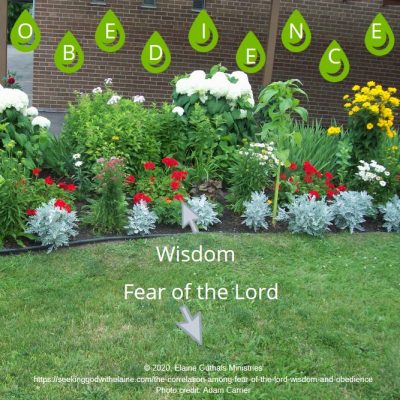
    Flowers

    Okay. So, the ground is the foundation. That is the fear of the Lord.

    We plant seeds or transplant plants onto that foundation. That is the wisdom we gain by growing in grace and knowledge of God.

    The plants grow through the nourishment of the rain. We grow by being obedient to God’s laws and commandments always — especially in trials.

    Let’s try saying it this way. We fear God, which makes us want to dive into His Word and know Him better. That not only helps us be more obedient when the trials hit, but it also makes us more obedient all the way around.

    It grows us in the right direction. Our relationship with God — our reverence and love for Him — becomes the foundation of our lives.

    Go back to Alford’s definition of fear of the Lord. He said it is “… an abiding and reverent sense of the presence of God and of accountableness to Him.”

    Accountablity. Because we love God and want to obey Him, we are accountable to Him.

    That means we obey all the laws and commandments. We don’t compromise with the world. We don’t keep our pet sin.

    We are all in.

    How Do We Apply This?

    • We read God’s Word.
    • We study it and meditate on it so we know how He is calling us to act.
    • We pray to Him asking Him to shore up the foundation.
    • We allow God to change us.

    In other words, we seek God. We know His character well — well enough to make it our own.

    Searching for and Seeking God

    Hearing His Word (Rom. 10: 17 NLT).
    Reading His Word (Rev. 1: 3 ESV).
    Praying to Him (Heb. 4: 16 ESV).
    Studying His Word (Ac. 17: 11 NLT).
    Meditating on His Word (Ps. 1: 1-2).
    Memorizing His Word (Ps. 119: 11 NLT).

    To read Has God Provided Everything We Need?, click the button below.

    Father. We are in awe of You. That You love us enough to send Your Son to die to pay the price for our sins is beyond our understanding. But we know You did, and that sacrifice paid the price for our sins. Lord, we want our fear of the Lord to be the foundation on which we build wisdom of You. May we always be obedient to do Your Will. Amen.

    What do you think?

    Leave me a comment below (about this or anything else) or head over to my Facebook group for some interactive discussion.

    If you don’t understand something and would like further clarification, please contact me.

    If you have not signed up for the email daily or weekly providing the link to the devotions and the newsletter, do so below.

    If God has used this devotion to speak with you, consider sharing it on social media.

  • Isn’t It Impossible to be Obedient?

    When we really get down to it, isn’t it impossible to keep all of God’s laws and commandments? Aren’t we always going to break some? This devotion looks at how burdensome keeping God’s laws and commandments really is.

    Nuggets

    • Keeping God’s laws and commandments all boils down to love for God.
    • We may feel obedience is impossible when it is just challenging for us.
    • The laws and commandments show us God’s character, which is holy and righteous.
    • Not following God’s laws and commandments does not make us pure.
    • Even with a light yoke, it is not going to be smooth sailing.

    To read a devotion in the What Is Obedience? series, click on the button below.

    Isn’t It Impossible to Be Obedient?

    Flowers with title Isn't It Impossible to Be Obedient?

    In the last devotion, we talked about keeping God’s commandments. Unfortunately, some of us find some almost impossible to keep some of them. Let’s take a look.

    Let’s Put It into Context

    “Loving God means keeping his commandments, and his commandments are not burdensome” (I Jn. 5: 3 NLT).

    Obedience means “to hear God’s Word and act accordingly” (Holman Bible Dictionary). We think of the word obey, but there are several words that the Bible uses: hear, listen, and trust.

    Obedience Is Not Burdensome

    “Loving God means keeping his commandments, and his commandments are not burdensome” (I Jn. 5: 3 NLT).

    Obeying isn’t as hard as Satan makes it out to be.

    Let’s go back a second to what we said in the last devotion. Keeping God’s laws and commandments all boils down to love for God. If we love God, we are going to want to please Him. Keeping the laws and commandments expresses that love.

    Aren’t things easier when we do them out of love? Our minds don’t put up as many roadblocks. The tasks don’t seem as daunting. We see success and blessings at the end of the line.

    When we really out our hearts into it, we are blessed. When we are blessed, things become easier. When things are easier, it is easier to be obedient.

    A good cycle!

    Besides, doesn’t Jesus say that “… [His] yoke is easy and [His] burden is light” (Mt. 11: 30 CSB)? Light is not burdensome.

    But there is a reason for them being light. “I love those who love me, And those who seek me diligently will find me” (Prov. 3: 17 NKJV).

    Newman said it this way. “Now it is obvious that obedience to God’s commandments is ever easy, and almost without effort to those who begin to serve Him from the beginning of their days; whereas those who wait awhile find it grievous in proportion to their delay.”

    I read this to mean they become habits. They become our normal.

    I grew up singing in front of an audience. That was my normal.

    A while back, I stopped singing. I wasn’t in a choir; I wasn’t doing solos. My normal changed.

    When I started back in front of an audience, boy was I nervous! It wasn’t easy because it wasn’t my normal.

    But Is It Impossible?

    Sharp makes a really good point. Is it really impossible?

    Let’s say it is hard for us to pray daily. We may even say it is impossible.

    But is it? People do that. People make the choice to be obedient and pray daily.

    So, it isn’t impossible. It is just challenging for us.

    Sometimes, we just use that as a copout. We don’t want to put forth the time and effort to be obedient. Or we don’t want to give up the sin.

    There are times it does seem totally impossible to us. We may be looking at past history, the depth of our commitment, or a variety of other reasons — excuses — we use to say it is impossible.

    We aren’t really focusing on God then. We are focusing on our inabilities and our understanding.

    Remember, “… nothing will be impossible with God” (Lk. 1: 37 CSB). If God wants us to be obedient — and He does — it is possible to follow His Will.

    Church

    Is Some Disobedience Allowed?

    I am still processing one of Sharp’s comments. “All that our religion forbids is the irregularity and exorbitancy of our passions.”

    I see that on some things, like wealth. We talked about how we shouldn’t put an exorbitant priority on gaining wealth.

    I can see where God doesn’t want us to just pray occasionally. He wants regular communication.

    But I see other things that we are just downright forbidden in which to engage. I will have to keep thinking on this.

    Let’s come at it from an angle. Some say that there are no guilty pleasures — if they give us pleasure, there should be no guilt involved.

    Others say that if we succeed in this world, that is a blessing from God — regardless of whether we had to disobey God’s laws and commandments to succeed.

    Look, think about this. The laws and commandments show us God’s character. God’s character is holy and righteous.

    Holy means to be set apart, perfect, and pure. Righteousness is the product of being holy, created by having faith and loving as Jesus does.

    Not following God’s laws and commandments does not make us pure. It makes us human.

    We want spiritual.

    Yes, we are still human and are going to be until we are changed (I Cor. 15: 51). We are not going to get it right every time.

    Still, we are called to be perfect. “But you are to be perfect, even as your Father in heaven is perfect” (Mt. 5: 38 NLT).

    So, It Is Going to Be Smooth Sailing?

    With a light yoke, that means it is going to be smooth sailing, right?

    Wrong.

    We are still going to struggle. We will still have to make the daily choice — sometimes minute by minute — to choose God.

    Satan is going to make that as rough as he can.

    What are the definitions of light and heavy? (You had to know Dictionary Chick would show up some time, didn’t you?)

    Let’s look at these definitions of light.

    • public knowledge
    • a particular aspect or appearance presented to view

    When we seek God, we grow in knowledge of Him. Now, the public aspect doesn’t fit because God only reveals Himself to His children. But He takes what little is in the Bible and presents Himself more fully to us.

    • a particular illumination
    • something that enlightens or informs

    God is really good at showing our sins to us. He wants us to see them as He sea them so that we can eradicate them.

    • having little weight : not heavy
    • designed to carry a comparatively small load
    • having relatively little weight in proportion to bulk
    • containing less than the legal, standard, or usual weight

    Is not the peace that coms when we are obedient to God so much lighter than the burden of sin’s guilt?

    A lot of the definitions for heavy, as you would imagine, are the exact opposite. But let’s point out a couple.

    • difficult to bear
    • borne down by something oppressive
    https://www.merriam-webster.com/dictionary/heavy

    There are some that don’t think sin is oppressive. All they see is the pleasure and shiny.

    Sin is oppressive because it leads to spiritual death.

    Making the Connections

    We do know that we cannot be obedient without God. God is fighting the spiritual warfare. We cannot exhibit self-discipline without Him.

    We also have to remember that we are tested through temptations. We just talked about that.

    To read a related devotion, click the button below.

    Let’s look at this. “The temptations in your life are no different from what others experience. And God is faithful. He will not allow the temptation to be more than you can stand. When you are tempted, he will show you a way out so that you can endure” (I Cor. 10: 13 NLT).

    • This is a standard temptation. Others have been tempted in this way, too.
    • God doesn’t leave us.
    • He is always there to help us get through the temptation.
    • He provides the pathway to obedience.

    So, if others can withstand the temptation and be obedient, so can we. Remember, it isn’t impossible.

    People

    How Do We Apply This?

    • We have to make obedience our normal.
    • We have to make it practical.
    • We have to seek obedience with all of our hearts.
    • We have to seek the blessings from it.

    The next time we feel obedience is impossible, we need to pray for God’s help to withstand. We need to claim His victory over Satan. We need to seek Him with all of our hearts.

    Loving Father. Your Word tells us that nothing is impossible for You (Lk. 1: 37). We cannot withstand temptation without You. Strengthen us so that we can be obedient to You. Amen.

    What do you think?

    Leave me a comment below (about this or anything else) or head over to my Facebook group for some interactive discussion.

    If you don’t understand something and would like further clarification, please contact me.

    If you have not signed up for the email daily or weekly providing the link to the devotions and the newsletter, do so below.

    If God has used this devotion to speak with you, consider sharing it on social media.

  • What Is Obedience?

    What is one of the first things that pop up when we think about self-discipline? We don’t discipline ourselves to follow all of God’s laws and commandments all the time. This devotion looks at what obedience is from God’s perspective.

    Nuggets

    • God is Sovereign God and expects our obedience.
    • God gives us laws and commandments to follow.
    • God’s laws and commandments are true because they came from Him.
    • We have to let God’s Word — His laws and commandments — change our character.
    • Obeying God’s laws and commandments does bring us rewards.
    Flowers with the title What Is Obedience?

    While some may say it is too difficult to obey all of God’s laws and commandments, others may question why we are being obedient to Him in the first place.

    Let’s Put It into Context

    “Yours, LORD, is the greatness and the power and the glory and the splendor and the majesty, for everything in the heavens and on earth belongs to you. Yours, LORD, is the kingdom, and you are exalted as head over all” (I Chron. 29: 11 CSB)

    God is Sovereign God. He is omnipotent, omniscient, and omnipresent.

    God created “… everything in the heavens and on earth …” (I Chron. 29: 11 CSB). That means He made us.

    Instead of forcing His rule on us, God allows us free will to choose to submit to Him. When we do submit to Him, He expects obedience.

    What Is Obedience?

    “Loving God means keeping his commandments, and his commandments are not burdensome” (I Jn. 5: 3 NLT).

    Obedience means “to hear God’s Word and act accordingly” (Holman Bible Dictionary). We think of the word obey, but there are several words that the Bible uses: hear, listen, and trust.

    We are supposed to respond in faith and do God’s Will. In other words, hearing alone is not good enough. We have to put into practice what God is telling us. This is one way we worship God.

    God gives us laws and commandments to follow. These are stated in the Bible. They not only tells us how we should and should not act, but they also tell us of God’s character.

    Melvill made an interesting statement. He said, “we naturally look to the New Testament for additional motives rather than for additional commandments.”

    The Old Testament was all about telling us what the laws and commandments were. The New Testament was all about calling us to obey those laws and commandments and giving us reasons to do so. We obey by loving God.

    Remember, Jesus said that the greatest commandment was “… Love the Lord your God with all your heart and with all your soul and with all your mind” (Mt. 22: 37 NIV). That is our priority

    To read a related devotion, click the appropriate button below.

    Why did Jesus pick that one (and love your neighbor)? “All the Law and the Prophets depend on these two commands” (Mt. 22: 40 CSB). It all boils down to love for God.

    If we love God, our obedience stems from that love. If we love God, we are going to want to please Him. Keeping the laws and commandments expresses that love.

    Hands shaped as heart

    Delight in the Law

    “Surround me with your tender mercies so I may live, for your instructions are my delight” (Ps. 119: 77 NLT).

    Let’s think about it this way. God’s Word is true. God never changes. He doesn’t lie.

    That means God’s laws and commandments are true because they came from Him.

    When mankind originally disobeyed Him, God could have written us off. He could have closed the door and not had anything to do with us ever again. Or worse, He could have just killed us.

    Instead, God showed us mercy. Mercy is the unexpected way God responds in love to our needs. “Great is his faithfulness; his mercies begin afresh each morning” (Lam. 3: 23 NLT). He gives us mercy every day.

    To read a related devotion, click the button below.

    This is especially so when we are obedient to God. His mercies protect us.

    It’s not a bad thing to want God’s mercies. It’s not a bad thing to want more of His mercies. When we do that, we are wanting more of Him in our lives. That is a good thing.

    But look what it is really saying (Cowper). “Because I delight in your instructions, give me more mercy.” Because I am obedient, reward me. I don’t want to sin.

    We don’t see obedience as a license to sin in other instances. “Well, I mostly get it right, so God is going to ignore this sin.” Doesn’t work that way.

    Obedience to God means we are all in. We try to obey all of His laws and commandments.

    Obedience Required

    “Joyful are those who obey his laws and search for him with all their hearts” (Ps. 119: 2 NLT).

    We are charged to obey God’s laws. Yes, we are rewarded, but this is how we seek Him.

    In order to obey God, we have to search His Word. But His words can’t just stay on the pages of the book or the screen of whatever device we use.

    We’ve got to bury God’s Word in our hearts. I know, we’ve talked several times about how hard it is to memorize. It is more than that.

    Searching for and Seeking God

    Hearing His Word (Rom. 10: 17 NLT).
    Reading His Word (Rev. 1: 3 ESV).
    Praying to Him (Heb. 4: 16 ESV).
    Studying His Word (Ac. 17: 11 NLT).
    Meditating on His Word (Ps. 1: 1-2).
    Memorizing His Word (Ps. 119: 11 NLT).

    To read Has God Provided Everything We Need?, click the button below.

    We have to let God’s Word — His laws and commandments — change our character. We have to let them help us to imitate Him.

    That means we have to believe what we are reading. We have to really dive into the Bible. It has to increase our faith.

    I like having a strategic plan. When I went on my first retreat, I developed a new one for my life. Okay, some of the things have worked out; some have to go to a different year’s operational plan. But it is a guide.

    The Bible is like that in a way, but not. It is our guide. It shows us how we are to work to become holy and righteous.

    Obeying God’s Word is not optional. Some things don’t give us wiggle room. There is no fudging with God’s laws and commandments. Millard said, “We must take it as the guide of our daily conduct, as the inspiration of thought and emotion, as the determining factor in our daily actions, as the light to lead us along life’s dark and difficult ways, As the food upon which the soul is nourished it must affect all our thought and feeling, speech and action; it must penetrate to the remotest corners of our life and give form and colour and character to every experience.” It has to permeate our lives.

    The Value of Obedience

    “Your instructions are more valuable to me than millions in gold and silver” (Ps. 119: 72 NLT).

    Obeying God’s laws and commandments does bring us rewards. Now, we are going to get into some of the benefits obedience brings in another series.

    For now, let’s look at a this. Dunlop and the Homilist give us lists of things that are upgraded for us — but not from the world’s perspective.

    • Food: “‘I am the bread of life,’ Jesus told them. ‘No one who comes to me will ever be hungry, and no one who believes in me will ever be thirsty again’” (Jn. 6: 35 CSB).

    To read a related devotion, click the button below.

    • Clothes: “I clothed myself in righteousness, and it enveloped me; my just decisions were like a robe and a turban” (Job. 29: 11 CSB).
    • Friends: “I no longer call you servants, because a servant does not know his master’s business. Instead, I have called you friends, for everything that I learned from my Father I have made known to you” (Jan. 15: 15 NIV).
    • Homes: “In my Father’s house are many mansions: if it were not so, I would have told you. I go to prepare a place for you” (Jn. 14: 2 KJV).
    • Culture: “So if the Son sets you free, you are truly free” (Jn. 8: 36 NLT).
    • Power: “For God has not given us a spirit of fear, but one of power, love, and sound judgment” (II Tim. 1: 7 CSB).
    • Higher enjoyments: “Now may the God of hope fill you with all joy and peace as you believe so that you may overflow with hope by the power of the Holy Spirit” (Rom. 15: 13 CSB).
    • A higher world: “For God so loved the world that he gave his one and only Son, that whoever believes in him shall not perish but have eternal life” (Jn. 3: 16 NIV).

    Wow! All of that because we are obedient!

    Don’t get me wrong. We need money for food, clothing, and homes in today’s world. It isn’t wrong to pursue earning a living — as long as we keep God as top priority of those lives.

    Making the Connections

    “Jesus replied, ‘But even more blessed are all who hear the word of God and put it into practice’” (Lk. 11: 28 NLT).

    Again, it comes down to knowing the laws and commandments and obeying them. We can read and read and read. Head knowledge won’t get us too far.

    We have to put what we read into practice — we have to obey.

    Our joy and blessings come from believing Jesus is our Savior and Redeemer. Yes, that is the B of our ABCDs.

    The ABCDs of Salvation

    If you have not become a believer in Christ, please read through the
    Plan of Salvation and prayerfully consider what God is asking you to do.A – admit our sins

    B – believe His Son Jesus is our Redeemer

    C – confess God as Sovereign Lord

    If you have not become a believer in Christ, please read through the Plan of Salvation and prayerfully consider what God is asking you to do.


    D – demonstrate that commitment by making any changes needed in our lives to

    live the way in which God has called us

    The Disciple’s Job Description

    How Do We Apply This?

    We don’t want to be like the one type of soil in Jesus’ parable. “The seed on the rocky soil represents those who hear the message and immediately receive it with joy. But since they don’t have deep roots, they don’t last long. They fall away as soon as they have problems or are persecuted for believing God’s word” (Mk. 4: 16-17 NLT).

    We have to hear to be saved, but we have to do everything God calls us to do. “But don’t just listen to God’s word. You must do what it says. Otherwise, you are only fooling yourselves” (Jas. 1: 22 NLT). Obedience calls for action.

    We have to seek God to learn what He is calling us to do. Then we have to put it into practice.

    Loving Father. You have given us laws and commandments to show us Your character. Help us to obey them so that we can imitate You. Accept our obedience as our worship of You. Amen.

    What do you think?

    Leave me a comment below (about this or anything else) or head over to my Facebook group for some interactive discussion.

    If you don’t understand something and would like further clarification, please contact me.

    If you have not signed up for the email daily or weekly providing the link to the devotions and the newsletter, do so below.

    If God has used this devotion to speak with you, consider sharing it on social media.